
Synchronize multiple collections of Traktor PRO automatically
I really like how DJ Josef Prusa has been using SugarSync to synchronize Native Instruments’ Traktor Pro DJ software, so that he and his brother have their full music collection at the ready at gigs. (Naturally, this same technique means that if one of their MacBooks should die, bro to the rescue!) Not only does music get synced, but playlists, collections, MIDI mappings, and settings do, too. Now, you could use something like the ubiquitous free command line utility rsync to do the same thing, but SugarSync has the advantage of giving you cloud storage, too, so you have an additional backup and always-on access to your files.
What is synced?
- playlists
- collection
- midi mapping
- settings
- music
SugarSync

New free reverb from Antress

Antress has released Modern Flash Verb, a freeware reverb effect plug-in for Windows.
Modern Flash Verb features
- Easy to use Reverb effect processor.
- Power On/Off button.
- Send mode On/Off button.
- Input control (-6 to +6dB).
- Level control (Relative reverb time).
- Room size control (box to infinity).
Modern Flash Verb is available as part of the Modern Plugins series, which was updated to version 3.96.
This plug-in pack now includes 36 freeware VST effect plug-ins for Windows PC.
More information: Antress
Ableton with microKORG session
A great loop recording session with microKORG XL and Ableton Live.

Antares has announced the availability of AVOX Evo and Harmony Engine Evo.
AVOX Evo is the newest generation of the Antares Vocal Toolkit.
Now featuring Antares’ seriously evolved Evo™ Voice Processing Technology, AVOX Evo combines ten state-of-the-art vocal processing modules to give you the power you need to create stunning vocal tracks in any musical style as well as design unique vocal effects for audio post-production applications.
New in AVOX Evo is the incorporation of Dr. Andy’s groundbreaking Evo™ Voice Processing technology. First seen (and heard) in Auto-Tune Evo, the result is an entirely new level of sonic performance. With faster, more accurate pitch detection, smoother, artifact-free pitch shifting, and seamless, natural-sounding (if you want it to be) throat modeling, AVOX Evo plug-ins just work better. Leaving you free to focus on creating your music.
Other additions include redesigned user interfaces for the original five AVOX plug-ins, five integrated channels of our unique CHOIR Vocal Multiplier in Harmony Engine Evo, high-quality pitch shifting in THROAT Evo, tempo-synced alienization rate in MUTATOR Evo, and more.
And at a new, lower MSRP, AVOX Evo matches its unbeatable creative power with truly unbeatable value.
AVOX Evo is available for Windows and Mac (VST/AU/RTAS) for $499 USD. Upgrades are available for purchase and download by current registered AVOX, AVOX AT, AVOX 2, Auto-Tune Vocal Studio (Native or TDM), Harmony Engine, and Harmony Engine Evo owners.
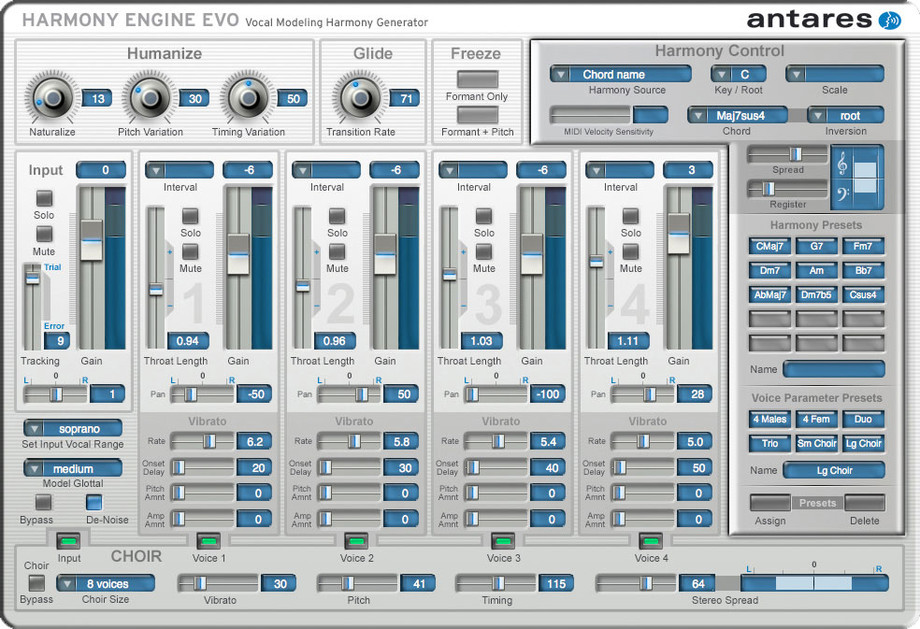
Harmony Engine Evo is the vocal modeling harmony generator from the AVOX Evo Bundle.
Building on the power and ease of use of the original Harmony Engine, Harmony Engine Evo incorporates Antares’ groundbreaking Evo™ Voice Processing Technology for faster, more accurate pitch detection, smoother, artifact-free pitch shifting, and seamless, natural-sounding (if you want it to be) throat modeling. And with the addition of 5 channels of Antares’ unique CHOIR Vocal Multiplier, you can create huge vocal ensembles out of a single vocal line.
With four independent harmony voices, a variety of powerful harmony generating modes, humanization features for natural sounding performances, and a flexible real-time preset system for harmony and vocal type, Harmony Engine Evo provides incredibly easy-to-use tools to quickly and easily produce virtually any vocal arrangement you can imagine.
Multi mode gating
Found this great video uploaded by thedeepelement, below is what he writes about the test:
“‘m testing out a)Make Noise’s Quad Multi Mode Gate (qmmg) module and b)Flip’s UltraHD camcorder. I wanted to share a video of how extreme the module can get with normal Tip Top Audio and Cwejman waveforms. I first preview all four channels without activating the gates. Then I turn all the channels to VCA, Both, LP and finally HP modes. After that I manually mangle the sound and return back to VCA mode. Everything is coming out of the summing mixer. So in short you get a Mixer, VCA and multimode filtering. Why don’t you have this yet?”
[youtube=http://www.youtube.com/watch?v=nMnsFtM8sv0&feature=player_embedded]
A danish little synth beauty
 |
Affordable 4 note polyphonic filterbank synthesizer with build-in granulator and distortion effects, step-sequencer and note randomizer. Small and compact in size with a great sound. The headphone output and the step-sequencer makes it ideal to express your musical ideas everywhere, and store them in 128 memory locations.
I have tested this little beauty during summer and it sure inspires you to do a lot more than you had origianlly planned, make sure to check it out and make sure to visit our danish friends web site >>
[youtube=http://www.youtube.com/watch?v=IKLFpGhWQkc&feature=player_embedded]
Specs:
- 4 voices with each 1 oscillator or 1 voice with 4 oscillators in unison mode.
- Oscillators has continuously variable and modulatable waveforms.
- 4 resonant multimode filters (lpf/bpf/hpf) that are separately programmable and each can be parallel or serial connected to each other.
- Distortion effect with 5 different types.
- Granulator effect build in.
- 4 LFO\rquote s with continuously variable and modulatable waveforms.
- 2 envelopes.
- Note randomizer.
- 32-step step sequencer.
- Most parameters can be controlled by a midi-controller.
- Small and compact.
- Memory: 128 sounds and sequences.
- Output: 16-bit delta-sigma with 256x oversampling.
Necessary tribute to Apollo 11
[youtube=http://www.youtube.com/watch?v=RMINSD7MmT4]
Forty years ago, men from Earth began for the first time to leave our home planet and journey to the moon.
From 1968 to 1972, NASA’s Apollo astronauts tested out new spacecraft and journeyed to uncharted destinations.
It all started on May 25, 1961, when President John F. Kennedy announced the goal of sending astronauts to the moon before the end of the decade. Coming just three weeks after Mercury astronaut Alan Shepard became the first American in space, Kennedy’s bold challenge set the nation on a journey unlike any before in human history.
Eight years of hard work by thousands of Americans came to fruition on July 20, 1969, when Apollo 11 commander Neil Armstrong stepped out of the lunar module and took “one small step” in the Sea of Tranquility, calling it “a giant leap for mankind.”
Six of the missions — Apollos 11, 12, 14, 15, 16 and 17 — went on to land on the moon, studying soil mechanics, meteoroids, seismic, heat flow, lunar ranging, magnetic fields and solar wind. Apollos 7 and 9 tested spacecraft in Earth orbit; Apollo 10 orbited the moon as the dress rehearsal for the first landing. An oxygen tank explosion forced Apollo 13 to scrub its landing, but the “can-do” problem solving of the crew and mission control turned the mission into a “successful failure.”
New verison of Kontakt, with full REX support – finally

– Extended Memory Addressing
KONTAKT 3.5 features full support for 64-bit memory addressing in both Windows and Mac OS X. This means you can load more than 4 GB samples into RAM in both stand-alone and plug-in mode. In Windows, 64-bit operating systems and sequencers with special stand-alone and VST versions are now supported. On Mac, the newly-created Memory Server feature bypasses the OS X’s 4 GB limit and can address as much RAM as you have installed – even in 32-bit hosts such as Logic or ProTools.
– Enhanced Sampling Engine
KONTAKT 3.5 features a completely re-designed sample playback engine. The Direct From Disk mode has been reworked to act dynamically, allowing the operating system to allocate memory in real time as you play and release voices. The result is a significantly smaller memory footprint which leaves more RAM for loading samples. This is especially useful with 32-bit systems where you can now load significantly more samples than was previously possible.
– Multi-processor support
KONTAKT 3.5 now provides true multi-processor / multi-core support. You can now switch multi-processor support on and off and set the number of processors / cores you want to use for KONTAKT. Up to 16 cores are now supported.
– Direct MIDI Learn
KONTAKT 3.5 now features MIDI Learn function for all sliders and knobs including Performance Views. Assigning MIDI controllers to KONTAKT sliders and knobs is quick and convenient with multiple assignments also possible.
– Enhanced Library Management
KONTAKT 3.5 integrates a visually enhanced library tab that now makes browsing and loading samples and libraries quicker and easier.
– Various Improvements
Further improvements in KONTAKT 3.5 include a bypass button for effect slots, localized info pane in six languages, improved automapping, Pro Tools compatibility under Mac OS X 10.5 Leopard, aftertouch interpretation added to KSP, a Play cursor for Beat Machine mode in Wave Editor and enhanced REX file support.
Dragonfly – New Sylenth1 Soundset Released!

Dragonfly is a brand-new patchset for LennarDigital Sylenth1 created by Sonic Elements and distributed by Nucleus SoundLab
Dragonfly takes advantage of Sylenth1’s two tiered VA structure to redefine what is possible with this analog inspired scream machine. It contains patches with naturally evolving synthetic timbres.
Inside Dragonfly there are a wide range of styles and genres contained in this bank. You’ll find subtle textures and timbres, hands-up style leads and bass, pulsating rhythmic bliss, ambient and gothic tones, and searing trance patches from beyond the cosmos. Details:
- 164 presets for Lennar Digital’s Sylenth1
- Compatible with Sylenth1 v2.2 PC/Mac
- Modwheel, Aftertouch, and Velocity mapped on every preset
- Emphasis on creating new and unheard of sounds with this VA monster
- Emphasis on creating sounds that build-up & decay naturally.
Listen to what Dragonfly offers by downloading the MP3 demos below. There is also a free demo bank available for download.
Full Song Demo by Jewbei
Preset Demo by Jay Yaskin
Introducing the robosynth wind controller
A really nice twist on electronic music evolution 
 http://robosynth.blogspot.com/
See the site for more. The following is just a snip on the Mark II Wind Controller. You’ll find samples on site.

“The circuit boards are housed in a wooden case made from cherry and walnut with some decorative inlays on the bottom part. The main body of the case was assembled as an octagonal assembly, but was rounded on the outside for that traditional instrument look and shape. There are three circuit board assemblies, the main board that has the processor and other active circuitry, an upper switch assembly for the fingering buttons, and a lower switch and LED assembly. The lower assembly connects to the main board before being inserted into the case. The upper switch assembly is also inserted into the case and connects to the bottom half sandwich with a small ribbon cable.”
//
DATAMASKIN

