
Experimental: TONEWHEELS HURDY-GURDY(VIELLE A ROUE OPTOÉLECTRONIQUE)
This optoelectronic hurdy-gurdy was commission by the Acces(s) Festival, Pau France in October 2012.
TONEWHEELS is an experiment in converting graphical imagery to sound, inspired by some of the pioneering 20th Century electronic music inventions, such as the Light-Tone Organ (Edwin Emil Welte, 1936 Germany), the ANS Synthesizer (Evgeny Murzin, 1958 USSR), and the Oramics system (Daphne Oram, 1959 UK). Transparent tonewheels with repeating patterns are spun over light-sensitive electronic circuitry similar to that used in 16 & 35mm motion picture projectors to produce sound.
The TONEWHEELS Hurdy-Gurdy presented at Acces(s) is not an “interactive” artwork in the common sense. While it does not reward the impatient museum visitor with flashing lights and noises at the simple touch of the button, it does invite participation in the process of technological music creation. Although it first appears to be a very traditional instrument known to many folk-music cultures, it functions in a very different way which can only be discovered by playing it.
The artist would like to thank Tobias Traub of Oroborus Customs e.K. and Carlo Crovato for their invaluable assistance in creating this instrument. Circuits designed by Jessica Rylan and Eric Archer are also used within the system.
More information on this project can be found at macumbista.net/?p=3020
Alesis Andromeda “Analog Spacepad”
The Andromeda A6 is a true analog synthesizer using two analog oscillators per voice, sub-oscillators, hard and soft sync and more! It features 16-voice polyphony. With the Andromeda, you’ll find a huge range of tonal possibilities: searing leads, warm pads, fat bass lines, extreme sound effects and more. And of course there are plenty of knobs (72) and buttons (144), even an assignable ribbon controller for addictive hands-on real-time control! The large high-resolution LCD display is excellent and shows you actual rather than relative values of parameters. Andromeda will integrate seamlessly into any studio with its total MIDI control and sync, individual voice outputs, stereo outputs and several audio inputs.
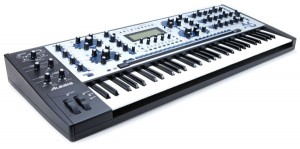
Andromeda is completely analog – no emulation! It features two analog filters per voice that sound great! They are a multimode 2-pole and a 4-pole lowpass. External audio can be routed through these filters too (three 1/4″ jacks)! As for modulation, Andromeda has three LFOs, each with six waveforms and they can be synced to MIDI clock. And there are three 7-stage envelopes with very creative and flexible functions. Also onboard is an extensive mod matrix for enormous freedom in configuring Andromeda’s sounds!
No analog synth would be complete without a set of classic effects and features. Andromeda also offers Portamento with nine slopes and legato functions. A built-in arpeggiator and analog-style sequencer are available, with MIDI sync! There are also some high quality digital effects such as reverbs, chorus, echo, distortion and more! Andromeda comes with 256 breathtaking preset patches plus 128 user. A PCMCIA-format memory card slot allows for additional programs and mixes. Andromeda is pure analog bliss, with all the features, stability and widgets of modern digital synths.
Roland CR-5000, Roland SH-2 Minimal Synth Demo
Here is a recording of Jordan Passmore playing the Roland SH-2 analog synth and Roland CR-5000 analog drum machine. The CR-5000’s trigger out is connected to the external in on the SH-2, allowing the synth to sort of pulse with the drum machine.
“The drum machine is ran through an analog chorus pedal while the synth is being ran through an analog delay. Both were mixed on probably the “worst” mixer I have ever heard; an early Bogen transformer line mixer. You can hear the distortion very well on the drums but it is also distorting the synth as well. The overall mix was treated lightly through an Ibanez SDR-1000+ reverb.”
Elektron Analog Four – Creating pattern from scratch
This video is intended to show how the Analog Four can be used for Sound and Pattern creation + Parameter locks.
https://www.facebook.com/Project.Dataline
https://soundcloud.com/dataline
Thomas Dolby – Leipzig Is Calling
This 80sObscurities was founded by DJ Rexx Arkana to showcase old, often unknown or forgotten acts and tracks from the decade when electronic music was truly the new wave. Rexx Arkana has been a club/radio DJ and promoter since the mid-80s and headlined festivals on several continents and currently holds a residency at DEFCON, NYC’s current longest-running weekly scene party. He is also the founder and lyricist of Brudershaft and one half of harsh electro act FGFC820.
Heiko: “This song is the B-Side of Thomas Dolby’s debut single, ‘Europa And The Pirate Twins,’ from 1981. In those days I used to spend a lot of time in record shops. I still can remember the moment I discovered the great cover; showing Thomas Dolby as a kind of scientist, standing in the middle of a stage, surrounded by globes and telescopes. Even without listening, ‘Leipzig Is Calling’ caught my attention. In the days of the “Cold War” it wasn’t common that an international musician wrote songs about a city from East Germany. I bought the 12″ vinyl right away. The sounds and especially the harmonies blew me away. Since that day this song is one of my favorite compositions – in terms of songwriting and of sound. Thomas Dolby is one of the most gifted composers and synthesizer players I know. His work always inspired me. ‘Well you’ll soon feel yourself again – And everyplace is just the same, isn’t it?'”
Rexx Arkana’s 80sObscurities previous playlists are also available on Facebook and YouTube. (Via SL)
Checking out the Roland JX-3P synth
The Roland JX-3P is a vintage synth that offers classic Roland analog sound, but without the full-on knobbiness of many earlier synths. The knobs were moved to an optional add-on, the PG-200 programmer, in order to make the JX-3P more affordable. The JX-3P features 6 dual-VCO voices, analog filters, amps and envelopes. A built-in chorus is also available. The JX-3P was one of the first synths to implement MIDI, and has a relatively basic MIDI implementation.
The Three Black Beauty Boxes perform Linus and Lucy
The Three Black Beauty Boxes perform Linus and Lucy by Vince Guaraldi commissioned for CBS Television in 1965.
Signal chain as follows
==================
Melody CV:
Pittsburgh Modular MIDI2 CV Out –> Endorphines Furthurrr Generator* –> KOMA Elektronik VCF-201 –> Pittsburgh Analog Delay*
Endorphines Furthurrrr Generator Modulation:
Pittsburgh VILFO –>
Pittsburgh Modular Analog Delay Modulation:
Pittsburgh Modular Oscillator –> Pittsburgh Modular Analog Delay
Melody Gate:
Pittsburgh Modular MIDI2 Gate Out –> Dave Jones Design O’Tool –> Steady State Fate Positronic Transient Generator* –> KOMA Elektronik Vactrol VCF-201
Steady State Fate Positronic Transient Generator Modulation:
Bubblesound uLFO –> Manhattan Analog CVP –> Positronic Transient Generator
Bass CV:
Pittsburgh Modular MIDI2 CV Out –> Endorphines Furthrrrr Generator –> Malekko Heavy Industry Wiard Borg Filter 1
Bass Gate:
Pittsburgh Modular MIDI2 Gate Out –> TipTop Audio Z4000 VC-EG –> Malekko Heavy Industry Wiard Borg Filter 1
Recorded with on board digital camera microphone.
Closer look at Samplr, Borderlands and Korg iPolySix
This episode Gaz takes a look at the beautiful Samplr – a sampling and playback app, plus Borderlands – a granular sample player with a unique interface. Nick checks out Korg’s new iPolysix synthesizer
Mickey Hart plays Animoog
The Grateful Dead’s Mickey Hart, who visited the Moog Factory on April 19, 2012 to test the development of the Grateful Dead Expansion Pack exclaimed, “Holy transmogrifica-tion, Batman… Amazing!” after hearing the Grateful Dead’s 44-year-old recordings trans-formed into sound design tools for artists.
The Grateful Dead Expansion Pack comes on the heels of Moog’s release of Animoog V2 on December 21, 2012. Animoog V2 is free for existing Animoog users. It includes many user requested features and product enhancements, such as: accelerometer integration which gives Animoog owners the ability to tilt their iPad in any direction as an interactive 3D modulation source; note hold and scale lock, and tools for advanced users like, Load/Save MIDI CC maps, Audiocopy/Audiopaste integration and support for the new Audiobus platform. Also, as a holiday gift, Animoog V2 features a powerful 4 Track Recorder, which gives Animoog users the ability to record audio from within Animoog or import audio tracks directly from their iTunes library. Users can then split, loop, copy, paste, and share individual clips, or mix down entire songs and upload them directly to SoundCloud, all from within the Animoog’s universe. This 4 Track Re-corder will be free to existing users until Dec. 31, 2012 at which time it will revert to it’s regular price of $4.99 in the Animoog Store.
Learn more about Animoog here:
http://www.moogmusic.com/animoog
Time machine: FARFISA SOUNDMAKER Analog Synthesizer 1979
“Synthesizer Demo of the analog synthesizer/string machine FARFISA SOUNDMAKER. I played the Soundmaker with a Roland DC-30 analog delay. The Farfisa Soundmaker came out 1979. It looks a bit like a Synclavier  It has a string section, a “poli” section and a monophonic synthesizer section. The keyboard has aftertouch. Also it is possible to run the polyphonic section through the filter of the monophonic section – like seen in the last part of the video.”
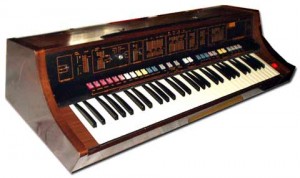
Built in 1979-81, the Soundmaker has Synth, String and Piano/Brass Sections. The Monophonic Synth section has 12 preset sounds (Tuba, Trombone, Trumpet, Sax, Clarinet, Oboe, Flute, Piccolo, Violin, Accordion, El Bass, El Guitar) and one Free patch which lets you use the controls to create your own sound. Basic controls for the filter, the one ADSR for the filter and/or the VCA, and the LFO are laid out plain and simple.
The Polyphonic Preset Synth section has Volume & Brightness controls for its four preset Piano type sounds (Piano, Electric Piano, Honkey Tonk, Brass).
The String section offers a fairly decent string sound with Volume, Brightness, Attack and Sustain controls for a choice of two preset strings (8″ footage or 4″ footage).
The Soundmaker is a bulky synth, weighing in at 27kg! Its keyboard may be split (at middle F only) and the Strings and Poly Synth sections play with the left hand and the Mono Synth plays with the right hand. The keyboard also has polyphonic aftertouch which can be used to control the Mono Synth Brilliance, OSC (vibrato), Synth Glide or Brass Brilliance. The String and Poly Synth sections can be switched to monophonic at the same time. The Farfisa is not the best String Machine you’ll ever hear, but it is very rare and that alone gives these machines some serious vintage appeal.
DATAMASKIN

