
Elektron Analog 4 Tutorial – Oscillators and Velocity Mod
This first A4 tutorial focuses on the Oscillator pages, and how to apply dynamic changes to a static sequence by modulating parameters with the velocity.
Waldorf Rocket review part 2 – sound demo
Background video description:
Following the feature rundown I am now giving you a sound demo of the Waldorf Rocket with some commentary on how I produced the sounds. The signal path is synthesizer going directly into the audio interface with the exception of lead sounds where I use Boss Space Echo (the modern emulated version) for delay.
U-he is gearing up for MusikMesse
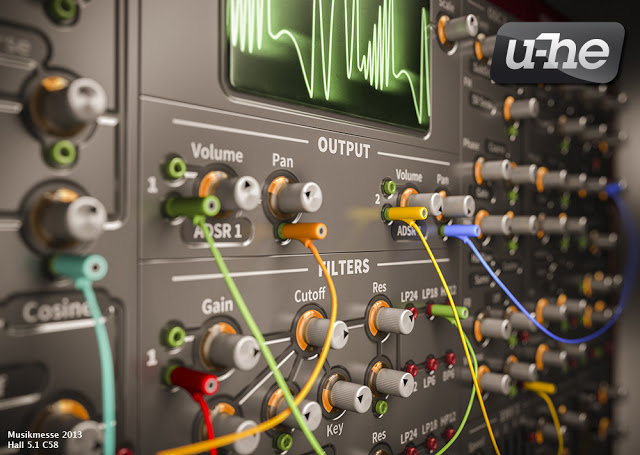
U-He has announced that it will be making several introductions at the upcoming Musikmesse 2013.
– we’ll showcase Bazille 1.0 (to be released in June/July)
– we’ll showcase Satin (tape machine emulation, due in May)
– we might showcase Presswerk, a massive compressor (ui pending)
– we’ll have a Digital oscillator module for Diva
– we’ll have a new “Uhbie” filter module for Diva and ZebraHZ
– we’ll have a sequencer/arpeggiator combo for Diva (all coming in June)
– we’ll have Caffè corretto to pick you up
And also, wish us luck for Diva’s second nomination for the MIPA award. It took Zebra twice to get it, so we’re in good spirits.
Some notes from Urs in response to comments:
“Well, hehe, it won’t look as 3D as the render of course.
But the new layout with those “channels” that show the signal flow within each module has become really great.
I’d post a screenshot, but alas… I’m still working on some shading algorithms (the gui currently gets rendered on the fly when the editor is opened or resized, not sure if we can keep that up because it takes 2-3 seconds)”
On the new digital oscillator for Diva:
“It’s got two oscillators. Each with 8 waveforms. Each waveforms has two “Control” parameters that can be modulated.
Most notably:
– TriangleMod: Does a foldback-distorted triangle wave combined with a symmetry-warp function
– SuperSaw: Does a sawtooth with 6 additional sawtooth mixed in, ad variable detune
– Feedback: Does a sawtooth with distorted feedback at variable (tuned) delay and gain
– Noise: Does noise with adjustable bandpass filtering and cutoff
– PWM: Does PWM with an invented-by-u-he pseudo-resonance control
– plus another sawtooth and triangle waveform
Both oscillators can interact by Ringmodulation, Sync and Crossmodulation.
I guess you’ll all easily guess where this is coming from”
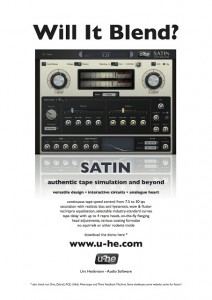
Satin:
“I’ll be sitting down with Sascha today to prepare the final touches of the user interface. Maybe we can have a more or less accurate screenshot then.
Basically… Satin is not just a tape emulation. I’m thinking of it as “all of tape”
Without being modelled after specific gear like Diva, Satin still has a mix and match approach. There are various pre-equalisation and post-equalisation curves to choose from as well as various noise reduction techniques and a choice of tape speed, plus a few head/gain adjustments. The sound of tape ranges from subtle to drastic. The adjustable noise level is irresistable
On top of that we’ve added a choice of typical tape applications:
as a tape emulation it can glue a mix, and there’s easy control for up to 8 groups of Satins that share the same settings
as a sound design tool it crunches, compresses, expands, “makes 3D”
in delay mode it does for a bloody damn fine tape delay (2 or 4 heads)
in flanger mode it lets you “fly in” flanging just like in the olden days
as a restauration tool it can “repair” recordings that were made with one machine and digitised from another
In tradition of u-he, Satin is to tape what MFM2 is to delay or what Filterscape is to equalisation. The CPU usage is on par with other tape emulations we’ve tried. While it doesn’t sound exactly like any specific machine, we’re confident that Satin behaves very much like those machines would.
Mini Bruitist Quartet
Collective work of improvisation for Minibrute, Little Phatty, Roland V Synth XT and Playel piano. All instruments by Marc-Henri Arfeux, Noé Charmet, Quentin Grini, Nathan Nadal. Voice by Heidi Berthier. Recorded live friday 19th of march 2013.
Experimental concepts: Wiimote TR-909 Ride Cymbal control
A wiimote and a candle is used to control the pitch of a TR-909 ride cymbal. This works also with other infra red sources such as a halogen lamp, a pocket lighter or the Wii “sensor bar” (which actually isn´t sensor).
—————————————-
https://sites.google.com/site/synthaq…
Prototype by Fourth Shape
Prototype is the artistic representation of 5 years spent researching advanced juggling concepts. This work unites a series of collaborations and is divided into two main parts. One half of the show is dedicated to new juggling skills, inspired by new juggling props. The other part makes live music for the show through the juggling itself. The result is a rare collection of juggling imagery that has never been seen before.
Support by RenegadesignLab (www.renegadesignlab.com), Manipulation Research Laboratory, JAM, and CIRKO Center (www.cirko.fi).
Prototype
Juggling – Music
www.fourthshape.com
TOUCH POINTS with the TC-11
TOUCH POINTS …
First sound designs and experimental studies with the Bit Shape TC-11 on iPad2.
aldemedia.com © 2013
New version out of Loopseque Mini
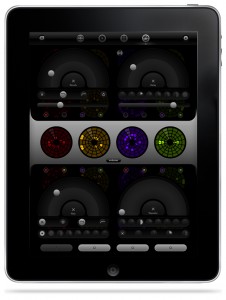
Loopseque Mini – music app for iPhone – has been updated few hours ago with many great features on board.
Intergration with Audiobus and MIDI support allows to use Loopseque with hardware drum machines, synths and other iOS music apps.
See full list of new features below:
NEW EFFECTS SET:
– Delay (two modes: stereo and ping-pong).
– Filter (LP, HP and LFO).
– Reverb (change size, wet/dry and dump).
– Beat Repeater (reverse mode and manual quantize).
All FXs can be easily assigned to each of 4 channels, we call it one-button extra fast routing.
MIDI (iOS 6 or higher):
– MIDI-out: Clock, Events, CC, Latency.
– MIDI-in: Clock.
– MIDI note for each circle: channel, velocity, root key.
– Attack, Release, Start and Length for each note.
– Chord maker presets.
– Pad for X/Y parameters, slider and trigger buttons.
OTHER FEATURES:
– Audiobus support.
– Background audio.
– New BPM control.
– New Tools popover.
– Minor GUI improves.
– OMAC support.
MOOG SOUND LAB Season 3 | Zola Jesus | In Your Nature
Nika Roza Danilova, aka Zola Jesus, is best known for her dark moody ballads, but with the 2011 release Conatus, Nika moved forward creating her most dynamic album to date. Not content to rest Zola Jesus ventured into the Moog Sound Lab and further evolved her single “In Your Nature.” In its original incarnation “In Your Nature” existed as an epic operatic with dance floor sensibilities, but here Nika imbues the song with analog warmth that contrasts her cold, snowy upbringing. A Minitaur Analog Bass synthesizer controlled by a Minimoog Voyager replaces much of the stringed arrangement found in the original version of the song. The Little Phatty played by keyboardist Nick Turco does double duty, further expanding what would have been a bowed arrangement and providing the arpeggiation featured in the second half of the song. The live violin played by Kim Free was routed through a MF-104 analog delay to thicken the sound and serves as the last trace of the rich strings that carry the original. Synthesist Alex De Groot provides the song’s rhythm, expanding on the song’s original percussive track with live drumming generated by three Voyager RMEs and controlled with a MIDI drum pad. Zola Jesus’s Moog Soundlab session not only captures the energy and emotion of the original, but reshapes “In Your Nature” with a richness and gravity unique to this version.
Watch Moog Sound Lab Season 3 as it debuts at: http://www.brooklynvegan.com/
See more of the Moog Sound Lab series at: http://www.moogsoundlab.com
How to Use AmpliTube and Audiobus – Connect your audio apps on your iPhone and iPad
http://www.ikmultimedia.com/news/inde… for more information – AmpliTube: http://www.amplitube.com/ios
Use AmpliTube with other iOS audio apps in real-time
AmpliTube for iPhone, iPad and iPod touch is now Audiobus compatible. Audiobus is a groundbreaking new app (developed by A Tasty Pixel in cooperation with Audanika) that allows users to connect the audio of multiple apps, opening up countless new sonic possibilities. For example Audiobus lets users send audio out of one app, filter it through the next one in the chain, and receive it in the third. A synth could be looped by a looper and its output sent to a recorder; or an electric piano could be run through a guitar multi-FX app and then into a sampler — all in real time.
DATAMASKIN

