
Twisted Electrons AY3 Chiptune Synth demo
The AY3 features two 8912 chips, boasting 6 voice polyphony. You can apply sequences, arpeggiators, noise, envelopes and pitch modulation to each voice with a click of a button.
AY3 features:
-64 preset memory (8 banks x 8 presets)
-5 pots and 1 endless encoder with push button
-40 blue leds
-16 step sequencer to sequence notes on/off, pitch and noise on/off
-4 Pitch modulation modes (aka lfo)
-4 arpeggiator modes
-ultra fat 6 voice unison mode with detune knob
-6 chords to split the voices
-6 voice polyphonic mode
-Glide mode
-Stereo sound (3 voice per channel/chip)
-intuitive 5×6 mode matrix to access and control:
volume, pitch, noise volume, envelope assignments, arp modes, sequencer assignments etc
-control of all knobs and other features via midi CC
-backlit front panel
Sharooz – Why I Love My SH-101
DJ and producers Sharooz explains why he loves his Roland SH-101 synthesizer, showing off the features of the synth and some of his favorite sounds.
Moog Apollo Solo – Erik Norlander
Bob Moog Foundation benefit, Isis music Hall, Asheville NC
Background history:
The Polymoog is the descendant of an ambitious project by Moog Music to create a large ensemble system called the Constellation. It was to include two keyboard synthesizers, the polyphonic Apollo and monophonic Lyra, and the Taurus foot pedalboard synthesizer. Although the Constellation project never made it to production, the Taurus pedalboard was released on its own, while the “Apollo Polyphonic Synthesizer” went on to become the Polymoog. It is also noteworthy that the Apollo/Polymoog project did not directly involve Bob Moog and was instead mostly designed by Dave Luce at Moog Music.
The Polymoog (model 203a) is a fully polyphonic preset-based synthesizer released in 1975. Its eight preset sounds consist of Strings, Piano, Organ, Harpsichord, Funk, Clavi, Vibes and Brass. There is also a Var (Variation) mode that allows any one of the preset sounds to be fully modified into unique and wild analog sounds using all of the available synthesis parameters on board. There’s a genuine Moog ladder filter inside with modulation, keyboard tracking and lots of LFO modulation sources. The Polymoog features a full 71-key, velocity sensitive Pratt & Read weighted keyboard that can be split into three sections, each with independent volume sliders. There is a 3-band EQ, sample-and-hold, pitch controller ribbon and a full set of envelope controls. What you won’t find, however, is patch memory or MIDI control.
The Polymoog 203a was originally known as the Polymoog Keyboard. In 1978, a newer, cheaper and more simplified model was released, the Polymoog Keyboard 280a. The original model 203a was thus re-named the Polymoog Synthesizer. The 280a model has more preset sounds (fourteen of them) but eliminated most of the editing functions that make the original 203a so much more flexible. The 280a model’s new preset sounds included Vox Humana, Strings 2, Electric and Honky Tonk pianos, Chorus Brass and a Rock Organ. Because programming is so limited you’re pretty much stuck with the presets. Fortunately the Vox Humana preset is a wonderful sound (used famously by Gary Numan). Editing is reduced to volume, tuning, hi-pass filtering, and basic LFO features. The 280a model can easily be identified by the name ‘Polymoog Keyboard’ printed where sliders and knobs would exist on the 203a model.
It should be noted that the Polymoogs are not true poly synths in the traditional sense. They use a ‘divide-down’ circuitry arrangement similar to certain string synths, combo organs, etc. This allows them to be fully polyphonic across the entire range of the 71-note keyboard. Sadly, the Polymoog is rather unreliable and prone to breakdown; used specimens are often problematic when left unserviced. Unfortunately, their complexity makes them difficult to service and even more difficult to find a qualified technician. By the way, the large amount of real-estate on the top of the Polymoog was designed that way as a place to put yourMinimoog (or other synthesizers) on top of it. Don’t worry, it can take the weight, as the Polymoog itself weighs a whopping 82 pounds!
Unique among Moog’s lineup, the Polymoog is not at all like the Minimoog or any of the other mono-synths Moog has become famous for. Instead, it was designed to complement Moog’s monophonic synthesizers. It’s a unique and finicky product, the brain child of David Luce instead of Dr. Bob Moog himself. But like all Moog products, this isn’t an ordinary instrument — it’s the Polymoog and it sounds fantastic for what it is.
Precision Knob — iMPC Pro Log
Retronym teaser for the upcoming Akai iMPC Pro music production center for iPad takes a look at their approach to making precision editing adjustments.
Every knob in iMPC Pro has a Precision Mode for fine tune editing and easy gestural access to advanced features.
iMPC Pro Log showcases the latest features from the freshest development build of iMPC Pro, the upcoming beat production iPad app from Akai Professional and Retronyms. A new video drops every week until we launch!
[Note: iMPC Pro is currently in development. All features are subject to change]
Follow Retronyms
http://www.facebook.com/retronyms
http://twitter.com/retronyms
Join the conversation with Akai Professional!http://www.facebook.com/akaipro
http://www.twitter.com/akai_pro
First picture of U-He’s new modular beast Bazille
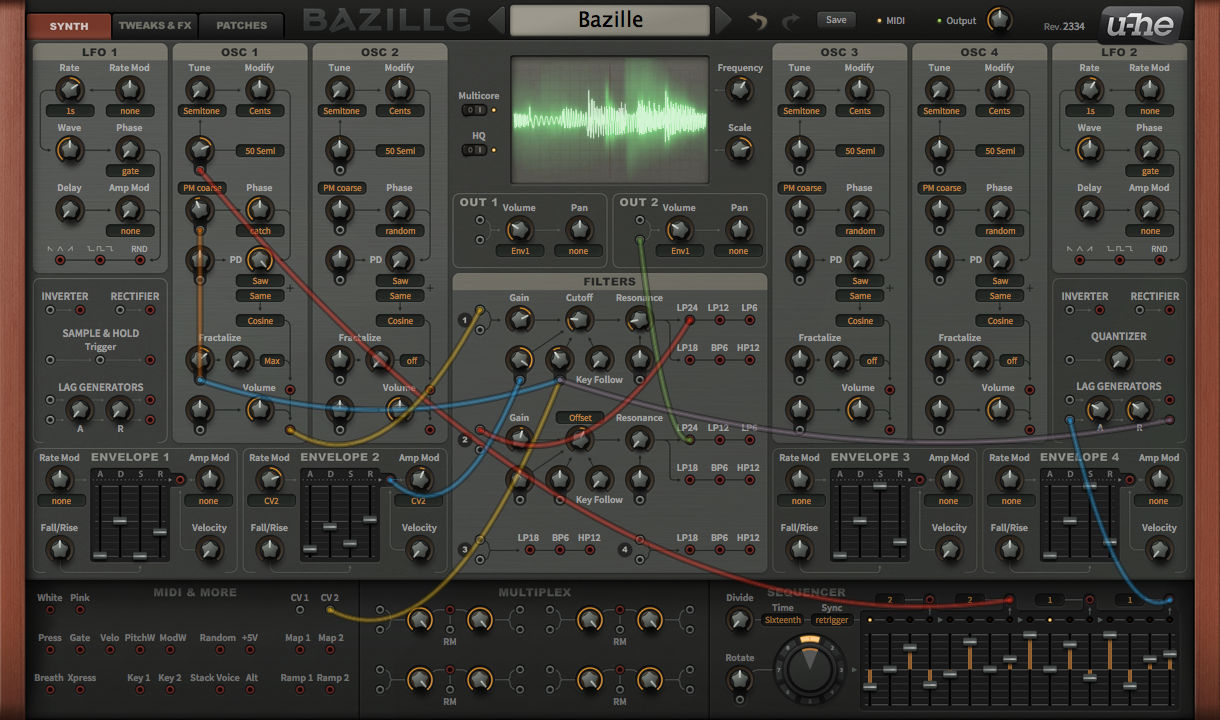
Bazille is a modular FM and Phase Distortion Synthesizer. It’s modular engine allows for patching of any signal output into any signal input, regardless of signal type. This makes Bazille a sibling of ACE, but it caters for a digital synthesis paradigm rather than for subtractive (virtual analogue) synthesis.
- hybrid modular system: digital oscillators, analogue filters – unlimited patching capabilities.
- 4 oscillators with simultaneous FM (phase modulation, linear / exponential / relative FM), PD (phase distortion) and FR (fractal resonance).
- 4 multimode analogue type filters, 2 of which have 6 parallel outputs.
- 4 ADSR envelopes, 2 LFOs with multiple outputs, 2 ramp generators.
- 2 modulation maps (can be used as oscillator waveforms), lag processors, quantizer, inverters, rectifiers, sample&hold.
- morphing snapshot sequencer: 8 slots of 16 steps each (splittable into 4, 8 or 12-step units).
The product page http://www.u-he.com/cms/bazille has been updated as well…
BAZILLE, the modular monster. After ACE, the second spawn of our ongoing ‘Berlin Modular’ project, this one is a very different, much larger beast…
This is an old teaser movie:
Here’s a sneak preview of the first synth inside the upcoming Berlin Modular System. This synth combines FM-Synthesis, Phase Distortion and subtractive in a rack-like appearance. In this video I’m showing teh layout and the basic oscillator functions.
Mark Ronson: How sampling transformed music
Sampling isn’t about “hijacking nostalgia wholesale,” says Mark Ronson. It’s about inserting yourself into the narrative of a song while also pushing that story forward. Watch the DJ scramble 15 TED Talks into an audio-visual omelette, and trace the evolution of “La Di Da Di,” Doug E. Fresh and Slick Rick’s 1984 hit that has been reimagined for every generation since.
TEDTalks is a daily video podcast of the best talks and performances from the TED Conference, where the world’s leading thinkers and doers give the talk of their lives in 18 minutes (or less). Look for talks on Technology, Entertainment and Design — plus science, business, global issues, the arts and much more.
Find closed captions and translated subtitles in many languages athttp://www.ted.com/translate
Follow TED news on Twitter: http://www.twitter.com/tednews
Like TED on Facebook: https://www.facebook.com/TED
Subscribe to our channel: http://www.youtube.com/user/TEDtalksD…
History of Neue Deutsche Welle – 17 track compilation
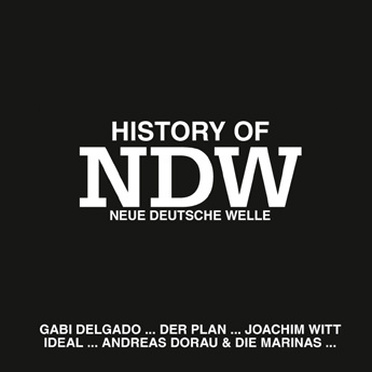
“History of Neue Deutsche Welle” is a brand new compilationalbum to be released on the German ZYX label. The compilation features 17 tracks including such artists as Die Krupps, DAF, Welle:Erdball, Pyrolator, Der Plan, Joachim Witt, Gabi Delgado, and many others. Ordering is possible here.
Tracklist:
- Pyrolator – Die Haut der Frau
- Andreas Dorau & die Marinas – Fred Vom Jupiter
- Der Plan – Tanz Den Gummitwist
- Malaria – Kaltes Klares Wasser
- Gabi Delgado – Neosexi
- Rheingold – Dreiklangdimensionen
- Die Radierer – Angriff Aufs Schlaraffenland
- Joachim Witt – Goldener Reiter
- Ideal – Blaue Augen
- Nichts – Radio
- Welle: Erdball – Die Roboter
- Die Krupps – Als Wären Wir Für Immer
- Fehlfarben – Ein Jahr (Es Geht Voran)
- D.A.F. – Der Räuber Und Der Prinz
- Foyer Des Arts – Eine Königin Mit Rädern Untendran
- Hans-A-Plast – Monopoly
- The Wirtschaftswunder – Analphabet
New video from electro act Dani’el
Croatian electropop artist Dani’el who has scored a major hit with “It’s time” returns with a brand new video, “Algabal”. Produced by Bryan Cox in a direction by fashion photographerMarko Grubisic.
Note that the lyrics were written by Stefan George in 1892… Being influenced by Greek classical forms, in revolt against the realist trend in German literature at the time, George was an important bridge between the 19th century and German modernism, even though he was a harsh critic of the then modern era. “Algabal” is one of George’s best remembered collections of poetry and the title is a reference to the effete Roman emperor Elagabalus.
Grayscale Algorhythm overview
Demo video for the Grayscale Algorhythm sequencer module:
grayscale.info/modules/algorhythm/
Audio taken from three sources:
Grayscale – Endless Random
soundcloud.com/grayscalemodular/endless-random
Grayscale – Algorhythm vs Turing Machine
soundcloud.com/grayscalemodular/algorhythm-vs-turing-machine
Richard Devine – Reticulating Rhythms:
vimeo.com/94437575
RetroBand – the effect plug-in for Windows and Mac is now freeware
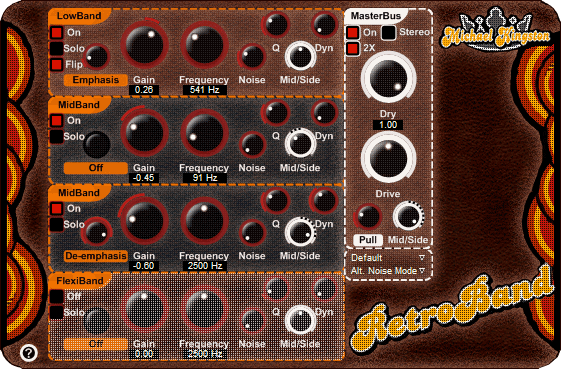
Michael Kingston is now offering his RetroBand effect plug-in for Windows and Mac as freeware.
RetroBand models several interaction aspects of gain stages and transformers. It generates IMD and crossover distortions present especially in Class A/B gain stages. RetroBand also features several forms of transient shaping.
RetroBand features
- Digital model of interaction between gain stages and transformers.
- Three flexible distortion models with noise modulation.
- Transient shaping within the distortion models.
- Mid-side stereo image controls.
- Advanced noise modes to imprint effects of noise on signal without the hiss and rumble.
- 64-bit signal path with highly optimised algorithms.
RetroBand is available for Windows and Mac (VST).
DATAMASKIN

