
Checking out the new Garritan Instant Orchestra cinematic virtual instrument
For full details visit: http://bit.ly/YI0HgY
Garritan Instant Orchestra is about instantly producing orchestral music very quickly and easily. Our goal is to provide an instantly playable orchestral library with many pre-packaged orchestral sounds.
This library was designed to be an effective shortcut to reach your musical goals. Consider it as a Swiss army knife for musicians – a clean, simple, multi-purpose orchestral tool that will allow you to do many things in an instant. Moreover, it is affordable and fulfills our mission of simplifying and democratizing making music and orchestrating.
Instant Orchestra is for those who do not want to spend time building orchestrations with one instrument or section at a time. It provides pre- packaged groups of instruments, combined sections, orchestral effects, and mood-based presets. Instant Orchestra is designed for those who know little about orchestration or do not have the time to build them. The idea is to provide a large variety of lush, playable orchestrations with the least time and effort.
This is mostly to show what is available and what IO is about. It does not even touch the amount of patches one can use. Often I just randomly hit the notes with the mouse in some cases. I did not want to make a composition, just simply show some stuff from each folder including big multis that are presets to give instant gratification.
I hope this clears up any misconceptions. It is a swiss army knife for orchestra.
The Artemis – A Wind/String Instrument Inspired by the Ondes Martenot
Inspired by the Ondes Martenot, the Artemis is a synthesizer whose pitch is mainly controlled by a ring attached to a loop of string.
It uses breath control for dynamics and combinable trill keys for discrete pitch changes. Using these together allow for some interesting musical approaches.
When I made this instrument, I decided to expose the loop on this instrument as it is interesting to watch as the pitch changes.
The sound and control core engine were made by Nyle Steiner (it is simply one of his early analog E.V.I.s.) The Artemis was completed in April of 2013.
Claviness and Wurlitsar instrument ensembles for Reaktor
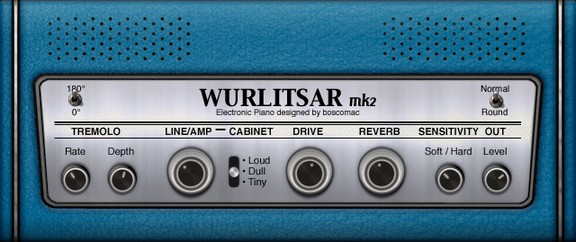
Boscomac has announced Mk2 versions of its Claviness and Wurlitsar instrument ensembles for Native Instruments Reaktor.
I announce that CLAVINESS and WURLITSAR are died … to be reborn better in their MK2 Version, Yeah ! Nothing is more difficult than doing a mk2 version that requires as much work as the creation of the instrument! But in the end, we get a better result, Yeah !
WURLITSAR is a Wurlitzer who has a warm et round sound! Now you can mix the direct signal with the amplified signal and get an interesting balance. You can also adjust the rate of distortion of the amplifier to get some “crunch” to the wurli. Vibrato has been replaced by the ability to adjust the tremolo on the panoramic. The instrument offers two types of sound, normal or round, and it has a nice little spring reverb …
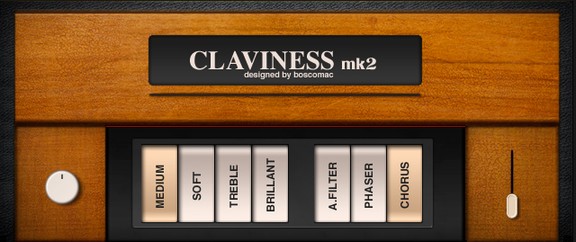
CLAVINESS is a clavinet with sensitive strings! More than MK2 version, it is a revisit to really approach the original instrument. The clavinet is an instrument that has a lot of feeling. Here, different tones are available with some very effective effects such as chorus, phaser and auto-filter and the ability to mute the strings. Ideal for the rhythmic players, it is almost impossible not to have the groove with such an instrument …
Both ensembles are available to download at no cost. Donations are appreciated.
Introducing Vio: Transform Your Voice
Transform your voice into a mesmerizing instrument. Morph and shape the sounds you create by exploring Vio’s entrancing interface. Learn more at http://transformyourvoice.com
Sonic adventures — always in tune
Build sonic universes from your own voice. The innovative audio engine behind Vio goes far beyond existing voice effects to create novel, futuristic vocal styles. Vio’s sound spaces vary in character from edgy and energetic to mellow and relaxing. Vio surprises and inspires your creativity: you may not intend to do something, and it comes out cool. Whether you are an amateur or seasoned professional, Vio’s pitch correction technology ensures that everyone sounds in tune and is beautifully harmonized.
Touch Control
Explore each sound space by touching Vio’s swirling particle vortex. Move the vortex around the screen and change how your voice is transformed – harmony is added or subtracted, melodies emerge and disappear, and reverberations shape shift.
Looping
Double-tap the screen, loop what you have just sung or hummed, and focus on morphing your sound with the particle visualizer.
Recording & Sharing
Record your performances and share them via email, SoundCloud, Dropbox, or iTunes file sharing. Choose between compressed and high quality audio files.
Advanced Features
Visit http://squareb.co/vio to learn about advanced features like changing keys and recording high quality audio.
Torsion – new monophonic Audio Unit instrument plugin for Mac
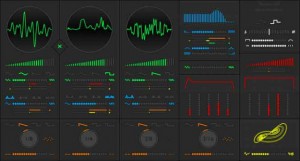
Sinevibes has announced Torsion, its new monophonic Audio Unit instrument plugin. They tell us that Torsion is built upon a unique combination of multiple synthesis technologies and modulation sources, wrapped into an intuitive interface which makes working with it as fun as playing a game. Sinevibes believes that it has a very distinctive, original sound character – and is ready to push your musical creativity in a fresh new direction. Here’s the details in Sinevibes’ own words…
Reinvented classics
At first glance, Torsion’s sound structure is similar to a traditional subtractive synthesiser – three oscillators going into a low-pass filter and into an amplifier – and it’s certainly as easy to use. But Torsion’s oscillators are completely different: they produce simple additive waves based on just a few partials, which are then enriched with lots of new spectral content using a technique called waveshape modelling (which literally “curls” the wave in real time). To further spice the sound up, there is a ring modulator and an audio-range oscillator for filter FM.
Modulation galore
Torsion features as many as four separate LFO generators – one for each oscillator and one for the filter and output amplifier. In addition to precise synchronisation, each LFO cycle can be self-randomised, which makes the modulation rhythmical yet non-repetitive. There are also two AHDSR envelope generators, as well as a two-dimensional chaos oscillator.
Interactive experience
The interface of Torsion is designed with high-contrast, colour coded elements, which lets you operate the instrument intuitively in just a few minutes. It also includes graphic representations for every building block – oscillator waves, LFO phases, envelope shapes and filter spectrum all change as you modify them, making sound design with Torsion a truly engaging, fun process.
Specifications
• Three oscillators each with four basic additive waveforms and four waveshape models.
• -24 dB/octave resonant low-pass filter.
• -12 dB/octave high-pass filter.
• Ring modulator.
• Modulation oscillator for low-pass filter FM.
• Four tempo-synchronised LFO generators with four waveforms and per-cycle randomisation.
• Two AHDSR envelope generators.
• Two-dimensional chaos modulation generator based on Lorenz attractor.
Pricing and Availability:
Torsion is immediately available as an Audio Unit plugin for OS X 10.6 or later (32/64 bit Intel), and costs $49.
More information
Waves Element Synth – Video Review and all the specs
Russ takes a look at the new Waves Element virtual instrument synth and asks can Waves do for virtual instruments what they did for plug-ins?
Find out what he thinks with this show and tell video review
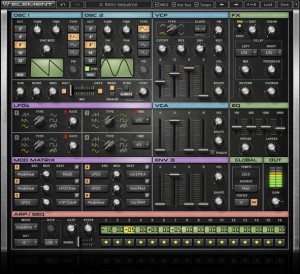
Introducing Element: The first ever synthesizer from Waves. Powered by Virtual Voltage™ technology, Element is an analog-style polyphonic instrument engineered to deliver the fat, gritty sound of the classics, with all the precision, flexibility and control of contemporary digital synths.
Element includes a vast array of convenient features and functions. Like integrated effects. A 16-step arpeggiator / sequencer. MIDI Learn for all controls. And a massive preset library, with total tweakability. Plus, all parameters are laid out right there in front of you, so when inspiration strikes, there’s no need to scroll through page after page to customize your sounds. Searing leads, booming basses, ethereal pads, electro-percussion, sequential motions, mind-blowing FX and lots more: Element does it all.
Features
Powered by Virtual Voltage™ technology
Integrated chorus, delay, reverb, distortion and bit crusher effects
16-step arpeggiator / sequencer
Plugin and standalone components
Controls
Oscillators
OCT determines the pitch range.
TUNE determines the pitch.
FINE fine-tunes the pitch.
TYPE determines the waveform type.
PW determines the pulse width. (Pulse waves only)
VCO selects between virtual Voltage-Controlled Oscillation and virtual Digitally- Controlled Oscillation.
SINE MOD controls the modulation of OSC 1 using a sine oscillator. (OSC 1 only)
FM (Frequency Modulation) controls the amount by which the frequency of OSC 2 is modulated by OSC 1. (OSC 2 only)
PhM (Phase Modulation) controls the amount by which the phase of OSC 2 is modulated by OSC 1. (OSC 2 only)
SYNC synchronizes the triggering the OSC 2 waveform to the rate of OSC 1.
Additional Oscillators & Mix Section
SUB mixes in a triangle wave one octave below OSC 1.
NOISE mixes in white noise.
RING controls the ring modulation of OSC 1 and OSC 2.
OSC 1 / OSC 2 activate each oscillator.
MIX balances the mix between OSC 1 and OSC 2.
MONO toggles between monophonic and polyphonic modes.
RTRG controls envelope re-triggering.
UNISON activates a doubling effect which creates a richer sound.
PORT determines the glide time (portamento) between notes.
LEGATO determines whether glide will always occur, or only when the previous note is still held.
Voltage Controlled Filter
TYPE determines the filter type.
SLOPE toggles between two types of pole filters.
CUTOFF controls the VCF cutoff frequency.
RES controls the amount of filter resonance.
ENV determines the envelope’s cutoff modulation depth.
KBD controls keyboard tracking using C3 as its reference point.
FM controls the amount of frequency modulation on filter cutoff by OSC 1.
ADSR determines the filter’s envelope cutoff behavior after a note is triggered.
VEL sets the VCF cutoff in relation to the Note On velocity.
SHAPE determines the contour of the envelope time constants.
Voltage Controlled Amplifier
VCA envelope controls the note level from trigger to release.
VEL sets the envelope depth in relation to the Note On velocity.
SHAPE determines the contour of the envelope time constants.
PUNCH controls the dynamic transient enhancer.
Low Frequency Oscillators
TYPE controls the LFO waveform shape.
RATE controls the frequency of the free LFO.
TIME controls the rate of the synced LFO, locked to the project BPM.
LED displays pulsate at the same rate as the LFOs.
Envelope 3
VEL sets the envelope depth in relation to the Note On velocity.
SHAPE determines the contour of the envelope time constants.
Modulation Matrix
PHASE inverts the phase, per assignment.
SRC determines the modulation source.
DEST determines the destination of the modulation source.
MOD sets the amount by which the modulation source affects the destination.
Arpeggiator/Sequencer
MODE determines the operational mode.
OCT determines the range, in octaves, of the arpeggiator.
TIME (drop-down) activates the host BPM sync function, and sets the rate using note values.
RATE sets the arpeggiator rate when TIME is set to Free.
GATE determines the length of each sequencer step as a percentage of its note length.
STEPS determines the number of steps in the current sequence.
SWING pushes even-numbered notes/steps toward the next odd-numbered note/step, to create a shuffle/swing feel.
Effects
DIST controls the amount of distortion effect.
PRE/POST is a toggle control which determines the placement of the distortion effect in the signal path, either pre-VCF or post-VCF.
CRSHR is a distortion-like effect which simulates a reduction in the bit-depth and resolution of the sound.
DELAY is a stereo delay allows separate delay times for left and right channels, using note values.
LEFT sets the delay time for the left channel.
RIGHT sets the delay time for the right channel.
MIX determines the amount of delay effect in the mix.
FEEDBACK determines the amount of gain fed back to the delay input.
REVERB controls both the amount and size of the virtual plate reverb sound.
CHORUS determines the amount of chorus modulation.
EQ
HiPASS controls the high pass filter frequency.
LoPASS controls the low pass filter frequency.
100 controls equalization at 100 Hz.
600 controls equalization at 600 Hz.
1500 controls equalization at 1500 Hz.
9000 controls equalization at 9000 Hz.
Global and Out Sections
TEMPO displays the current tempo.
SOURCE determines the clock source.
VOICES determines the number of voices which may be played simultaneously.
HD activates High Definition mode, which extends the digital resolution, resulting in enhanced depth and greater high-end definition.
GAIN sets Element’s overall output volume, after all generators and processors.
METER displays Element’s overall output energy.
9000 controls equalization at 9000 Hz.
Read more: http://www.waves.com/content.aspx?id=12081#image#ixzz2Gw3J6yqS
Element – new synthesizer instrument plug-in for Window and Mac
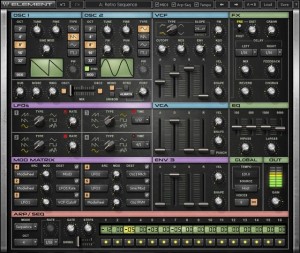
Waves has announced the release of Element, a synthesizer instrument plug-in for Window and Mac.
Introducing Element: The first ever synthesizer from Waves. Powered by Virtual Voltage™ technology, Element is an analog-style polyphonic instrument engineered to deliver the fat, gritty sound of the classics, with all the precision, flexibility and control of contemporary digital synths.
Element includes a vast array of convenient features and functions. Like integrated effects. A 16-step arpeggiator / sequencer. MIDI Learn for all controls. And a massive preset library, with total tweakability. Plus, all parameters are laid out right there in front of you, so when inspiration strikes, there’s no need to scroll through page after page to customize your sounds. Searing leads, booming basses, ethereal pads, electro-percussion, sequential motions, mind-blowing FX and lots more: Element does it all.
Element for Windows and Mac is available to purchase for the introductory price of $99 USD (regular $200 USD).
Basso Live: Phantom and the Flying Saucer UFO Controller, Ultrasonic MIDI Instrument
Googlish from Finnish:
Bass Live Phantom 16.11. 2012. The band played songs Kisses morning a bass.
Video: Jussi Sirviö & Annika Ranin

UFO stands for Ultrasonic Frequency cOntroller.
- Five ultrasonic sensors – that is, distance sensors based on ultrasonic echo location (a typical range-finding sensor)
- Send MIDI notes, using gestures to send notes with controller data. (This is a bit like the Theremin arrangement – and like any touch-less arrangement lacks tangible feedback – but with more axes of data. And unlike the Theremin, it’s tuned to scaled octaves so you send fixed notes, as on a piano.)
- Send controller data.
- LEDs for feedback on modes.
- MIDI out. USB class compliance (for USB MIDI).
- Built around Arduino Mega 2560
Planned for the future:
Presets that you can store and recall
Sustain pedal support
MIDI IN for arpeggio clock sync
Arpeggiator patterns
LFO CC curves
Quick switching of presets by sending MIDI commands to the device
INSTRUMENT 1 – upcoming MIDI controller / musical instrument for iOS

Artiphon has announce the INSTRUMENT 1 – an upcoming MIDI controller that they describe as ‘the most advanced musical instrument for iOS. INSTRUMENT 1 is controller that’s compatible with CoreMIDI iOS apps and designed to be a professional quality instrument. The body of the INSTRUMENT 1 is inspired by the forms of traditional stringed instruments and is cut from ‘heirloom-quality’ hardwood. It can be held in multiple familiar positions–from guitar and fiddle to lap steel and upright bass.

Artiphon INSTRUMENT 1 Specifications:
- Compatible with any CoreMIDI-enabled iOS app and thousands of audio apps.
- Patent-pending force-sensitive interface with six virtual frets and strings, and a strum section inspired by single-coil guitar pickups.
- Accommodates five playing positions: guitar, mandolin, bass, violin, & lap steel.
- High-quality onboard connections for headphones, microphone, ¼-inch stereo instrument cable, and MIDI in/out, and USB.
- Controls for volume, instrument modes, and octave switching.
- Rechargeable internal battery and 12v power input.
- Integrated stereo speakers and a 30-watt, class-D amplifier.
- Advanced control of multi-track recording apps including GarageBand, Pro Tools, and more.
- Body carved of specialty hardwoods and bamboo from sustainable sources.
- Designed and hand-built in Nashville, TN.
“We designed the INSTRUMENT 1 as a hybrid of pro-level components, ergonomic accessibility, and traditional instrument manufacturing techniques,” says Artiphon founder Mike Butera. “It’s been two years in the making and is unlike anything else on the market. We can’t wait to see all the ways musicians put it to work in their creative processes.”

Note: The images shown here are based on an INSTRUMENT 1 prototype. The final prototype is nearly complete and production of the first units is planned for early 2013.
Price and Availability:
Artiphon will begin taking pre-orders for the INSTRUMENT 1 in the first quarter of 2013, at a price point under $1000.
Exploring Gestrument, iDensity and iPulsaret iPad instruments
The show dedicated to making music on touch devices – this time we look at Gestrument – a brand new App for generative music/intelligent arpeggiator and two new Granular synthesis apps from Apesoft
DATAMASKIN

