
Skanner XT – unique and highly distinctive virtual instrument
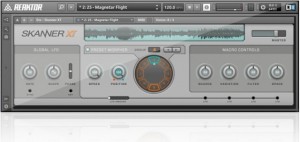
Native Instruments today introduced Skanner XT, a ‘unique and highly distinctive’ virtual instrument, designed by the team behind Reaktor:
With a strong focus on unconventional tone and genuine musical expression, SKANNER XT is both an exceptional library addition for REAKTOR 5 users as well as an excellent sound resource for the free REAKTOR 5 PLAYER. Part sampler, part synth, SKANNER XT utilizes a unique synthesizer architecture to create a wide variety of intense and cutting-edge sounds for contemporary electronic music production and sound design. Two oscillators ‘scan’ a sample, which at low frequencies deliver a scratch sound.
At higher frequencies the oscillators, shaped by the sample waveform, become the dominant force. In this way, Skanner XT provides a broad range of highly distinctive sounds – from heavy and dirty bass tones to morphing soundscapes and organic pads.
About Skanner XT
Developed together with NI synthmeister Stephan Schmitt, Skanner XT offers two interface views for different levels of interaction with the complex architecture under the hood. Besides a simplified page with a preset morpher and four macro controls, a second view provides access to more detailed parameters in order to further explore the sonic potential of the instrument. A morph control option allows for convenient switching between eight different snapshots – producing unpredictable, evolving sounds that range from the ethereal to the extreme.
Skanner XT is available at the NI Online Shop for $59 / 49 EUR. See the NI site for details.
Rhythmic Robot releases Boss DR55, Magnus Reed Organ and StyloDrum Kontakt Instruments
Rhythmic Robot have released three new instruments for Kontakt 4.2.3 and later:
- Doctor 55: a sampled recreation of the Boss DR55 analogue drum machine.
- Magnus: a reed organ emulating a 1950s Bakelite Magnus organ and a 1970s plastic version.
- StyloDrum: a glitchy drum machine with four kits sampling scratches, crackles, pops and squeals from vintage Stylophones which have been pitched, looped and trimmed to form electronic drum sounds.


Doctor 55 costs £4.95. Magnus and StyloDrum cost £3.95.
Doctor 55 is a Kontakt version of the Boss DR55 analogue drum machine. It samples the original with great precision at 24-bit. Each of the four original kit pieces (kick, snare, hats and rimshot) are covered, plus an additional “hidden” snare sound that only showed up on the original during programming. This additional snare has been given its own Attack and Decay parameters, hidden on the rear panel, which allow the user to create brushed snare sounds or snares with long decay tails.
Additionally, as usual with Rhythmic Robot drum machines, multiple samples have been taken through the entire travel of the DR55’s “Accent” control. These differently-accented samples can then be accessed either by tweaking the “Accent” control on the GUI panel, or by velocity from a MIDI keyboard (or by drawing velocity automation straight into a DAW lane). Accent amounts change the tonality of the kit pieces considerably, and can be dialed in on a per-kit-piece basis, which of course was not possible on the original instrument (where Accent functioned globally).
The Doctor 55 rounds things out with a Tone control, plus effects control over tube saturation, bit-crushing effects, Drive distortion and an output compressor / limiter for “gluing” and pumping effects.
Features:
- All the sounds of the DR55 captured through the entire travel of the Accent control.
- Kit pieces individually adjustable for level, pan and Accent.
- New “hidden” snare sound sampled, and adjustable for attack and decay.
- Velocity Retrofit button allows incoming velocity to vary the Accent level dynamically (for humanised beats).
- Bitcrusher, tube saturation, distortion and compression / limiting on the outputs.
Magnus is a reed organ instrument sampled from two vintage Magnus reed organs: a Bakelite model from the 1950s, and a red plastic model from the 1970s. The Bakelite model was Magnus Organs’ first ever model and is extremely rare.
Magnus allows the user to blend the “Bakelite” and “Plastic” samples to taste via the front panel controls, and adds Tone and “Electrify” — which brings in tube harmonic distortion to the sound. Attack and Release controls are available for the amplitude envelope, and longer release times invoke a slight pitch drop-off as the sound decays, which mimics the behaviour of a real reed organ having its keys very slowly let up (air pressure through the reeds drops, and the pitch falls as a result). Stereo spread, chorus and phaser effects are available on the rear panel.
Magnus is designed for unusual organ sounds and breathy pad textures.
Features:
- Bakelite 1950s and Plastic 1970s samples can be blended to taste.
- “Electrify” control for adding harmonic distortion; Tone control for high-end roll-off.
- Attack and Decay parameters.
- Original pitch drop-off emulated on long ADSR release settings.
- Stereo spread, chorus and phaser controls on rear panel.
StyloDrum is an analogue drum machine built from sampled scratches, bleeps, bloops, fizzes, noises, crackles, thumps and glitches — all taken from vintage Stylophones. These have been pitch-shifted, looped, trimmed and fiddled with as necessary to turn them into old-school-style analogue hits. StyloDrum incorporates four kits spread over four octaves, each with at least two kicks and two snares. Most have hats, some have crashes, toms, claps or other “classic” sounds. Interspersed are a lot of random scratches, glitches and other Stylophone-based weirdnesses.
Kit pieces can be adjusted in level and pan position, and there’s a comprehensive effects section with Saturation, Drive and “Pump” compression to really kick things into gear. StyloDrum is a unique source of left-field electronic sounds for any genre, with a glitchy, grainy edge.
Features:
- Four kits built entirely of Stylophone scratches, glitches, squeaks and squeals.
- Pan and level controls.
- Tube saturation, Drive distortion and “Pump” compression.
- Unique and unusual electronic elements for any genre.
Fanfare – new Kontakt Player virtual instrument
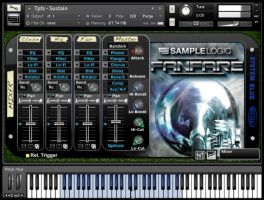
Sample Logic and System Blue have announced the release of Fanfare, a Kontakt Player virtual instrument pairing the DCI World-Champion Blue Devils marching brass with the award-winning sound design of Sample Logic.
From traditional marching brass to full-blown cinematic soundscapes, Fanfare delivers a marching brass library for educators and arrangers, and a versatile construction toolkit for film, TV, game composers, producers, and electronic musicians. Tapping into the mind of premier wind and brass arranger John Meehan, Fanfare features a broad array of samples recorded by Leslie Ann Jones on The Scoring Stage at Skywalker Sound (Lucasfilm Ltd Company) and on the field at Ralph Wilson Stadium (home of the Buffalo Bills) by Grammy Award winner Frank Dorritie. The indoor recordings were done at close, mid, and far microphone placements, while the outdoor recordings were captured with state of the art stadium surround sound recording techniques. The resulting sonic textures range from full stadium ambience to an “in-your-face” 85-piece brass ensemble, with all of the recordings capturing The Blue Devils’ signature sound of inventive chords, avant-garde clusters, swells, and organic brass effects.
And it doesn’t stop there…
Fanfare not only boasts the finest traditional marching brass samples, but extends the library’s sonic reach via Sample Logic’s signature “blurring the line between music and sound design” programming techniques. Starting with the traditional brass recordings, an entire library of morphed “cinematic” multi-sampled instruments was created, putting not only marching brass at your fingertips, but also an inspiring array of melodics, pads, leads, stingers, impacts, transitions, atmospheres, and articulated rhythms–all organized into easily accessible, production-ready presets.
The Instruments & Multis:
- A complete collection of traditional marching brass instruments (trumpets, mellophones, euphoniums, tubas, and trombones) recorded with multiple round robins, multiple dynamics, and up to five microphone placements.
- Scoring Stage: Individual instruments and sectionals.
- Stadium: Large sections and full ensemble.
- A complete collection of evocative morphed cinematic instruments and rhythms.
- Atmospheric/ambient soundscapes and stinger construction kits.
- Arpeggiator/Arpeggigater rhythmic instruments.
- Swipes, scrapes, impacts, and reverse transitional effects.
- Performance-ready multis (playable interactive preset templates made from multiple instruments).
The FX
Fanfare offers full control over sound and performance, thanks to Sample Logic’s custom-designed Kontakt Player interface. Building on the exclusive “multi-core effects sequencer” first introduced in their Cinematic Guitars collection, Sample Logic puts complete, customizable user control right at your fingertips, with sequencers, LFOs, programmable arpeggiation, a unique Rhythmic Articulator, and a fully integrated multi-microphone mixer. Fanfare boasts over 40 screens of powerful, intuitive user interface controls.
Sample the future: The Arpeggigater
Sample Logic introduce a powerful addition to Fanfare: The Arpeggigater, which allows users to design custom gate sequencer patterns with effects simultaneously. This powerful addition allows for infinite sound-sculpting results.
Swirling the space: The Spinner
All of Fanfare’s multi-mic instruments include a sound-swirling spinner effect. This effect allows users to not only change the listeners perspective around the concert hall (Left to Right and Close to Far), but also allows you to automate the listening position swirling the sound with your own custom patterns.
Technical Specifications:
- Over 800 Instruments and multis recorded and processed at 88.2k/24-bit, delivered at 44.1k/24-bit.
- 30GB sample library (uncompressed).
- 20GB via Kontakt’s lossless sample storage compression.
- Available in both boxed and direct download formats.
- Standalone, VST, AU, DXi, or RTAS.
Minimum System Requirements:
- Kontakt Player Free 4 or higher (also runs in the retail version of Kontakt).
- Mac: OS X 10.6 (latest update), 10.7, Intel Core Duo, 2 GB RAM (Kontakt Player 4 and higher).
- Mac: PPC (Kontakt 4) and Intel (Kontakt player 4 and higher) Compatible.
- PC: Windows 7 (latest Service Pack, 32/64 Bit, Inteo Core Duo or AMD Athlon 64, 2GB RAM.
- 20GB of disk space for Fanfare library.
- 1GB of disk space for Kontakt/Kontakt Player.
Fanfare is available now with an MSRP of $399.99. Find out more at www.samplelogic.com/fanfare
Paint the sound of the 808 drum computer
Installations don’t have to be complicated to be fun. Color a Sound is more like an instrument, and it is not very difficult to operate: you use a colored marker to draw lines or shapes and you will hear the result immediately.
To keep things simple and easy to operate, also for a untrained musician, only the major scale is used. Blue dots can be drawn to trigger the sounds of a vintage 808 drum computer, although this does not seem to work very well because it is impossible to keep it running at a constant speed.
Crazy instruments – the Karlax MIDI controller
Da Fact, a French music instrument company, has introduced Karlax
Karlax is a new type of MIDI controller designed to “re-establish the artist’s body at the heart of the performance.”
The Da Fact Karlax is designed to capture a variety of expressive movements which can be accessed in a simple, intuitive manner.
Da Facts:
Its sensors are fitted to precision mechanics components. The innovative architecture allows pistons, keys, switches, benders, triggers, a rotation axis and an inertial unit (comprising an inclinometer, accelerometer and a 3-axis gyroscope) to be activated separately or simultaneously.
An embedded screen for displaying and editing settings makes it possible to safely leave the computer off stage. With the product comes also a dedicated software compatible with both MAC and PC.
“Karlax pushes the boundaries of language,” says Nils Aziosmanoff, Chairman of LE CUBE, a creative centre devoted entirely to the digital arts. “The creative process is increasingly becoming an experience to savour: we are adopting an exploratory approach to creativity, instead of the previous contemplative, passive approach.”
Remember all these old toy instruments

Toy Instruments comprises an eye-popping collection of musical toys from around the world made between the 1950s and today. Culled from author Eric Schneider’s personal collection, Toy Instruments is the first book to explore this niche of the toy industry doing so with an informative and humorous approach. With an intro from the author and a foreword from world-renown experimental electronic and hip-hop musician Paul D. Miller a.k.a. DJ Spooky That Subliminal Kid, the book collects the toy instruments you may remember from your past, and the wacky ones you’ll find hard to believe ever existed.
From the late 70s to the early 80s, the heyday of these bleeping, chirping, thrumming and keening devices, while children were busy driving their parents crazy with battery-powered sounds, adults were incorporating the unique tones into the earliest samples of electronic music and techno. And, just as dazzling as the cacophony of sounds produced by these toys are the designs of the toys, as well as their packaging. Made all over the world, the predominately gender-neutral design applied to the products and packaging is at times more fascinating than the toys.


H.G. Fortune releases Plutonia – best of all its free

H.G. Fortune has released Plutonia, a free VST instrument for Windows PC.
As I made wavesets as sf2 files available I did a small free VSTi synth so one might get an impression of the contents of the wavesets.
Plutonia features
- 2 oscillators with 256 sf2 based PCM waveforms each.
- Selection of built-in waveform from H.G. Fortune wavesets: AlioModularity, HGF Best of # 1 & # 2, Athmonia-a (complex waveforms generated from images), Seamless Textures (complex waveforms generated from images), HGF Retro Set.
- 24dB Lowpass filter with resonance per synth voice.
- Condensed Spook B fx.
- BassEnhancer to enhance low frequencies (works indenpendently from Color signal).
- BPM-synced delay.
- 2 ADSR envelope generators (one for Filter, one for VCA) for modulation.
- 4 LFO’s (including SLFO) and one Sample & Hold.
Plutonia is available as a freeware VST instrument plug-in for Windows PC.
Manipulate sounds by moving glowing blocks
[youtube=http://www.youtube.com/watch?v=0h-RhyopUmc]
The reacTable, a new instrument that lets musicians manipulate sounds by moving glowing blocks on a round, transparent table, is wowing festival audiences after it was hand-picked by Björk for use on the singer’s summer tour.
The modular synthesizer mashes up shades of Tron, laser hockey and classic Moogs using open-source reacTivision software and an under-the-hood camera to track blocks that, when added, rotated or moved, combine to produce beeps, whoops and soaring synth lines.
The reacTable‘s developers say it is the latest in an emerging wave of “tangible music interfaces,” but to the touring musicians who play the thing, it’s merely “cool.”
Each block has a different function — like changing a sound wave’s amplitude or acting as a metronome — that is denoted by a unique hieroglyph. Players move, rotate and flip the blocks, run their fingertips over the tabletop’s surface and alter the blocks’ proximity to each other to control the music produced by the machine. Pulsing visuals that light up the tabletop come courtesy of a projector beneath the reacTable’s translucent Perspex surface, making the instrument interesting to the eyes as well as the ears.
[youtube=http://www.youtube.com/watch?v=QVVULBXvmxk]
Have a nice weekend
DATAMASKIN

