
Soviet synths: ELEKTRONIKA EM-25 Demo
Electronica EM – 25 is a synthesizer-strings that has 3 timbre sections: stringed – contrabasses, violoncellos, violins, organ-registers (“16′”,”8′”,”4′”,”2′”), wind-trombones, trumpets.
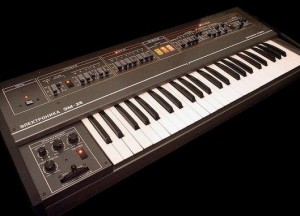
Stringed and organ sections:
- polyphonic attack and release of sound with duration control
- switching decay mode
Wind instruments section:
- generator of curved with controls: ATTACK, DECAY, SUSTAIN.
- modulator with controls: RATE, DELAY, VIBRATO
- controlled filter with controls: ENVELOPE, MODULATOR, CUTOFF, ACCENT
- filter run mode -mono or polyphonic
There is also a possibility to split the keyboard to 2 section (with setting up different timbres of sounding)
More info:
“Elektronika” was the so-called brand name for any former Soviet electronic product made in any former Soviet factory more or less involved in the manufacturing of any electronic devices and there were a whole range of electronic products released in Russia (watches, TV sets, amps, speakers, tuners, and more) that used this ‘trademark’. Bizarre but true!
Wherever it originated, the EM-25 was a polyphonic synth specialising in strings, organ and brass. Like other such instruments, it was of the ‘divide-down’ variety to give a totally polyphonic generator through a single filter, amp and envelope.
The strings section had mixable contrabass, cello and violins with variable attack and decay and the obligatory chorus unit for the rich ensemble effect.
The organ offered variable footages at 16′, 8′, 4′ and 2′ with variable attack and decay whilst the brass section offered trombone and trumpet. Of course, none of these sounds were ‘realistic’ but there were plenty of controls and facilities to coax some sonic mileage out of this trio of sounds.
There was an LFO that could be used to sweep the apparently fiercely resonant, self-oscillating filter and all the sections could be mixed and balanced – even split across the keyboard range – and so, in that respect, the EM-25 was not unlike the Moog Opus, Korg Trident and other such keyboards. To the left was a performance section with a pitchbend lever that appears to have been lifted directly from Roland’s ‘bender’ design!”
Comments
DATAMASKIN

