
Yamaha CS-80 Sound Sampler
Here’s some nice sound samples by Gavin Curtis featuring the CS-80. “My CS-80 restoration project about 1/3 completed and the instrument’s health bar is finally in the green. Most of the systems are working. Enough to present to you what a properly functioning CS-80 should sound like. Definitely resides in the category “most complex production electronic musical instrument”. Over 200 lbs of printed circuit board and wiring. Less than 800 CS-80s were made due to high cost and complexity. Serial numbers started at 1000 and ended before 1800. My CS-80 is serial number 1306, the 306th unit off the assembly line.”
Signal path is the CS-80 —- Lexicon 224XL digital reverberator —- direct line audio feed into Sony HDR-XR520V HD camera.
About the CS-80:
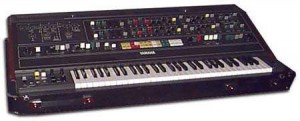
A very old and very huge (over 200 lbs.) classic synthesizer. Considered Japans first great synthesizer. It had some pretty amazing features for its time such as eight voice polyphony, patch memory storage and polyphonic aftertouch. It can generate great analog strings, brass, drones and pads with that instantly recognizable classic polysynth sound. No synth sounds greater. Some examples of its extremely fat sound can be heard in “Blade Runner” and “Mutiny on the Bounty” by Vangelis as well as “Dune” by Toto. The thing that really made this synth sound so powerful was its “natural” detuning….thus its brass and string sounds were unparalleled not only for authenticity, but for pure width! Unfortunately for the CS-80, it was released the same year as the more programmable and cheaper Prophet 5.
With two analog oscillators per voice, the CS-80 has the potential for some really fat sounds! A great VCF filter with independent hi pass and low pass resonant filters, a powerful ring modulator and plenty of modulation controls further enhance the CS-80’s sonic potential. There are 22 preset sounds (6 user) selected from bright and ugly colored buttons above the keyboard. The keyboard is weighted and has a full 61 keys with performance controllers for vibrato, pitch, brightness and volume. Surprisingly there’s also a long ribbon controller for the pitch-bending, located above the keyboard. There is no MIDI or cv/gate control. The only way to MIDI it is via a rather complex retrofit receive-only kit from Kenton.
Comments
DATAMASKIN

