
The poor man’s Moog has been revived
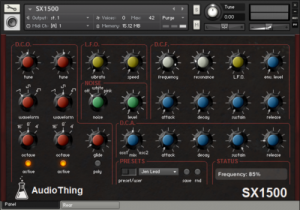
In the lab, for years, covered by other instruments and things, there was this old Italian analog synthesizer from 1979: the Jen SX1000. Monophonic with just 1 oscillator, it was often called “poor man’s Moog”. It is always hard to sample analog gears so, instead of trying to clone it (which is obviously impossible for a sampler), we decided to use the samples of each waveform to build an hybrid synthesizer taking advantage of the Kontakt Script language. It sounds both vintage and new! It is also possible to drift the oscillators to emulate the tuning problems of vintage analog synthesizers and to hear the usual knobs noise caused by dust while tweaking them. The Performance View follows the original parameters scheme adding, of course, new features.
 Documentation
Listen to it here:
SX1500 by AudioThing
About the original Jen SX1000:
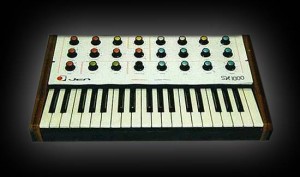
Mention the SX1000 to any serious vintage synth anorak, and you’ll be met with much laughter. But why the little Jen should have become so uniformly derided escapes me. Even in the digitally dominated days of 1985, Julian Colbeck described it as a “fine box for mucking around with, or for learning about synthesis” and “a first class first-time buy”. On its release in 1977 this might have been justified, at least in part, by its super-low recommended price of just £210. Indeed, this had dropped to £159 or thereabouts by the time that the SX1000 was discontinued in 1982, and its street price was often considerably less. But it would be unfair to suggest that the only reason for liking the SX1000 was its price. It was also a fine little synth.
At first sight, the SX1000 appeared very basic. And, on second and third sights, nothing changed this. It had a short, 37-note C-to-C keyboard, a mere 24 programming controls, no CV & Gate inputs or outputs, and no pitch-bend or modulation wheels. Indeed, it was entirely without frills: no velocity sensitivity, no pressure sensitivity, no nothing!
The sound was generated by a single oscillator, described on the control panel and the voice cards as a VCO, but by previous writers as a DCO. The truth is a strange halfway house that is neither entirely voltage-controlled nor digitally-controlled. It worked something like this… The oscillator itself was a high frequency squarewave generator stabilised by a digital circuit. So far, so DCO. The output from this was passed to a large 40-pin chip (that would now be almost impossible to replace) that shaped the wave into a wider selection of waveforms and divided it down to the standard range of audio frequencies. But what about the ‘Fine Tune’ control on the top panel? This, indeed, was a standard voltage control that affected the frequency of the high frequency oscillator. The range of its affect was rather small but it was, nonetheless, a voltage control.
Clearly, the SX1000 was a hybrid, and it suggests that, in 1978, Jen had a technological lead over much of the rest of the synthesiser industry. After all, it was to be another four years before Roland released the Juno6 – the instrument that is often credited as being the first DCO-based synth.
DATAMASKIN

