
Experimental: HERMAN KOLGEN – URBANWIND – sound installation
Herman kolgen
sound art installation
in my series windfields
urban wind is an installation taked from my serie windfields. the devices of the serie windfields have in common that they rely, in one way or another, to the dynamic characteristics of the wind _ the air flux. in urban wind, they are wind sensors are installed in strategic points of the city [ e.g. ::: intersections, bridges, tunnels, parks, rooftops . . . ].
the velocity and direction of the wind will be analyzed and than transmit by wifi to a group of accordions that will emit a euphonic soundscape. public can ear the pulmonary dynamics of the city trought each accordeons bellows.the differents harmonies are created by the wind flow.
presented for the first time in korea at the incheon international digital art festival 2010.
Vectr 2.0 Experimental Session
Vectr pairs well with Make Noise gear for some experimental noodling. This video features Vectr firmware 2.0. Vectr is generating clock beginning with the tap tempo set up at the very beginning. The left Vectr is controlling the Phonogene on the left. The right Vectr is controlling the MMG filter and the Erbe-Verb on the right. The left Vectr is generating clock which is fed to all other module’s clock input. The result is sonic awesomeness. Make that with your plug-in!
Experimental instrument – Aodyo Sylphyo Wind instrument controller
Aodyo introduced the Sylphyo – a new wind instrument MIDI controller.
Aodyo expects the Sylphyo wind instrument controller to be available around the first of next year, priced at 700-800 Euros. Details are to come at the Aodyo site.
Hyper cool stage performance: Sirqus Alfon – LASER Magic
Babham have a super master programer in his team of scientists, that makes good arduino hacking and mega strong laser light instruments! Now Sirqus Alfon can finally make playing with Lasers and make good best show on earth with touch of magic!!!
Booking and info : Konfront.se
Experimental from ::vtol:: kalculator
interactive installation
By pressing a button, the visitor is selecting one of 18 names from the top charts of young perspective Russian artists, according to the Art Newspaper Russia.
Within several moments the program is requesting the Google search and returns the number of times this name was mentioned in the Internet.
A special algorhythm further transforms this number into a sound composition played through the speakers. Complexity and length of this composition depends on the number previously received
Thus the object is using other people’s fame as the input for creating electronic music.
special for “Why Can’t You Divide By Zero?” exhibition, Museum and Exhibition Center “Worker and Kolkhoz Woman” Moscow, 2015
more info – vtol.cc/filter/works/kalculator
Experimental: 8-bit instant photo gun
8-bit instant photo gun
– game boy
– arduino
– camera
– thermal printer
Experimental: R x2 by ::vtol:: and anastasiya alekhina
Kinetic sound installation.
Computer algorithm collects from Internet the data on power and depth of shocks in planet’s crust and captures all the earthquakes above 0.1 (Richter magnitude scale). On an average day there are up to 200 of such shocks. This data is converted into signals that control the motors which are attached to Thunder Drum acoustic drums.
more info – vtol.cc/filter/works/r-x2
authors:
anastasia alekhina
::vtol::
Mars Gallery, Moscow, 2015
Experimental: CubeSequencer (Rubik’s Cube)
THE RUBIK’S CUBE SEQUENCER. CAMERA + LIGHT MOUNTED OVER A GAME BOARD, COLOR RECOGNIZING ALGORITHM
PLAYS SOUNDS IN A CHROME WEB SEQUENCER, HORIZONTAL = 16 BEAT LOOP, VERTICAL = LOW PITCH – HIGH PITCH
OR DIFFERENT DRUM SOUNDS, 16 CUBES ( 4X4X4) WITH DIFFERENT COLORS, EACH COLOR REPRESENTING A MUSICAL INSTRUMENT: WHITE IS DRUMS, GREEN IS BASS
ORANGE IS PERCUSSION, RED IS SYNTH 1, YELLOW IS SYNTH 2, BLUE IS SYNTH 3
. IN ORDER TO COMPOSE: PLACE THE RIGHT CUBE IN THE RIGHT BOX, TWIST THE CUBE TO GET THE DESIRED COMBINATION, CHANGING ONE INSTRUMENT
EFFECT OTHER INSTRUMENTS. COMPOSING MUSIC BECOMES A PUZZLE, A VERY DIFFICULT PUZZLE. BUT WHAT IS THE DIFFERENCE BETWEEN PLAYING A GAME AND PLAYING MUSIC? AND WHO IS THE WINNER?
THE RUBIK’S CUBE SEQUENCER
CONCEPT AND SOUND DESIGN BY HÅKAN LIDBO, PROGRAMMING & VISUAL DESIGN BY PER-OLOV JERNBERG, GAME BOARD BY ROMEO BRAHASTEANU
Kickstarter: Introducing the Artiphon INSTRUMENT 1
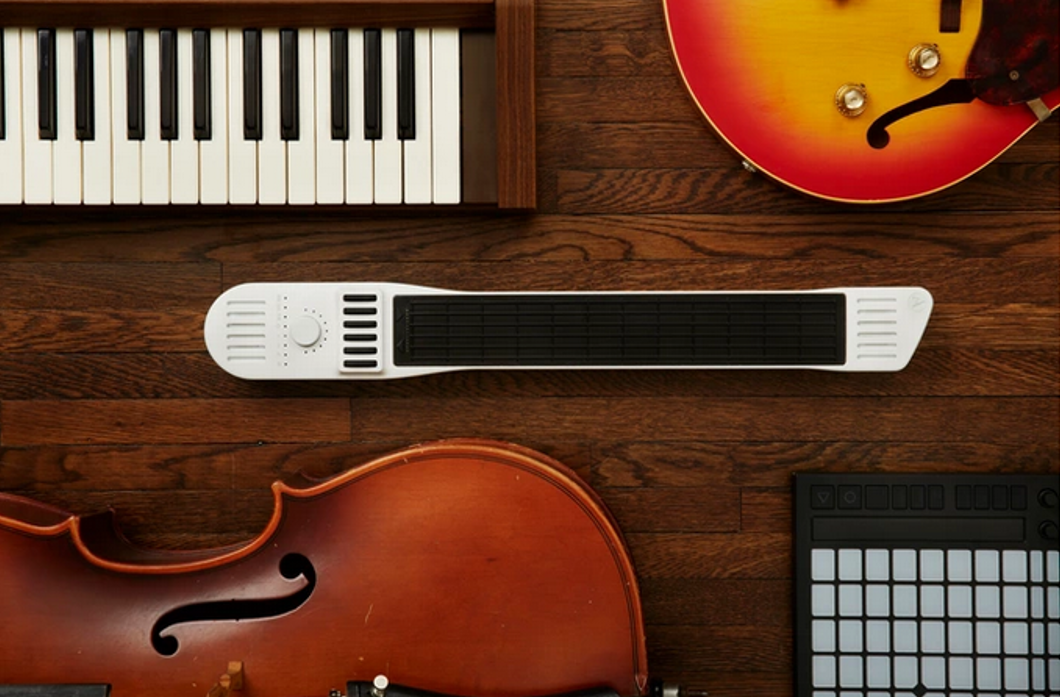
Description: A guitar is designed to be strummed; piano keys are pressed; drum pads are tapped; violins are bowed. But what if a single instrument could be played with any of these techniques? That’s exactly what we’re creating – one instrument that lets you be the whole band.
- Play any instrument, style, and sound with a single device that connects directly to your smartphone, tablet, or computer.
- Our patented multi-instrument technology transforms the INSTRUMENT 1 into a guitar, violin, bass, piano, drum machine… it’s any instrument you want it to be.
- Plug in and play 100’s of apps like GarageBand with universal musical gestures: strumming, tapping, bowing, sliding, and more.
- Digital string-like interface works with any MIDI-compatible software.
- The unique ergonomic design can be held in multiple positions, and is fully ambidextrous.
- Design new instruments and custom tunings via the Artiphon companion app.
- It’s compact, portable, durable, self-powered, and simple.
- Designed and engineered in Nashville, TN.
The sound of empty space
The sound of empty space explores relationships between microphones, speakers, and surrounding acoustic environments through controlled, self-generating microphone feedback.
Amplifying and aestheticizing the acoustic inactivity between technological “inputs” and “outputs” – stand-ins for their corporeal correlates, the ear and mouth – the notion of a causal sound producing object is challenged, and questions are posed as to the status of the ‘amplified’.
By building flawed technological systems and nullifying their intended potential for communication, the ear is turned towards the empty space between components; to the unique configurations of each amplifying assemblage.
In each of the interrelated works – pieces which are equal parts banal, inventive, and absurd – sound is revealed not as a distinct object or autonomous event, but rather as a mutable product of interdependent networks of physical, cultural and economic relations.
DATAMASKIN

