
Digging the Vodka beat
European multitalent Tua produces a beat solely with sounds of a vodka bottle.
Tua und Vasee auf Evigila Tour 2010:
10.12 Braunschweig, Jolly Joker
11.12 Hamburg, West Coast Lounge
12.12 Berlin, Stellas Hangar (Kein VVK / Nur Abendkasse)
17.12 Reutlingen, Franz K.
21.01 Würzburg, bhof
22.01 Crailsheim, Ratskeller
23.01 München, Feierwerk
27.01 Stuttgart, Zwölfzehn
28.01 Mannheim, Rampenlicht
29.01 Köln, Underground
Karten gibt es ab 10EUR auf http://www.eventbuero.com und an allen bekannten Vorverkaufstellen.
synthachon chaos
a completely different sound event each time a key is touched. for more examples of this amazing synth:
Synthesis of complex stereo waveforms
Synthesis of complex stereo waveforms with CPLD programmable logic core. (Lattice ispLSI1032E).
If you are comfortable designing DIY digital circuitry with 7400 / CD4k chips, look into CPLDs, they are amazing. Inside a CPLD is a collection of primitive logic elements equivalent to hundreds of 7400/CD4k chips, and through the magic of logic synthesis, these elements are configured by software to realize your circuit. Its like a dream where the chips jump up and plug themselves into your breadboard, and wires magically appear to fulfill the schematics you draw on the screen. Plus they are erasable/reconfigurable indefinitely. It is a very futuristic feeling to use this technology.
I used Lattice’s free software environment ispLEVER Classic 1.4 and the ispDOWNLOAD USB JTAG programmer (~$80) to configure these devices.
This is a nice way to familiarize oneself with the toolchain. Once a few more concepts are in place, the power of FPGAs will be accessible.
Grainslide Demo
My first app for monome written in max/msp!
Any sound manipulation/change that you hear while my hand is not on screen is being caused by the crop sample length control within max. Changing the length of each sample loop.
more details here: post.monome.org/comments.php?DiscussionID=10253
Played around with Plinkome tonight for my uprlip.com post. Nothing special… just start it and let it do it’s thing.
Shared by Jared Smyth
Feed my speakers
Feed My Speaker is a composition completely based on feedback. It is written for 4 player, 4 microphones, 4 speakers and a computer.
Every players has a score in front of him where instructions tell when the player needs to place the microphone above the speaker.
The feedback that occurs is tuned by means of the computer (and MaxMSP) which is placed in the feedback loop. The first player can select presets which are indicated in the score and change the scales so harmonic content can be played.
Lunapark Ensemble asked me to write a compositon based on Pendulum Music by Steve Reich. Feed My Speaker is the result.
This composition is written for Lunapark and was funded by the Fonds PodiumKunsten in the Netherlands.
This performance was in de Toonzaal in Den Bosch on october 7th 2010
A score of this composition can be obtained via the composer:
dannydegraan.nl“
Modulation Voodoo
Scary stuff hehe
http://vimeo.com/18312753
Using the nodes on the Ciat Lonbarde Tetrazzi Organus with alligator clips for various modulation experiments. The voodoo doll pins act as mults for certain patches. Eventide Timefactor used for adding echo to the panning outputs.
Eat more seitan.
Atomic Powder
http://vimeo.com/18179514
“Atomic Powder” was created during the summer 2010. This video is a sign of energy people are used to get through bread and atom. Basically, these things make our bodies and screens work. By watching it the author would like you to think about how these amazing things happen together.
References go to german techno musician SuperMayer and his very track called “Two of Us” and probably a pioneer of video art Gary Hill, whos rather similar video experiences Ioffe discovered on YouTube a while ago after the production of “Atomic Powder” had been finished. And of course a very nice guy from Finland whos name I recall a little later!
Via IOFFE
The mighty Macbeth M5
http://vimeo.com/18329846
The mighty Macbeth M5 shakes hands with a Serge Creature/Gator combo while a voyeuristic spectre watches. Shot with a Kodak Zi6 at sunrise with ample amounts of Ken Macbeths spectacular spring reverb sauce soaking the Apogee. Foucault was a horse thief.
http://vimeo.com/18312753
Using the nodes on the Ciat Lonbarde Tetrazzi Organus with alligator clips for various modulation experiments. The voodoo doll pins act as mults for certain patches. Eventide Timefactor used for adding echo to the panning outputs.
Via HexEnduction
Rocking robots
PAM’s getting back to her shredding roots. PAM (Poly-tangent, Automatic (multi-)Monochord) was built by Expressive Machines Musical Instruments (www.expressivemachines.org).
MARIE are a set of virtuosic and expressive music robots that are portable, reliable, user-friendly, and fit within the dimension/weight limits for international checked baggage. In other words, these are music robots for touring musicians. The hope of EMMI and the EAR Duo is that the usability and portability of MARIE and similar music robots will finally push this powerful technology out of research labs and onto stages around the world. Within this aim, the entire project will be publicly documented online and the source code and hardware diagrams all provided as public knowledge for other enterprising musicians and technicians to construct similar robots.
ASAM – Audio Synthetic Artifact Manager
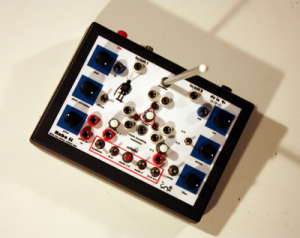
ASAM – Audio Synthetic Artifact Manager. Modular version of a Robo Synth. Ultimate source of anti music – drone madness and radio beating, pitch-shifter and digital distortion… All futures of old Robo + modular banana routing options and external control capabilities.
general features:
– 4 main sound modes
– feedback oscillation
– triple morphing modulator
– pitch control
– theremin mode
– analog oscillation and “drone” mode
DATAMASKIN

