
The never ending expandable modular synth from 4ms
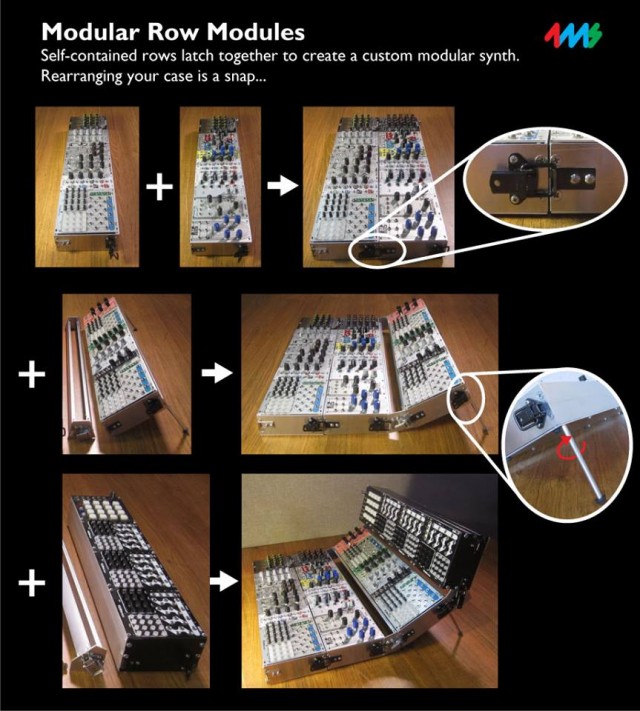
4ms has announced a new case solution for Eurorack synths – Modular Row Modules. Each row is an independent Eurorack case and can be latched together to form any size or shape system you need. Table top. Vertical wall. Console style. Angles and curves. No screwdrivers or tools are needed – you just snap the rows together and add angle pieces and support legs where you need them.
Here are the details:
- Connecting Rows
- Each Row Module can be a stand-alone unit
- Rows connect directly to each other with built-in latches (no tools required!)
- Angled connectors allow for 30 and 45 degree angles
- Support legs screw onto any Row
- Specifications
- Row Modules come in two sizes: 2″ deep or 3″ deep
- All-metal construction, and light weight (about 2.5 pounds)
- Plain aluminum sides, or a variety of colors/finishes will be available (powdercoated colors, anodized black)
- Wooden end caps and angle pieces will also be available
- Power
- Available with busboards, flying bus cables, or without power
- Barrel plug jack on the side of each row, or on a 4HP panel. For vertical configurations, 4HP panel can be mounted to the rear.
- Two barrel jacks on each row allow for daisy-chaining and/or directly powering each row
- Compatible with the 4ms ultra-isolated power system (forthcoming).
Pricing and availability info are to be announced.
Make Noise Maths Optomix Thrash ( DPO MMG PRESSURE POINTS BRAINS )
Paul provides a snap shot of some modular gear, description below:
First mess about with the modular since receiving MATHS & OPTOMIX today. Just a bit of fun, some seriously crazy modulations , squeals and screams.
Also used are the DPO, Moddemix, Pressure Points, Brains, MMG, A145 LFO, A160/161 Clock Sequencer/Divider.
The audio is going through a Quadraverb for delay, then recorded into Logic. The video was filmed on my iPad. The audio & the video were then merged using iMovie.
New interview with Synthesis Technology’s Paul Schreiber
Oliver Chesler talks with Paul Schreiber of Synthesis Technology, creator of the MOTM line of large format synth modules and a line of Eurorack modules. Schreiber has been designing and building modules for years and has been a key figure in the renaissance of modular synthesizers.
Modular Wild presents PROFILE – Steady State Fate Ground Control
A short description of the Steady State Fate Ground Control module for Eurorack. Ground control is a handy utility with a wealth of features. Sound and Video by Raul Pena.
Modular synths perform ‘A Progression of Angels’
A new Encore Electronics Frequency Shifter prompted David Ryle to patch the modular synthsizer for this piece.
This consists of a single vco (Synthetic Soundlabs 1200) with PWM from a Segwencer and CGS dual LFO. The pulse wave goes direct to the Encore FS and the Up and Down outs are routed to the Modcan 73B Dual Delay. The Frequency Shifter has a cv input from a Yusynth voltage controlled Quadrature LFO to make the bowed or pulsing sound.
The pitch voltage is from a synthesizers.com Q960 and Q119 sequencer pair. The Q960 is run into the Q119’s ADD INPUT and the Q119 is shifted every 16th division of the Q960 by way of an SSL TTLFO and Moon Modular 554 Octal Divider. The divider also sends sync timings to the 73B delay
A final mix of the outputs of the FS are routed to the studio mixer through a panner and each channel is split off to a Strymon Blue Sky reverb. A final pair of reverbs are the Lexicon MX200 and TC Electronic D-Two.
Recorded in Cubase 6 and video processed by Apple Final Cut Pro.
Time again for some playtime on the Buchla Easel
Todd Barton plays the Buchla Easel
“using the keyboard’s arpeggiator to drive the on board Sequential Voltage Source — some fun little patterns and timbres. . .”
“just another “getting my ya-yas” out and havin’ fun. enjoy!”
About the Buchla Easel:
The Music Easel is a highly evolved electronic musical instrument. It maintains many of the design philosophies and functional characteristics of its predecessors, the 100 series Modular Electronic Music System and the 200 series Electric Music Box. The Music Easel introduces some substantial innovations in electronic instrument design – innovations that make it a truly expressive real-time instrument for composition and performance.
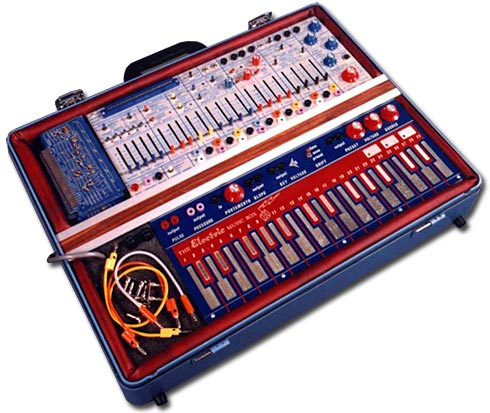
The Music Easel contains many of the elements commonly used to generate and process sound: a keyboard, sequencer, pulser, preamplifier, envelope detector and balanced modulator; oscillators, gates, envelope generators and filters; facilities for mixing, monitoring and reverberating. Many of these elements possess an unusual degree of sophistication. The keyboard is solid state, with touch sensitive, chromatically organized keys, accurate and reproducible pressure output, tactile feedback, octave shifting, and voltage controlled portamento. A complex oscillator, developed through computer aided simulation studies, is a rich source of complex audio spectra. featuring voltage control of pitch, timbre and waveform, this oscillator provides the Music Easel with a timbral range unapproached by other musical instruments.
The connectives are as important as the elements to be connected. Interconnection within the Music Easel is accomplished with a combination of switching and patching, a system which is flexible, expedient, and open ended. Logical, compact organization and color coded graphic feedback facilitate rapid and effective interaction. Multiple correlations between a performer’s actions and the Music Easel’s responses are readily implemented, enabling a degree of expressive articulation heretofore impossible with electronic instrumentation.
Further augmenting the Music Easel’s real time performability is the capability of permanently storing and immediately retrieving complete instrument definitions (patches) or portions thereof. (An “instrument definition” includes settings of parameters, degrees of articulation, switch positions and interconnections.) Storage entails the installment of resistors on program cards; retrieval is accomplished by plugging in a desired program card and activating a switch.
With its extended timbral resources, unusual expressive capability, and its facility for storage and recall of instrument definitions, the Music Easel opens new horizons to the composer and performer. To appreciate its potential as a new musical instrument the Music Easel must be seen, heard and played.
Moon Modular 591 Quad Matrix Switch
John L Rice is back with a new modular exploration, details below:
I highly recommend adding the Moon Modular 591 manual switch (or similar and/or DIY switch) to your system, especially when using the 554 Octal Clock Divider!
Notes:
1) The 591 I have I purchased secondhand recently for less than half price of a new one, since it had been damaged and only partially repaired, so switch #3 doesn’t work correctly and switch #2 is a little intermittent.
2) The video didn’t compile correctly so the last 30 seconds were cut off, sorry about that! It was my second attempt and didn’t want to try again since it ties up my computer for hours each time! :-/ Something is wrong with either Sony Movie Studio 12, certain plugins, Windows 8, other running applications, the PC hardware and/or a combination of everything. 
Crazy modular guy: Touch It And Lick It!
A new genre within modular music perhaps 😉
Buchla 100: Eighty Seconds
First exploration with an original Buchla 100. For better audio go to:
https://soundcloud.com/user7621213/bu…
The first major synthesizer by Buchla was the modular 100-series produced from about 1963 to the early 1970’s. The system usually consisted of a large wood case with room for a bunch of modules (up to 25 modules on a single power-supply). Although the modules consisted of your basic collection of voltage controlled oscillators, filters, etc. the unique keyboards on this and other models to follow were flat capacitance-sensitive touch-plates. Although they may feel awkward to play, they are pressure sensitive and individually tuneable. There were also 8- and 16-step analog sequencer modules available. Patching and programming a Buchla 100 was a monstrous task since lots of patch cords as well as synthesizer knowledge were a requirement to even get a sound to be heard, and the oscillators usually drift out of tune! These are extremely rare systems but they can make some awesome and unique analog music, if it still works! About the only places where Buchla 100’s can be found nowadays are at the The Audities Collection and a few scattered Schools and Universities across the US.
The Polymath modular synt has been released
Analogue Solutions tells us that the Polymath modular synth has been officially released and is available for pre-order.
Features:
- 4 VCOs. Each have Pulse Width, Portamento, Saw wave, Square Wave, CV inputs, CV outputs, Sync. VCO1 has Sub-Osc output too
- Multimode VCF based on (not a clone) the Oberheim SEM (LPF, BPF, HPF, Notch) with multiple CV control
- Audio input, to allow processing of external audio (vocals, for example, from your DAW, etc) through the filter
- 2 LFOs
- 2 ADSR Envelopes
- 8 Step Analogue Sequencer with sliders
- Arpeggiator – with Up, Down, Up/Down modes and Octave range
- Poly Mode (Paraphonic)
- Note Trig/ReTrig
- Unison Mode for mega-fatness
- Ring Modulation
- Sample and Hold
- Noise
- Multiples
- Adaptor
- Spring Reverb – a triple spring Accutronics unit is used.
- MIDI to CV Converter
- Mixer
- Inverter
- Headphone Amp
- VCA
- Real Wood sides made by Lamond Design
- 2 LED Gooseneck Lamps included
- Solid steel and aluminium construction
- Carry handle
- Includes an assortment of patch cables
Pricing and Availability:
Available for pre-order.
Estimated UK retail price: £2899 GBP (exc. VAT and delivery)
DATAMASKIN

