
Buchla sound manipulation at its essence
Extend your performance technique beyond spaghetti tossing and knob twiddling to the caress of Thunder and the zap of Lightning.This three panel unit tactile sensor responds to a feather-weight touch, or to several pounds of pressure. An accompanying spatial sensor, mounted in the third row and occupying 1 panel unit, tracks the movement of the hands as they leave the confines of the surface. The tactile surface is normally mounted in the first row of a 201e-12 or 201e-18 cabinet: alternatively, it may be mounted in the recently announced 201e-3u frame, relieving spatial binds in crowded systems.
An ergonomic array of 27 keys sense pressure and velocity; fourteen respond to location in one or two dimensions. Arrayed into multiple user-defined groups ranging in size from 1 to 25 keys, they produce a variety of user-programmed control voltages.
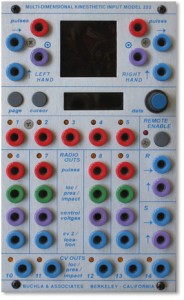
Location, pressure, impact and tuned voltages, as well as pulses, are presented at a total of 30 outputs. The LCD based user interface is remarkably simple and flexible. Trigonometric detection of 2 wireless rings provides spatial information in three dimensions, with additional data provided by ring-mounted switches. Charging of the rings is accomplished by plugging them into powered USB sockets. All settings, including key programming, can be memorized and recalled by the 225e or 206e preset manager
In this video:
exploring various ways of manipulating the sound of a single oscillator (261e) via the touch plate routings. For a high resolution audio of this performance go to:
soundcloud.com/user7621213/buchla-222e-touchplay
please excuse the ugly, loud click at 1:20 — must have hit something with my sleeve–it doesn’t appear in the soundcloud audio track.
Buchla 222e Basic Programming
“This is a very, very rough hand-held flipcam video tutorial of just the most basic programming of a few pitches on three touchplates. Be sure to pause the video to check all the knob and light settings. Sorry for the blurring readout of the 223e window but my verbal explanation covers it all. And, yes, I do have a moment of verbal dyslexia and call the 259e the 295e, ugh. Hope this helps.”
Buchla Random Ambient #1
A variation on the patch used for Buchla Rhythm Study-3c only all the voltage controls are slower and longer. all self-generating except for a few times where I tweak the eg (281e). oh yeah, a ton of reverb. for a higher resolution audio track go to: soundcloud.com/user7621213/buchla-random-ambience-1
Shared by todd barton
Buchla 259e Mod Oscillator Exploration
Testing what the Mod oscillator sounds like, raw and modulated, through the 292e in filter mode, VCA mode and both. Modulation proved to be quite hard but I liked the sound of the whole thing and as usual, there are gems to be found in there!
Buchla + MonoMachine = Sweet
Controlling and processing the Buchla through my Elektron MonoMachine proved to be totally lovely! This is something I’ll spend a lot of time doing in the future. The rhythm based delay and reverb inside the MM and the very dynamic timbres of the Buchla match very nicely.
Long audio at sound cloud here:
http://soundcloud.com/7thdansound/buchla-belly
The Stradivarious of electronic instruments
As this years Musikmesse has come to an end I’m reminded the endless stream of new instruments and synthesizers beeing released, software and hardware. If you are like me you have more instruments already available than you have time to learn how to use really good. But there are some that done the opposit and choosen one instrument and mastering it.
Charles Cohen is one of them. Thomas Lehn is another. Incedently both have choosen a small but modular analog synthesizers as their instrument of choise, Buchla Music Easel and EMS AKS.
Charles Cohen sais: “I’ve been playing the Buchla Music Easel since 1976. With its color-coded slide pots, its musically logical panel layout, and its almost sculptural patching system, I can comprehend the state of the instrument with a fleeting glance. The touch-sensitive, capacitance-activated keyboard responds smoothly at the speed of light to the slightest skin contact, and its assorted control voltage outputs can be directed to sonic and structural parameters very quickly. The potential to supplely flow into and amongst all the basic electronic sound forms is literally at my fingertips. I am happy when I’m playing this instrument”
CHARLES COHEN AT THE BUCHLA MUSIC EASEL from alex tyson on Vimeo.
Since 1994 Thomas Lehn’s main electronic equipment has been the Synthi A modular analogue synthesizer combined with the DK-2 keyboard, both developed and produced by the British company EMS in the late 1960’s.
Thomas Lehn’s electronic music is instrumentally live-performed. Musical material, process and structure are created and performed in real time.
 By the way, don´t forget to stop by our new Fanpage >>
Just a Buchla
Buchla 200e live performance. Buchla track in one take.
Buchla Melodies and Waves
This is a quick test of using the Buchla 259e and Verbos 258v for melodic purposes. They are driven by an Elektron MonoMachine via a Kenton Pro Solo MIDI-CV unit. Then the MonoMachine acts as gate and adds a little effects to the 259e (delay) and filtering to the 258v. But just a little. I think I got pretty decent results even with heavy modulation and when using the mem/skew wavetables.
Buchla Module removal and installation
This is a quick demonstration of the removal and re-installation of a Pendulum/Ratchet module for the Buchla 200e modular synthesizer. It shows how easy the process is.
Buchla 200e Randomness Experiment
A simple “controlled randomness” experiment wherein three oscillators randomly change pitch with each new trigger via the Source of Uncertainty. The pulsing is achieved from the ring modulator and, of course, the filter sweep is touch controlled.
Shared by T Barton
DATAMASKIN

