
The future of the NES synth
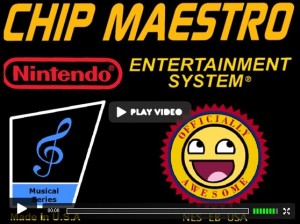
Here is what the author has to say about it:
I am prototyping, designing and assembling a special cartridge called Chip Maestro which can be used in any Nintendo Entertainment System. This cartridge will accept a MIDI input from any instrument, and by passing the MIDI notes through the NES, the cartridge will make the NES synthesize 8-bits of awesome in true NES squarewavey goodness. See the video for more details!
Most chiptune artists today use ‘software synths’ to try and recreate the sound we grew to love. By providing artists with a low-cost and easy to use hardware solution, they can use a real NES to compose their music, and even play it live on stage! And if you don’t have a MIDI instrument, don’t worry; you can use your PC with an inexpensive USB-MIDI converter, or create your own instrument using Arduinos or other microcontrollers that can output MIDI, so you can turn anything into an 8-bit instrument!
Getting this cartridge into the hands of musicians takes a bit of funding. All the money raised will go towards finishing the prototype, a thorough debugging, and beginning production. This entire project will be showcased on Kickstarter as well as my site, and every backer will get backdoor access to my build logs. And, best of all, it will all be open source! Yes, even though there is money involved, I am still putting all my schematics and code on the internet! This way people can improve on my design, and remix it into their works. These remixes come back to me, and I can improve the original product based on those works. It’s an endless cycle of creativity, and I wouldn’t have it any other way.
Background on the NES:
The Nintendo Entertainment System (also called NES or Nintendo) is an 8-bit video game console that was released by Nintendo in North America during 1985, in Europe during 1986 and Australia in 1987. In most of Asia, including Japan (where it was first launched in 1983), China, Vietnam, Singapore, Middle East and Hong Kong, it was released as the Family Computer . In South Korea, it was known as the Hyundai Comboy and was distributed by Hyundai Electronics. In Russia, an unlicensed clone was manufactured called Dendy (Де́нди). A clone that was popular in Eastern Europe in the 1990s was the Super Design Ending-Man BS-500 AS, also known as Terminator. Similarly in India, clones were popular by the names of Little Master and Wiz Kid, in Poland there also was a clone produced, called Pegasus. in Argentina, the clone was called Family Game. It was succeeded by the Super Nintendo Entertainment System.
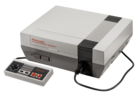
As the best-selling gaming console of its time, the NES helped revitalize the US video game industry following the video game crash of 1983, and set the standard for subsequent consoles of its generation. With the NES, Nintendo introduced a now-standard business model of licensing third-party developers, authorizing them to produce and distribute software for Nintendo’s platform.In 2009, the Nintendo Entertainment System was named the single greatest video game console in history by IGN, out of a field of 25. 2010 marked the system’s 25th anniversary, which was officially celebrated by Nintendo of America’s magazine Nintendo Power in issue #260 (November 2010) with a special 26-page tribute section. Other video game publications also featured articles looking back at 25 years of the NES, and its impact in the video game console market.
Technical details:
I am exploiting the 2a03 chip inside the NES by keeping it in an infinite loop, and injected note addresses and data using opcodes derived from NES note tables. The internal circuitry inside the cartridge translates MIDI note data into NES note opcodes, and sends that to the 2a03 APU, which synthesizes the notes on the appropriate channel. Full technical details will be up in a week, and all backers will receive a link to a secret page with all the details!
Shared by Kickstarter
Missing SMS – the old SEGA Master System, then here´s a chip treat for you
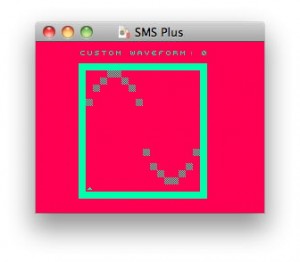
CWP for SEGA Master System / SEGA Game Gear is a simple tool for playing custom waveforms in real time using the control pad. Works in an emulator and on hardware.
The Master System (マスターシステム, Masutā Shisutemu) (abbreviated to SMS) is a third-generation video game console that was manufactured and released by Sega in 1985 in Japan (as the Sega Mark III), 1986 in North America and 1987 in Europe.
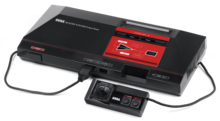
The original SMS could play both cartridges and the credit card-sized “Sega Cards,” which retailed for cheaper prices than carts but had less code. The SMS also featured accessories such as a light gun and 3D glasses which were designed to work with a range of specially coded games. The Master System was released as a direct competitor to the Nintendo Entertainment System in the third videogame generation The SMS was technically superior to the NES, which predated its release significantly, but failed to overturn Nintendo’s significant market share advantage in Japan and North America. In the European, Oceanic, and Brazilian markets, this console launched Sega onto a competitive level comparable to Nintendo, due to its wider availability. It enjoyed over a decade of life in those territories. Due to strong international support, the Master System became the second best selling Sega console. With 13 million units sold worldwide, only the Mega Drive sold more. The console was redesigned several times both for marketing purposes and to add features, most notably in Brazil. The later Sega Game Gear is effectively a hand-held Master System, with a few enhancements. In 2009, the Master System was named the 20th best video game console of all time (out of 25) by the video gaming website IGN.
Features:
– 8 customisable waveforms
– Handy pre-loaded waveforms including sine, triangle and everyone’s favourite, square
Controls:
– Directional pad up / down / left / right: trigger a waveform
– Button 1 and directional pad up / down: change currently-selected sample
– Button 1 and directional pad left / right: change current cursor position / sample
– Button 2 and directional pad left / right: change currently-selected waveform
Credits:
– Thanks to Maxim for his Hello World tutorial / source code, which can be found here: http://www.smspower.org/maxim/HowToProgram
Download:
– ROM: http://milkcrate.com.au/_other/chipmusic_software/sms/CWP_20110508.sms
– Source Code: http://milkcrate.com.au/_other/chipmusic_software/sms/CWP_20110508.asm
LSDJ tutorial (advanced) by Danimal Cannon
DOWNLOAD THIS SONG HERE
https://8bc.org/music/Danimal+Cannon/Gorelax+++DMG+and+Guitar+and+LSDJ+TUTORI…
In this tutorial I break down my chiptune song “Gorelax” and show how I made the song in LSDJ. Hopefully this will inspire you get creative with LSDJ! I go into several things like:
– humanizing
– creating effects using commands
– channel optimization
– stereo tricks
– general sound design
AND MORE
Shared by danimal201
Featuring an interesting chip music seminar from Revision 2011
Elements of Chip Music
Abstract:
When working with a soundchip such as the SID or the 2A03, the artist faces a number of technical constraints that limit, guide and inspire the creative process. The seminar will highlight and briefly explain some of these constraints, with particular emphasis on how they influenced artists during the golden age of chip music to give rise to some of the clichés that now define the genre. We will also see (and hear) how variations of the same constraints have emerged in other genres and ages, and how composers such as Bach have tackled them in similar or different ways.
http://www.linusakesson.net/music/elements/index.php
http://www.revision-party.net/
Mister Beep
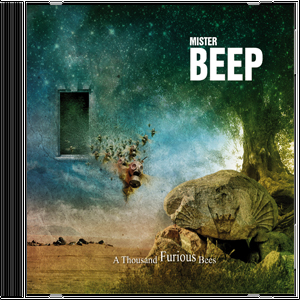
Newest album containing 10 multichannel 1-bit chiptunes , all recorded from REAL HARDWARE.
MISTER BEEP – “A thousand furious bees” 1-bit multichannel chiptunes made on ZX Spectrum 48K (beeper).
via COUCOU NETLABEL: FREE DOWNLOAD – COUCOU13 / Mister Beep.
Chip bootlegs coming your way
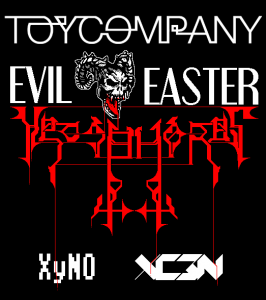
Toy Company is happy to release some excellent bootlegs from the last gig!
Stream the entire video from DJWEB.TV:
http://djweb.tv/view.aspx?video=182
OR get a higher quality MP3 bootleg from http://datagramradio.org :
DJ Procyon Lotor
DJ Procyon Lotor
Xyno
XyN0
XC3N
XC3N
HEOSPHOROS
HEOSPHOROS
Packy Plays Tetris – with a Nintendo Guitar
Packy Lundholm (lead guitarist for I Fight Dragons) plays Tetris in various locations around Chicago. Then things get a bit crazy.
Also his guitar is made from an actual Nintendo Entertainment System (NES).
“As always, you can get a free song at www.ifightdragons.com/free!
And if you live in the Chicago area, come see us play live @ Lincoln Hall on Thursday, 3/31. It’s all ages, and we’ll definitely be using this guitar 
http://www.lincolnhallchicago.com/
Chip from L-TRON

http://l-tron.bandcamp.com/album/l-tron Upon discovering what the program was capable of, the scientists took immediate percautions, securing it inside of the nearest electronic device they could find: A nintendo Game Boy. They feared its power yet could not bring themselves to destroy it. Trapped inside the machine with no way to escape and return to its own time, the program began expressing itself through the sound chip of the Game Boy. Eons passed… An exploration vessel near a planet called earth recorded the following transmissions – code-named: L-tron credits released 01 May 2010 All songs written and arranged by: L-tron Engineered and mastered by: Logan Erickson Recorded and mastered @ little bit studios (Studio B) Artwork By: Ree LBR003 Copyright 2010 L-tron + little bit records
via ChipMusic.org, for more info click here
Goto80 -HYDORAH video by Raquel Meyers
ForeverC 2011 8bit demoscene party
8bit demoscene party
18. – 2o. o3. 2o11
SLOVAKIA/TRENCIN/HORNA SUCA
DATAMASKIN

