
How about some cool modified toy pianos
Five modified toy pianos circulate the gallery on five elevated wooden tracks. Each piano is equipped with small speakers to play amplified sounds picked up from conductive tape on the tracks. Each piano also contains small motors which intermittently spin to strike the toy pianos’ tone bars, adding acoustic elements to the overall soundtrack of the work. The installation also features five video monitors, which display images of five different real landscapes to compliment the abstract landscape of the wooden tracks. As the pianos begin to move around the gallery, these video landscapes are also populated by a seemingly infinite stream of mobile pianos. The video documentation composites footage of the installation in the gallery with footage shown on the monitors within the installation. This work was originally exhibited at the Museum of Contemporary Art, San Diego.
Lego stop-frame animation
This music video combines the Lego stop-frame animation of Parker W Young with BT’s Nocturne de Lumière, from These Hopeful Machines,
via parkerwyoung:
“Le Nocturne de Lumière” [mixed with “Suddenly”]
BT [Brian Transeau]
These Hopeful Machines, 2010
Directed by: Parker W Younghttp://www.btmusic.com/
http://www.facebook.com/bt
Over 2,700 images were shot over the course of 3 weeks (some were also reused) and compiled in Final Cut Pro 7 and After Effects CS4. In less than 2 weeks the images went from memory cards to final video output, making it the fastest edit I’ve ever done.
In that two weeks, all the compositing with holographic characters, additional motion graphics, camera movements, audio adjustments, color correction, titles and other effects were added to the original image line.
Everything you see on the screen was shot through a Canon D50, including the holograms.Elements were not added to the original images, only rearranged. Many-a-night’s sleep was lost during the process, but it was ultimately worth it.

How to turn stock prices into music
AAPL 1984-2010 is a project which takes the stock price information and converts it into music. The AAPl stock was chosen for its wide price range and because it was one of two stocks the author once owned.
The prices where scaled to a range between 36 and 124 in Open Office spreadsheets. The stock was broken into years because this allowed for a wider range of progressions especially with regard to price. The volume was scaled to between 40 and 120. While midi can be between 0-127 the extreme values are not really audible and not often playable on instruments.
The rhythm is a scale of the difference between daily high and low prices and scales to values between 0.5 and 4. The final values are from an IF macro where values less than .8 become 0.5, values between .9 and 1.7 become 1 and larger than 1.7 is two.
Each time period’s pitch, velocity and rhythm values are exported separately and imported into AC Toolbox (see “A Simple Song” video for AC Tool box info) and used as stockpiles to define a musical piece.
The piece is exported as a midi file to Cognitone’s Synfire to check the harmony and ensure a playable range for the piano. The midi from that process is saved and imported in Reason/Record for instrumentation.
The pieces where conceived roughly as piano pieces so that was the initial instrument with some bass and pads added.
The final works are a bit more monotonous than I initially envisaged but the experiment does lead to further work in this area.
The next steps possibly include adding in more technical analysis figures for controller values. More than one companies stock can be use to construct duets, trios, quartets etc. There is also the use of macro economic data to construct songs.
Via tladb
Experimental: The electric eel
The duo play a diy instrument called the “electric eel“, which “synthesizes a variety of important electronic sounds when the slider is moved left and right.
These two instruments, constructed in an afternoon by workshop participants, show the reference design for Exertion Instruments – Electronic instruments with built-in electrical generators. They can play harmonic music across several octaves, while powering their built-in speakers, keyboard, and synthesizers with a bowing motion between the two Lego wheels.
Stop motion form and colour, using light painting techniques
This unofficial Tron Legacy music video, Light Drive, features stop motion light painting by Kim Pimmel:
I’ve been interested in taking my Light Study photo series and evolving them into motion pieces. I shot a lot of footage for a VJ gig for FITC San Francisco. So I edited together those stop motion sequences, mashed up some audio from the Tron Legacy trailers, and out came Light Drive.
The video is stop motion, so every frame is an individually shot photograph. Each photograph is a long exposure photo, with exposures reaching up to 20 seconds in some cases.
To control the lights, I used an Arduino controlled via bluetooth to drive a stepper motor. The stepper motor controls the movements of the lights remotely from Processing.
The light sources include cold cathode case lights, EL wire, lasers and more.
Five-movement opus programmed onto a tiny 8-MHz, 8-KB microchip
I have blogged a “bit” on this guy before, but here’s some more details:
Tristan Perich, a New York composer of experimental music, wanted to see how small he could make big philharmonic pieces. His new release, 1-Bit Symphony, is a 40-minute, five-movement opus programmed onto a tiny 8-MHz, 8-KB microchip in super-efficient assembly language. The dinky chip containing this program (source code included in the liner notes) is installed in a CD jewel case and wired to a watch battery, volume knob, and headphone jack. Order the assembly at bangonacan.org, hit the On button, and the music flows through your earbuds.
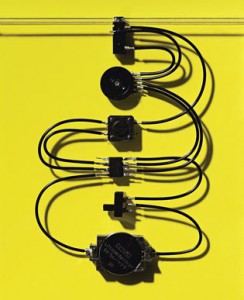
“I wanted to pare things down as much as possible and remove all of those extra layers,” Perich says. “Ultimately, the lowest you can go is 1 bit.” He couldn’t get quite that small; but still, at under 8 KB, the richness of his composition, which sounds like a grand polyphonic score performed in pulsing Nintendo bleeps and bloops, is surprising. And so is its conclusion: The final movement of 1-Bit Symphony is programmed never to end—the last tone simply goes on forever, or at least until the 3-volt watch battery runs out.
Speaktron
Speakatron uses your webcam to identify when your mouth is open and plays a sound if it is. It uses the shape of your mouth and its position on the screen to help control the sound.
Speakatron was selected as a best hack of Music Hack Day London. It’s available as a download from Bereza’s site.
Color chaser
Who wouldn’t want the color chaser
Colour Chaser detects and follows black line whilst it reads the colour and translate the colour RGB data into sound.
Video Transmission and Electromagnets
Get ready for some serious noise
Video transmission feedback look that is being modulated by an electromagnet whose own energy is received from the audio produced by the system.
Tectonic is a sound sculpture created in real time by earthquakes
Tectonic is a sound sculpture created in real time by earthquakes as they occur across the globe. A tightly integrated system between Max/MSP, Google Earth and Ableton Live processes a stream of real-time data that is translated into synthesis and sample playback parameters.
When an earthquake occurs, seismic data is relayed to the system, sound is produced and Google Earth immediately flies to the coordinates of the latest earthquake giving us a visual representation of the newest developments. As multiple earthquakes occur daily, the sculpture builds, enmeshing itself in a complex soundscape of textures and tones – every second, different from the last and never repeating the same stage twice.
DATAMASKIN

