
2010 promotional message from Georgia Tech
Shimon, an adaptive, improvisational, percussion-playing robot
So why don´t we all get ourselves a beer synth before the weekend starts?
Matt has designed beer bottle labels that have markings on them to indicate the pitch of the note that the bottle makes when blown, based on the amount of beer left.
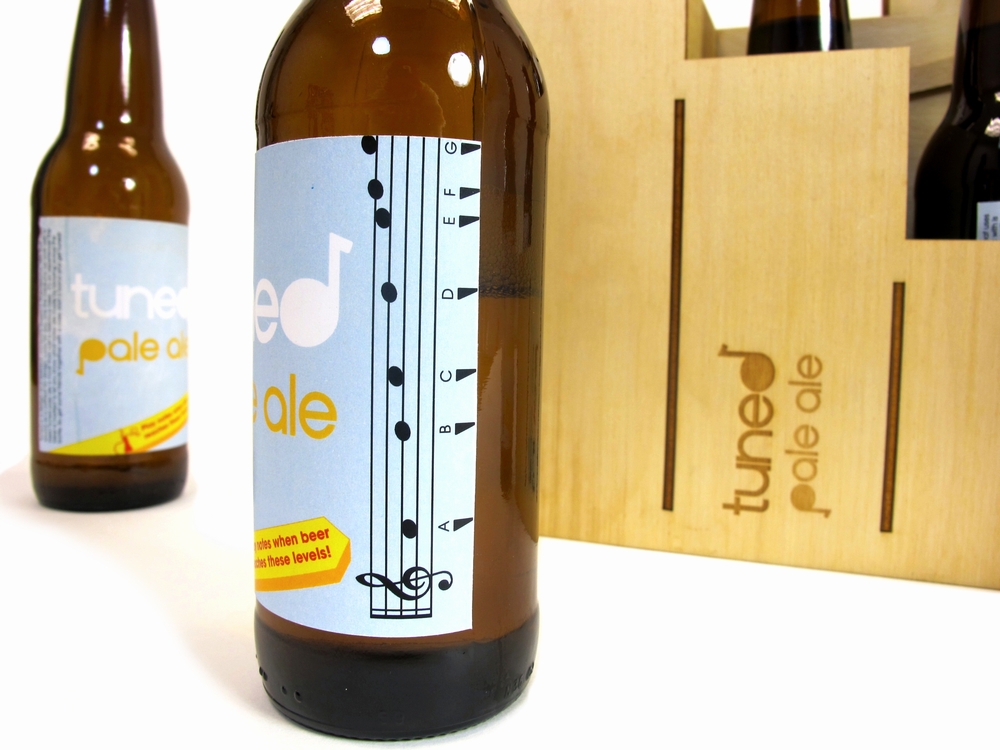
“Tuned Pale Ale is a product that explores the musical affordances in everyday objects and promotes social spontaneity. While drinking beer, people become musically encouraged and often start making music with objects around them. This product aims to promote more of this type of social interaction. This product aims to inform users about the musical qualities of existing bottles and to make the bottle a better instrument.”
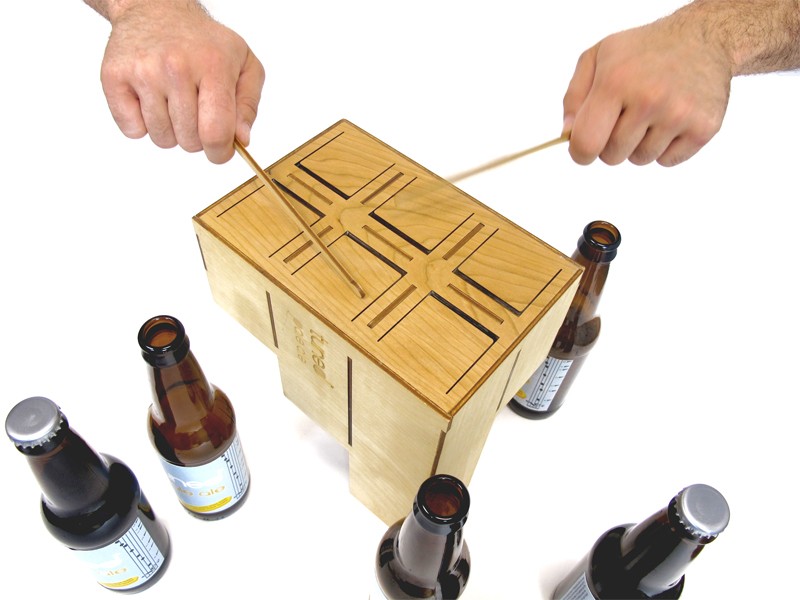
Not only do the bottles produce music, but when turned upside down, the limited edition beer case is a tongue drum that produces six different tones!
Daft Punk interactive music tool

Not new but quite fun if you have not seen it before…
http://www.youtube.com/watch?v=kdanwXiicp0
Music through your mind
Robert Schneider (Apples in stereo singer/producer) practices using the Teletron, a modified Mattel MindFlex toy that uses EEG sensors, to play a Moog analog synth with his thoughts.
Ambient improvisation on the Juno 60 drone
Ran Kirlian’s Threniar Vish – an ambient improvisation, based over the Roland Juno 60 drone. The other instruments are the Access Virus Indigo and the Indigo 2 Redback.
All audio is processed thru a TC Electronics M-One.
Into visuals
RtP Release Show – Nullsleep 3
Exploring the Cappucino synth
The sound isn’t much raw, though with some processing it could go in any direction you might imagine, and there’s something sculptural and inspiring about watching metal spin. The basic technique is really as much about the pickup, the amplification of the source, as anything. And that means any number of household items could take on new meaning.
As it happens, Gijs has shared a tutorial on how he makes his pickups, among other electronics how-to notes. Or make that a “puckup” (I’ve made a few of those, on CDM and elsewhere):
inductor-puckup
Generate sound from running sorting algorithms
This particular audibilization is just one of many ways to generate sound from running sorting algorithms. Here on every comparison of two numbers (elements) I play (mixing) sin waves with frequencies modulated by values of these numbers. There are quite a few parameters that may drastically change resulting sound – I just chose parameteres that imo felt best.
After making this video I found that someone already tried to audibilize sorting algorithms:
http://www.pillowsopher.com/blog/?p=116
– he mentions other older attempt: http://www.math.ucla.edu/~rcompton/mu…
And someone in comments metions similar attempt on different aproches to Towers of Hanoi problem in 1982; there was also attempt on trying to hear minimax search in chess engine in 2009: http://www.krazydad.com/blog/2009/05/… .This is my first attempt on making algorithms audible. For some time I was wondering what would it sound like if cpu made different noises for different instructions. It all started while trying to play raw files (texts, images, programs…), then I heard few “raw” tracks on Alva Noto CD… and then I did one strange audio-visual simulation http://vimeo.com/6711459 and then I tried to play out voltage potentials simulated by spiking neural network implementation – it worked out really cool so I wanted to try something with algorithms – thats how I got here. I know this work is not novel but I feel it isn’t explored enough. I see future uses of similar techniques in monitoring and debuging, teaching and gaining insight of more complicated algorithms, science (as an extension to ploting tools)… and arts.
Antarctica through a direct Internet connection
This one I enjoy very much 
“Departing from the paintings of the Antwerp painter Jan van Kessel (1672), under the heading of “Room of arts and miracles” in which the cultural knowledge of the world was presented as a series of mannerist paintings, Kr+CF presents a computer model (knowledge model) about Antarctica which has the following origins: -the unrepressable expansion of virtual information spaces to shape the complex information processing through networks. -the immaterial visualization of the (scientific) topics involving Antarctica can only gain meaning when related to those matters on and off Antarctica that they concern. -contrary to the 16th and 17th century “Wunderkammer”, where static objects and descriptions had to give an impression of reality, nowadays, dynamic systems are used to visualize continually changing processes in a model.
The audience was contacted to existing scientific research stations on Antarctica through a direct Internet connection. These telephone connections will be visualized through a minute monitor in the exposition room. In the same room, a computer graphic representing Antarctica will be projected. The audience will be able to retrieve information through the telephone connection and this information will change the arctic “image”. Thus, the image the audience will get of Antarctica will be largely dependent on, and constructed from the – in this case scientific – information from Internet.
Knowbotic Research: Yvonne Wilhelm, Christian Hübler and Alexander Tuchacek
More info: http://www.krcf.org/krcfhome/DWTKS/1d…”
Futuristic dual multitouch instrument
Jordan Rudess improvises on a futuristic dual multitouch instrument setup, with SoundPrism and MorphWiz.
A little live improvisation with SoundPrism on the Ipad and MorphWiz (played here on the iphone) together.
SoundPrism is a wonderful new chordal based new Ipad app. Get it here. http://bit.ly/9AHmQt and MorphWiz is my app Ipad.Iphone app which seems to be a perfect melodic fit for SoundPrism! Get it here: http://bit.ly/cQrknD This was recorded with the Zoom Q3.
DATAMASKIN

