
Are you into odd sounds and instruments?
If yes this one’s definitely for you….
Soniccouture have announce their latest product : Tingklik. Here’s what they have to say about it…
A Tingklik is a bamboo percussion instrument from Bali. A Tingklik typically has 11 bamboo tubes, although the instrument we sampled has 12. The longest bamboo is about a metre long for the lowest pitch. With five notes per octave, the range is just over 2 octaves. The tubes are suspended using string over a brightly coloured wooden frame. The player sits on the ground and strikes the bamboo tubes with rubber-tipped mallets.

Because the Tingklik only has 12 notes, it is possible to sample it in great detail without it becoming too large in terms of sampler memory. Each note was sampled at 12 different velocity levels, with 6 alternate samples for each level, ensuring a very natural, living sound. The Kontakt and Ableton Live versions include tools for doubling the Tingklik to simulate the authentic paired playing found in Bali. Both the original tuning and a full chromatic western tuning are included in all formats.
Pricing and Availability:
Tingklik is available now as a Download, priced EUR 29 / USD 39
More information:
Computer duet using computer vision technology
“Collaboration of Charles Martin and Chi-Hsia (Lisa) Lai. We’re producing a new percussion / computer duet using computer vision technology, Supercollider and Open Frameworks. Sounds like fun right?”
Ribbon Controller was originally made as a kind of MOOG SYNTHESIZER
Yuichi Onoue plays his original tune “Ribbon Space” by handmade Ribbon Controller.
Studio live in 2002.
This handmade electric musical instrument can change a oscillator pitch smoothly, depending on the place which you press down. Ribbon Controller was originally made as a kind of MOOG SYNTHESIZER’s controller in late 60’s. I made this following its example. And playing style is self-taught.
This ribbon controller hooked up to simple analogue oscillator. The frequency of the oscillator changes in the value of electric resistance. Electrically, This ribbon controller is just an electric variable resistance. Not a midi box.
More Videos:
http://www.youtube.com/profile_videos…
Up for some really weird stuff?
The Otamatone hails from Japan (had to really…) and is a ‘singing’ instrument, one hand on the neck controlling pitch the other hand opening and closing the ‘mouth’.
Greensleeves otamatone Otamaton I tried to play greensleeves on.
Thermonuclear testing made into music
The 2003 work was dedicated as a kind of universal message, thanks to its rendering in sound:
This piece of work is a bird’s eye view of the history by scaling down a month length of time into one second. No letter is used for equal messaging to all viewers without language barrier. The blinking light, sound and the numbers on the world map show when, where and how many experiments each country have conducted. I created this work for the means of an interface to the people who are yet to know of the extremely grave, but present problem of the world
Cellular AutoMidi in Adobe Air
Lawrie Cape from England is working on a new project called Cellular AutoMidi. It’s a generative audio app running inside Adobe Air. It has internal sounds but also uses the Flash Midi Server system so you can control VSTs with it. If you don’t have your copy of Audio Damage’s Automaton at work this could get your Cellular Automata algorithm fix in!
“I’ve just finished work on a generative audio app called Cellular Automidi. Cellular AutoMidi is a generative music app, making “music” based on a modified Cellular Automata algorithm. It can make music itself, or you can use it as a midi controller with other software/equipment. Each cell can be alive or dead. Once in a generation, each cell looks at it’s surrounding cells, and dies if it is lonely or overcrowded. If a dead cell has an optimum amount of neighbors, it will come to life! Each generation, all the cells which have come to life will sound a note. The notes are assigned based on the cell’s y position, and are all in the pentatonic scale.” – Lawrie Cape
The Daft Punk challenge
Keen on becoming a true Daft Punk fan, well than you definitely need a helmet
Harrison Krix – a self-proclaimed “27-year-old dork working in graphic design and living in Atlanta” – was up for the challenge, and after “17 months and countless hours,” his unique hi-tech headgear is finally complete.
The helmet is a replica of the one worn by the Punk’s Guy-Manuel de Homem-Christo, and you can see how it was made, in no less than 749 steps, in the video above. More details are available on Harrison’s blog.
Oh, and before you ask, no he’s not going to build you one. “THIS PROJECT WAS A ONE-OFF. I AM NOT TAKING ORDERS FOR DUPLICATES,” says Harrison, and with extreme capitalisation like that, you know he really means it.
Getting the grips on Gestural Music Sequencing
Chromatic Textures, by Unearthed Music, is “a study on the synesthetic nature of our senses of sound and sight.”
Video input is used to produce generative musical phrases. The visual media is analyzed by the GMS (Gestural Music Sequencer) to create the musical forms in real-time.
http://www.vimeo.com/13114656
The software includes adjustable probability distribution maps for the scale and rhythm. Adjusting these settings allows familiar structures to emerge. The settings chosen for this piece cause notes within a particular scale to play more frequently, however, it is still possible for any note within the twelve-tone chromatic system to occur. As a result, dissonant or blue notes can be heard at rare instances throughout the piece.
The Gestural Music Sequencer is a free app for Mac & Windows.
Transforming a piano into a kinetic sound and video installation
For her Piano Migrations Installation, Kathy Hinde took the inside of an old upright piano and transformed it into a kinetic sound and video installation. The projected birds seem to excite the strings as they fly by and sit on them.
The twitching and fluttering of small machines, fastened to the piano, touch the strings and cause them to resonate. The image is analyzed by the controlling software to make sure only the string closest to the moving bird is heard.
Listening in on micro-electronics


Weren’t Long – 5:36
from Under New Manna
Called Out of Time – 4:10
from Route Canal Diary
Plate Radio – 4:42
previously unreleased
Mother of X – 3:14
from “The Princess of Nebraska” Score
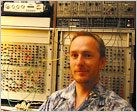
Kent Sparling is a visual and recording artist living on the Northern California coast. He was born in San Francisco in 1966, and began composing at the piano after having been asked to leave his elementary school orchestra for inventing harmony counter-melodies on his saxophone. He formed the pop band Eyeland in 1983, acting as singer-songwriter, keyboardist, and co-producer, and the group became popular over the next decade with their cassettes, live performances and radio airplay in the Bay Area.
In 1985 Sparling began composing experimental music, creating longform works of up to 45 minutes, employing the classic musique concrète methods of manipulation and montage. With the use of electronic devices and electro-mechanical constructions such as oil drum reverbs and modified speakers, he alters the sonic character of a broad range of recorded sounds, from environmental noises, raw electronic sound and radio reception, to more traditional ‘musical’ sounds created by familiar instruments. He has created several ‘system music’ compositions, where, as the composer, he sets up mechanical and electronic possibilities for sound creation, and then sets the ‘system’ in motion, allowing it to create the ‘musical result’. The pieces created in this manner are recorded ‘live’, and represent a kind of improvisation, where sound character becomes the principal means of expressing the emotional content of the work. Recently he has been exploring the world of micro-sounds which he calls ‘picophonics’, vibrations too small to move enough air to be perceived by the ‘naked ear’, wherein he has found a whole new palette of emotive sounds. He has six CD releases of experimental electro-acoustic music to his name: 1997’s ‘Route Canal Diary’, 2000’s ‘Under New Manna’ and ‘Camphor and Caraway’, ‘Leaf Spring’ from 2003, and ‘Evening Air, Freeway Birds, No Wind Birds’ and ‘Indian King’, both released in 2006. His music was included in the soundtrack to the Canadian Nation Film Board documentary ‘In the Flesh’, and he has composed original scores for Wayne Wang’s ‘Princess of Nebraska’, ‘Seven Fallen Objects’ by AD Liano, and Eduardo Sanchez’s ‘Seventh Moon’ with Antonio Cora. He has just completed the score for Frazer Bradshaw’s ‘Everything Strange and New’, in collaboration with Daniel Plonsey.
the full feature is available for download as a pdf.
DATAMASKIN

