
Roland A-01 Quick Start 01 “Installation on K-25m”
A-01 Controller+Generator
Powerful pocket module with MIDI/analog connectivity and sound engine.
These Quick Start Videos contain step-by-step instructions that will quickly introduce you to its major features.
- The A-01 is the same size as Roland’s Boutique synths, and can dock in the Boutique K-25m keyboard.
- It’s a MIDI controller that works over full-size MIDI & USB.
- It’s also a wireless Bluetooth LE controller.
- It’s a unique 8-bit virtual analog synthesizer.
- It’s also a step sequencer.
- It’s got CV/Gate connectors, so it can control analog & modular gear.
For more info on the A-01, see the Roland site.
Roland A-01 MIDI Controller & 8-Bit Synthesizer
At the 2016 NAMM Show, held in Anaheim, CA Jan 21-24, Roland introduced the A-01 – a unique mobile MIDI controller and 8-bit synthesizer.
Here’s an overview of the Roland A-01 from the NAMM Show floor.
More cool stuff from Roland – A-01 Controller + Generator
Take control of your musical setup with the A-01 Controller and Generator. Connect your gear using standard MIDI, hook up to your computer-based DAW with USB MIDI or play music apps on tablets and smartphones via Bluetooth. You can also drive vintage synthesizers and modular synths via the CV/Gate outputs and step-sequencer. Along with the knob and ribbon controllers, the A-01 also includes an 8-bit monophonic synth engine for creating distinctive synth tones.
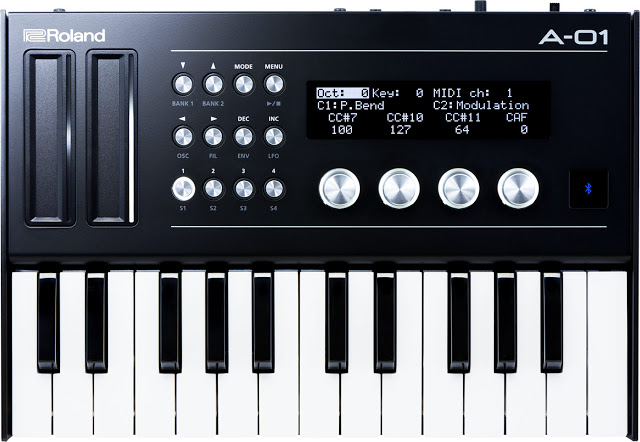
A controller is a vital part of any music production setup, but choosing the right one can be a dilemma. You want a unit with the flexibility to drive all your MIDI and CV/GATE-equipped analog gear. You need to connect to the huge range of music-making apps for tablets and smartphones. And as a modern musician moving from gig to gig, you need to be able to work on projects whenever inspiration strikes. The Roland A-01 ticks all of your boxes—whether you want to warm up backstage, control every element of an elaborate home studio setup, or create original music from scratch, this flexible controller and sound generator is your one-stop solution.
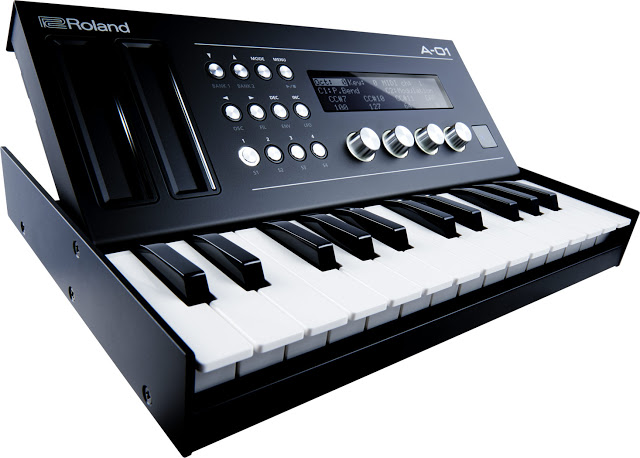
SPECIFICATIONS
Memory
Controller Mode: 16 patches (4 patches x 4 banks)
Synth Mode: 16 tones (8 tones x 2 banks)
Seq Mode: 16 patterns (8 patterns x 2banks)
Connectors
PHONES jack: Stereo miniature phone type
CV OUT jack: Stereo miniature phone type
GATE OUT jack: Stereo miniature phone type
MIDI (IN, OUT) connectors
USB port: MicroB type (MIDI)
Bluetooth
Bluetooth LE
Power Supply
Rechargeable Ni-MH battery (AA, HR6) x 4
Alkaline battery (AA, LR6) x 4
USB bus power
Current Draw
500 mA (USB bus power)
Expected battery life under continuous use:Rechargeable Ni-MH battery: Approx. 12 hours
* This can vary depending on the specifications of the batteries, capacity of the batteries, and the conditions of use.
Accessories
Owner’s Manual
Leaflet “USING THE UNIT SAFELY”
Alkaline battery (AA, LR6) x 4
Options (sold separately)
Keyboard unit: K-25m
SIZE AND WEIGHT
Width300 mm
11-13/16 inchesDepth128 mm
5-1/16 inchesHeight46 mm
1-13/16 inchesWeight950 g
2 lbs 2 oz”
NAMM: Roland has debuted the SYSTEM-500 Complete Set

Roland has debuted the SYSTEM-500 Complete Set. This fully analog modular synthesizer is inspired by the SYSTEM-700 and SYSTEM-100M. Made for Eurorack format, the SYSTEM-500 Compete Set is a comprehensive system with multiple oscillators, filters and effects in a versatile, custom case with top-quality patch cables.
The Roland SYSTEM-700 and SYSTEM-100M modular synthesizers are sought after by synthesizer enthusiasts to this day. Used by pioneering musicians on numerous recordings throughout the seventies and eighties, they combined the best of Roland’s analog synthesizer technology in modular instruments. With the SYSTEM-500 Complete Set, it’s now possible to own a modern version of these classics.
Roland SYSTEM-500 Complete Set Features:
» Complete analog modular synthesizer with multiple oscillators, filters and effects
» Vintage Roland analog sound in a quality modern instrument
» Wood and metal case is portable, stackable and can sit flat or angled
» 512 module with two voltage controlled oscillators with saw, sine and square waves
» 521 module with two voltage controlled filters with selectable high-pass filters
» 530 module with two voltage controlled amplifiers each with multiple CV inputs
» 540 module with two ADSR envelopes and invertible LFO with five waveform types
» 572 module with classic phase shifter, delay, gate delay and invertible LFO
» Numerous CV connections for an array of modulation possibilities
» Built in USA
Designed and built in the U.S., the SYSTEM-500 Complete Set is made to exacting standards, with quality components and attention to detail. It claims to deliver the classic character and playability of a vintage Roland modular synth — with all the advantages of a modern instrument. The Eurorack format also makes it easy to expand or neatly integrate into an existing modular setup. Its versatile wood and metal case can sit flat or tilt, providing plenty of clean, stable power, and blending in with the classic looks of the SYSTEM-500 modules.
The SYSTEM-500 Complete Set includes: the 512 module with two voltage controlled oscillators featuring saw, sine and square waves; the 521 module with two voltage controlled filters featuring selectable high-pass filters; the 530 module with two voltage controlled amplifiers, each featuring multiple CV inputs; the 540 module with two ADSR envelopes and invertible LFO; and the 572 module with classic phase shifter, delay, gate delay and LFO. With two VCOs, two VCFs, two VCAs, two ADSR envelopes, two dedicated LFO sections, and a powerful effects module, the SYSTEM-500 Complete Set is flexible and capable right out of the box. An array of CV/Gate connections and well-placed controls make it an ideal centerpiece for any modular setup.
No pricing or availability has been officially announced.
Roland TR-808 vs Korg Volca Beats
Background video description:
I noticed there was no TR-808 / Volca Beats comparison on YouTube, so I thought of posting one for today’s daily video. I know, I know… it’s sort of a silly endeavor and also a bit unfair to compare a mega-classic that these days goes for $3K to a super-cute little $150 box… but I think both machines are great and each has their own unique character! I have to say, I am impressed by the whole Volca line (I recently got all four models and will be posting videos of the others soon). The bass drum on the Volca Beats is amazing, by the way!
Roland TR-707 – the three factory demo tracks
Roland TR-707 – the three factory demo tracks
Experimentation 8 (Moog Mother 32,Yamaha CS,Roland Boutique,TB-3)
An actual video session this time. Mostly trying out new instruments(Moog Mother 32, and the Yamaha CS), added in with the last stuff we were working on. I’ll try to get a mid-week semi-modular video up too. Thanks for watching and listening!
R-8 MkII – new free sample pack made with the classic Roland R-8 MkII drum machine
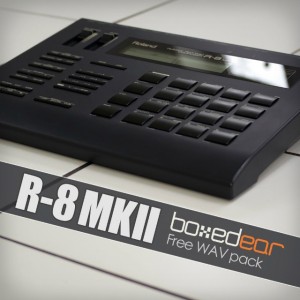
Boxed Ear has announced the release of R-8 MkII, a free sample pack made with the classic Roland R-8 MkII drum machine.
A spokesperson said, “You can hear the Roland R-8 on early 90s tracks by Aphex Twin and Autechre and it helped to define the IDM genre during that time. It’s characterised by a clean sound with plenty of bottom end and is still a favourite in many studios today. The original R-8 focussed on acoustic sounds, but the popularity of the SN-R8-04 Electronic and SN-R8-10 Dance sound cards, which contained TR-808, TR-909 and CR-78 samples, prompted Roland to release the MkII which had most of those sounds already built in. Whilst the sounds don’t sound exactly like a real 909/808/78, they do have a power and usability all of their own.
This isn’t an exhaustive sampling of the R-8, but instead we chose to focus on the electronic sounds that made this drum machine popular with artists such as Aphex Twin and Autechre. And to add a bit more charm, we sampled it though our favourite UA 1176 compressor.”
Roland Juno-60 – the 56 classic factory patches
The 56 classic factory patches of the Roland Juno-60 (1982)
Ten classic Roland TR-909 patterns
Ten classic Roland TR-909 patterns
DATAMASKIN

