
The second Fairlight preview – CMI-30A sampling
In this second video preview of the new Fairlight CMI-30A, Peter Vogel demonstrates the sampling page. This video includes what is probably the most expensive method of generatng a sawtooth wave known to mankind.
A bit of trivia: the sounds sampled in the making of this demo are used in the sting at the start and end of the video. Listen on big speakers.
The new CMI is unique in that it produces the classic “Fairlight sound” that defined music of the eighties as well as the modern Fairlight sound — that of uncompromising signal purity.
Both these extremes are made possible by the extraordinary processing power of the Crystal Core engine which lies at the heart of the system.
The Crystal Core media processor(CC-1) was developed by Fairlight.AU as the engine for its range of top-end digital audio workstations. The CC-1 uses FPGA (field-programmable gate array) to achieve performance far in excess of what can be achieved using even the fastest digital signal processor of conventional design.
Pure synth fans in action: Mail Order Monsters – Fairlight
Mail Order Monsters performing the song Fairlight, live in studio at WKTV.
“We play exclusively through the ‘SID’ chip, taken directly from Commodore 64 computers and placed in a new hand built circuitry that allows greater flexibility, and compatibility with modern MIDI equipment. We utilize over 20 chips in our performances.”
http://www.mailordermonsters64.com
First peek at the Fairlight CMI-30A
First peek at the CMI-30A. Peter Vogel presents a first look at the 30th Anniversary edition of the classic Fairlight sampler.
The Fairlight CMI-30A features the retro look of the original, but offers current technology to more much more power than was possible in the 80’s.
See the links below for more information.
Pricing and Availability
The Fairlight CMI-30A is priced at A$20,000 (Australian dollars) plus GST if delivered within Australia. A 50% deposit is required as part of the agreement. Deliver is expected to be within 90 days.
Links:
Fairlight for a reason ;-)
Introducing the new Fairlight XXL refill for Reason 5.
Bitley has introduced Fairlight CMI Legacy XXL for Reason 5 or Reason 5 & Record 1.5. It offers about 3,000 individual patches..
Features:
- All sounds from II+ – demos and info here
- 3,04 Gb of files unpacked
- About 3,000 patches for all Reason instruments
The Fairlight CMI Legacy XXL Refill is priced at 100€ (100 Euros).
Fairlight Demo “TRON” at CRAS
Presentation at The Conservatory of Recording Arts and Sciences with Jeff Harris demonstrating the Fairlight CMI as used on the movie TRON.
The Fairlight CMI was a development of an earlier synthesizer called the Qasar M8, an attempt to create sound by modeling all of the parameters of a waveform in real time. Unfortunately, this was beyond the available processing power of the day, and the results were disappointing. In an attempt to make something of it, Vogel and Ryrie decided to see what it would do with a naturally recorded sound wave as a starting point. To their surprise the effect was remarkable, and the digital sampler was born. In casting about for a name, Ryrie and Vogel settled upon Fairlight, the name of a hydrofoil (named in turn after Fairlight, New South Wales) that sped each day past Ryrie’s grandmother’s large house in Point Piper, New South Wales, underneath which Ryrie had a workroom.
By 1979, the Fairlight CMI Series I was being demonstrated in Australia, the UK and the US, the latter country covered by Bruce Springsteen’s concert sound engineer Bruce Jackson, once Ryrie’s neighbour in Point Piper. At this time the sound quality was not quite up to professional standards, having only 24 kHz sampling, and it was not until the Series II of 1982 that this was rectified. In 1983 MIDI was added with the Series IIx, and in 1985 support for full CD quality sampling (16 bit/44.1 kHz) was available with the Series III.
The Fairlight ran its own operating system known as QDOS (a modified version of the Motorola MDOS operating system) and had a menu-driven GUI. The basic system used a number of Motorola 6800 processors, with separate cards dealing with specific parts of the system, such as the display drive and the keyboard interface. The main device for interacting with the machine apart from the keyboard was a light pen, which could be used to select options presented on a monochrome green-screen.
Fairlight CMI sound EFX for “TRON”
Fairlight CMI used on the movie “TRON”
BBC Tomorrow’s World Fairlight CMI from 1980 Kieran Prendiville
Not seen this before on YouTube so I’ve put it up for the Fairlight video collectors out there.
Kieran Prendiville bashes out a tune on a new synthesiser that can sample real sounds! Revolutionary for 1980 and now so main stream. One of TW’s hit predictions.
He’s wrong when he says the Fairlight (well he never actually mentions it’s a Fairlight) “mathematically works out” the sound. It doesn’t synthesise the sound which is the impression Kieran Prendiville is giving. He’s also wrong when he says “those aren’t recordings”. They are of course, sounds sampled into memory as we all know and love.
Although the tape based Mellotron from 15 years or so earlier than this was used to play back sound effects 😉
I’m not so keen on his mugging to camera though. Probably a struggling actor coming out of him. Maybe that’s why he wrote “Ballykissangel” 😀
Fairlight apps compared
A brief comparison of the features of the two versions of the Fairlight App for iPhone and iPad, Fairlight Player and Fairlight Pro. These apps canb be bought separately from the App store, or the Player version can be upgraded to Pro via an in-app purchase. Cost of the Player plus Pro upgrade is the same as buying the Pro in the first place, and functionality of the Player once upgraded is identical to the Pro.
For full details see: http://www.fairlightinstruments.com.au/ios
Fairlight – standard vs pro version
Perhaps as a reaction of our review on the regular version of the Fairlight app, this video has turned up 
Review: The Fairlight app, regular version
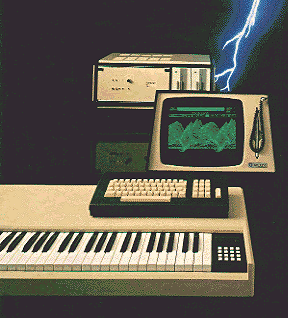
Anyone being casually interested in making synthesizer based music in the 80s have probably dreamed of owning and using a Fairlight. A complete workstation with sampling and synthesizing sonic capabilities, hugh sound library, muliti timbral, pattern and song sequencing, total recall, all in one computer and controlled by a light pen resembling of a miniature lightsaber. Only issue was that it costed as much as a house. A nice house. You could even have to add the garage. And a car.
Now fast forward 30 years and you can get all those features and capabilies for close to free if you happen to have a computer, a midi keyboard and Internet access. That’s progress for you. Still, the concept defined by the Fairlight inventors still applies apart from the lightsaber… the all integrated computer based workstation with a huge sound library still rules.
Last week the empire striked back and released the first Fairlight software only product in shape of an IOS app. It’s available in the Apple App Store for iPhone and iPad for 9.99USD, or in whatever currency you have. But unlike many other app developers that have a free or light version AND a full version in the App store, Fairlight have a only one version in the store. The uppgrade to the Pro version (as they call it) is only available from within the App itself. And the price for the Pro version is 39USD. It’s a bit of an easter egg approach.
The regular version gives you alot of vintage feel in terms of whirling floppy disc noise, load waiting time and 500 accurate sounds from the original Fairlight library including Orch 2 hits, Ahhhs and glass crash. Also the the original GUI using pages is used and fit’s like a glove in the IOS world. But from the original 20 pages the IOS app leaves you with 6 pages.
Once started you are confronted with a menu of 5 pages where one tells the history of the Fairlight. Head over to Wikipedia or Holmes page to get the full story though.
Page 2 and 3 is about loading sounds and combining them but as you can’t create or edit combinations (called instruments) page 3 is meaningless in the regular version. So what you can do is to browse though the library and load one sound at a time and then play it from the one octave keyboard. It’s here thing gets too limited, though. You get not only just one octave of keyboard to use, but it’s only from C to C. You can select which octave but is have to start with a C! This makes it hard to play just anything but tinkle little star. To load you own sounds you have to upgrade to the Pro version which I havn’t tried yet.
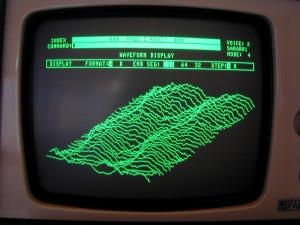
You do get the famous R page sequencer but you only have 2 demo songs to play – no edits, no save, no load. And the cool looking page D to inspect the waveform landscape is not only hard to use as you have to tilt the iPhone and keeping it still is kind of hard – but it’s kind of meaningless as you can’t load you own samples and you can’t loop the ones you get with the library. Looping is disabled. And the whole point of page D is to match the sample rate to the sound frequency to find good loop points.
Conclusion
The regular version of the Fairlight app I would call demo version. You can’t really use it in a musical context as it’s too limited. What you get is an app demonstrating the classic Fairlight library, however made with love and care it’s only a novelty app. Unless you are prepared to buy the pro version don’t expect to make any music with this app.
As I still feel a bit ripped off, I havn’t bought the Pro version but I guess I will once calmed down. What’s worring though is that although with the Pro version you can load your own samples via email or iTunes you cannot record them directly via the mic. Also the synthesizer side of the Fairlight CMI like drawing waveforms and harmonic profiles is not included in the Pro version either.
The history page in the app sais that “the app is as powerful as the first Fairlight CMI” but I really don’t agree. This is more like the marketing deparments ploy trying to find customers for the new CMI-30A. And the CMI-30A cost you ….like a house, a nice house. And the garage. And a car. Now, where’s my lightsaber!
DATAMASKIN

