
Straw demo
Nice patch
On Saturday, I folded multiple loads of laundry, cleaned the bathroom, and played closet tetris in order to claim some space to put the air conditioner I pulled from the window. Then I cleaned the top floor. Feeling pretty good about releasing a 512 version of press cafe the day before, I decided to tackle an idea I had for the monome involving FM synthesis. The horizontal axis is pitch and a modal pitch map can be quickly generated on any base note, or you can edit the pitch map arbitrarily. The vertical axis is a modulation parameter that can be routed simultaneously to several destinations. Patch editing is very gratifying as everything is live all the time, so you don’t have to re-trigger notes to hear the effect. This also opens the door to additional real time control. It is easily hackable. There are no polyphony/voice limitations. The downside is it isn’t light on the processor. This patch consumes 20% of one core on my core i7. I’m using some hacked in support for the powermate knob to quickly make some parameter changes to broaden the range of timbres demonstrated.
I finished the patch on Saturday night and resolved to make a video on Sunday. I had in mind something more musical for a demonstration, but I was losing sunlight, so this will have to do for now. I added reverb after the fact (Valhalla Shimmer), otherwise, you’re hearing the real-time output.
20 years ago, I wished for the ability to design a purpose-built synthesizer/instrument in a specific configuration, and use an adaptable, non-specific interface to control that synthesizer. Today this is possible. I wish I could spend every day making things like this.
On stage real-time synthesizer patching
Here’s the digest video of DenshiKaimen – ElectroSeaLevel – Modular Synthesizer Performance on 08062010 at uplink/factory Shibuya Tokyo Japan. Hideyuki eicheph Fukasawa versus Mr.Nobuhiko Nakayama on the stage of real-time synthesizer patching. It was a strange party ever.
Nakayama on the stage of real-time synthesizer patching
Promotion Video to come on 08062010 at uplink/factory Shibuya Tokyo Japan. Hideyuki eicheph Fukasawa versus Mr.Nobuhiko Nakayama on the stage of real-time synthesizer patching. It will be a strange party ever.
8月6日(金)「電子海面01」が渋谷UPLINKにて開催!出演、中山信彦、深澤秀行 http://www.uplink.co.jp/factory/log/0…
Bank of vocal-oriented patches
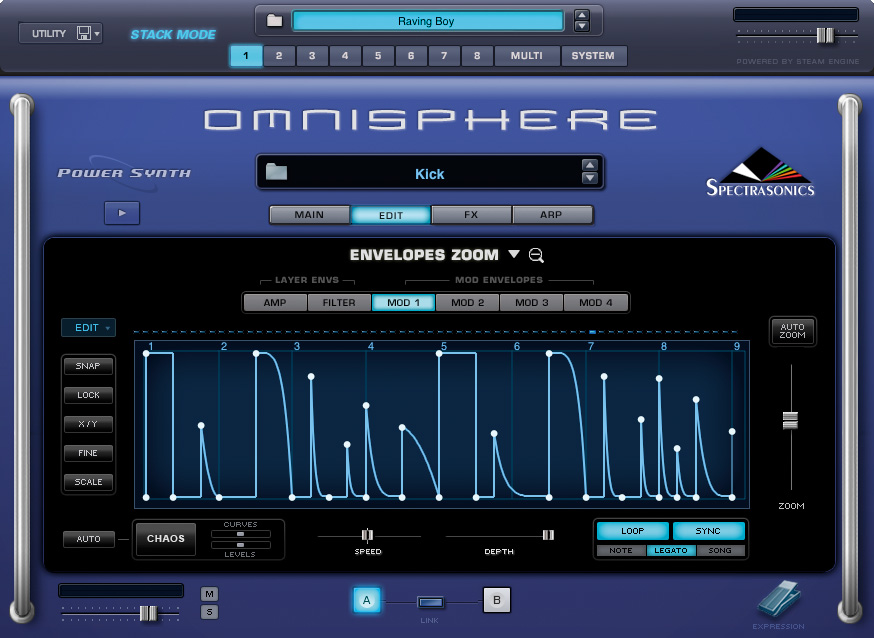
KVR user aMUSEd has uploaded a bank of vocal-oriented patches for Spectrasonic’s Omnisphere. The patches are free, but donations are accepted, so if you get some good use out of these patches, consider throwing some ducats in his direction.
New patch library for the Arturia MiniMOOG
Kid Nepro has introduced the Arturia Minimoog V Collection, a new patch library for the Arturia Minimoog software synthesizer:
Kid Nepro purchased his first original Minimoog back in the mid 80’s and has been using them ever since. We still have one in our studio which continues to get lots of use when we are looking for that certain sound – that only the Moog can provide. So for us, programming a Minimoog is like riding a bicycle – you never forget how to do it! The collection of sounds that we have programmed for the Arturia V collection is done with expert care from someone who knows the Minimoog very well – so you can be sure that the sounds are well crafted and sound great.
The Minimoog V patch library is available for download for $25.
|
The original Minimoog was released in 1970. By the time it was discontinued in 1981, about 13,000 were produced. One of the true landmark synthesizers produced though the 70’s – it’s compact design, great sound and easy to use interface made it popular with both Rock & Jazz keyboard players ranging from Keith Emerson to Chick Corea. The Minimoog was designed to include the most important parts of a modular synthesizer in a small package, without the need for patch cords. The original Minimoog is monophonic and its three-oscillator design gave it its famous fat sound. The Minimoog Model D adapted some of the circuitry (such as the filter section) from earlier modular instruments, but designed other circuitry (such as the oscillators and contour generators) from scratch. You could not save patches in it’s internal memory – so just one sound at a time could be stored and played. Yeah, that’s the way things were back then! Original Minimoogs did not have midi, but you could get several midi retro kits which could be installed to give you basic midi features. Kenton makes a good own which we have installed on our vintage Minimoog.
Kid Nepro purchased his first original Minimoog back in the mid 80’s and has been using them ever since. We still have one in our studio which continues to get lots of use when we are looking for that certain sound – that only the Moog can provide. So for us, programming a Minimoog is like riding a bicycle – you never forget how to do it! The collection of sounds that we have programmed for the Arturia V collection is done with expert care from someone who knows the Minimoog very well – so you can be sure that the sounds are well crafted and sound great. Our Minimoog V Collection is available as a download via our free e-mail delivery. Just open the file in your Arturia software and your ready to roll! Pick the Mac or PC “patches” format when ordering online at our web site. Please contact us if you need any more info. |

DATAMASKIN

