
Ample Metal Eclipse II (AME) – new virtual guitar instrument modeled on the ESP Eclipse I
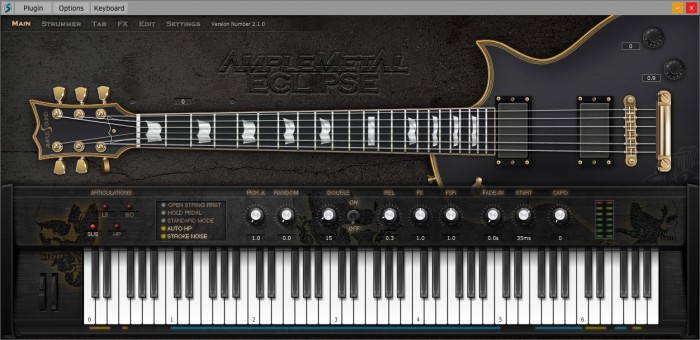
Ample Sound has announced the release of Ample Metal Eclipse II (AME), a virtual guitar instrument modeled on the ESP Eclipse I.
AME has a 3.5 GB sample library which is recorded each single fret. It features 8 articulations including Sustain, Palm Mute, Artificial Harmonic, Hammer On & Pull Off, Legato Slide, Slide in & out. The Legato articulations can be used to achieve legato notes of any duration, pitch and polyphony.
Ample Metal Eclipse II features
- Most widely used tuning (C G C F A D) in contemporary heavy music. Regular tuning can also be achieved by tuning up low C String.
- Strummer system specifically designed for heavy music. All chord presets and strum patterns have been remade for the context.
- Cycle+: When toggled on, sample cycles can reach up to 24 (default is 8), which significantly enhances repetitive notes in heavy music. No more bland and robotic ‘machine gun effect’.
- Automatic switch between Sustain, Palm Mute and Artificial Harmonic by velocity layers. No keyswitch is needed.
- Automatic stroke noise applied to solo mode, making metal riffs more realistic.
The Ample Metal Eclipse for Windows and Mac (VST/AU/RTAS/AAX) is available for the introductory price of $99 USD until October 12th, 2015 (regular $119 USD).
7 Minutes with an Ipad Synth – TC Performer
TC Performer is a free app with in-app purchase for full presets
https://geo.itunes.apple.com/lu/app/t…
Explore unreal synthesis with the most unique performance control on iOS! TC-Performer presents a multi-touch performance environment unlike any other synthesizer. Simply touch the screen; there are no buttons, keys, or sliders to hit. The sounds are generated entirely by your touch movements.
Each patch has a unique method of control. Pull, tap, drag, twist, and stretch your touches on the screen. There is no wrong way to play! Every instrument is a new landscape of sound creation. Pads, leads, effects, and indescribable oddities await.
New experimental production from ::vtol:: silk
The installation is tracking the real time changes in the market activities related to cryptocurrencies Bitcoin and Litecoin – independent and uncontrolled by any state peer-to-peer payment systems. Constantly changing currency rate of of Bitcoin against major world currencies is influencing the strain of strings in installation and the way the picks are hitting them. The robotic system of the artwork is directed by a computer algorithm: influenced by dynamic changes of data, the installation sounds like a complex sound instrument.
Technically, the installation consists of two poles of 2 meters height. Each stand sprouts 5 diagonal strings which correspond to 5 currencies (US dollar, Yuan, Euro, Canadian dollar and Russian ruble). These strings are pulled on special automatic tuners moved by stepper motors directed by computer algorithm. Each motor features high precision of movement, which allows very precise tuning of string even with quite insignificant changes of parameters.
more info – vtol.cc/filter/works/silk
the project is co-commissioned by Laboratoria Art&Science Space and Lykke AG
Moscow, 2015
Radio Music in the Clouds (Mutable Instruments)
First experiment with the Mutable Instruments Clouds.
The Music Thing Radio Music is patched into the Clouds module via a CGS/Serge 1973 VCF. The Radio Music is patched almost exactly like my previous video, but I am also modulating the Station input. The output of the Clouds is set to 100% wet and I am modulating the Reverb amount via the Ian Fritz Chaos module.
The bass drops are an Electric Druid VCDO. The FM type sound is two Yusynth VCO’s inter-modulating each other and feed into a MFOS EchoRockit.
Podcast: Autechre – a very impressive four-hour mix of influences
Very few musical acts achieve the levels of unanimous acclaim of Autechre. The English duo of Rob Brown and Sean Booth are not an act you simply like; they are an act you love, fawn over and dream about. They’ve got themselves here over the course of the last 28 years, and have done so by amassing a discography that’s about as perfect, influential and accomplished as could ever be possible. A key Warp label act from day one, they have released tens of albums, well over a ten EPs and have featured on a dizzying amount of essential compilations, mixes and remixes in that time. Without their contribution to the IDM canon, its fair to say the modern musical landscape would look very different.
Rhythmic but experimental, absorbing yet abstract, cerebral and psychedelic, their ever evolving output is up there with the likes of fellow luminaries Boards of Canada and Aphex Twin as some of the most important in all of electronic music. As well as being fine craftsmen in the studio, Autechre are also revered live performers who really manage to conjure up captivating and otherworldly soundtracks that marry heavy bass with ethereal melody. The pair themselves do not care for genre, but suffice it to say that they have mastered everything from hardcore to ambient to glitch and plenty of indescribables in between.
When the pair recently laid down an impressive set at Dekmantel Festival, we asked if they might be up for a doing an early inspiration mix, whereby they put together a collection of the sort of electro and hip hop tracks that turned them on as youths. At first they hesitated, pointing out that “we don’t do strictly retro stuff, it’s too corny.” But alas, a few days later, a huge file landed in our inbox… That file is a 4 hour and 18 minute mix that basically encapsulates not just Autechre’s own influences, but also acts as a fine anthology of the greatest electro sounds of all time. Every sub genre imaginable gets touched upon along the way, with nods to forefathers like Kraftwerk, killer cuts from Man Parrish, classics from Newcleus and retro gold from the likes of The Beat Club. It is a thrilling ride and a truly rare treat that reminds us just why we love Autechre, as well as shining a light on a vast genre that often pays second fiddle to house and techno.
Checked out SolarBeat yet?
http://www.whitevinyldesign.com/solarbeat/
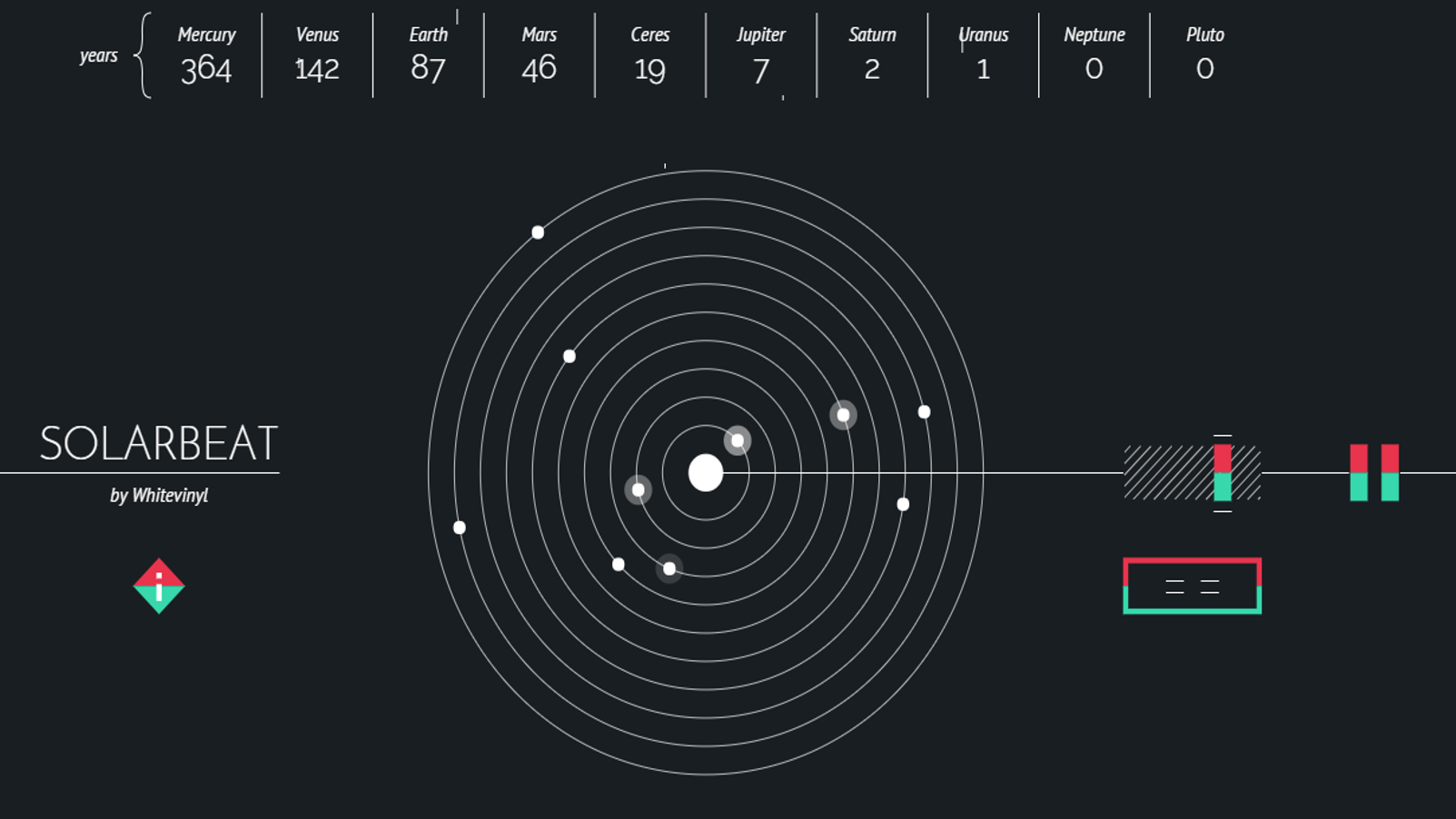
Designer Luke Twyman’s solar system simulation doesn’t have intricate graphics or a load of features to explore, but it can do what many others can’t: sing. Called SolarBeat, it plays a music box-like tune while the planets — represented by dots — revolve around the sun.
Monday morning:::::Human League Boys and Girls
“Boys and Girls” is a song by the British synthpop group The Human League. It was released as a single in the UK in February 1981 and peaked at number 48 in the UK Singles Charts. It was written by lead singer Philip Oakey and the band’s visual director / keyboard player Philip Adrian Wright.
It was the first single released by the new Human League line up of Oakey, Wright together with new teenage dancers Susanne Sulley (now called Susan Ann Sulley) and Joanne Catherall. The new line up formed after the acrimonious departure of Martyn Ware and Ian Craig Marsh from the band four months earlier.
By late 1980 Oakey was deeply in debt to Virgin Records so both he and the label were keen that he release a single to start clearing that debt as early in 1981 as possible.
“Boys and Girls” was a song that had been used on the November 1980 European tour. On return from the tour it was recorded quickly and rushed out by Virgin Records in late February 1981.
At the time it was remarked on that Sulley and Catherall were missing from the song, after the mythology that had been started in the media about their recent recruitment to the band from the Crazy Daisy Nightclub four months earlier. This was because they had both returned to school full-time and “Boys and Girls” was originally written without any female vocals. Although both Sulley and Catherall do feature on the record sleeve artwork and publicity material.
MacBeth: Experiment – Elements Sept 2015
Background video description:
A facebook friend suggested that it might be a good idea to record what I’ve had playing automatically in the background while I work on Elements synths that are going out. Now I actually play them on this video- not so automatic! For those following this -so far 16 units released, by the end of this week- 40- consult Analogue Haven or Schneidersladen. This recording done direct to my Canon 600D camera….audio is not bad….could be better….just a quick demo!
You only need one synthesizer and one drum machine to make great EBM
Electronic Body Music – The Basics. (Bass Station 2 and Roland TR8)
You only need one synthesizer and one drum machine to make great EBM. Enjoy!
Hidenori Matsuoka released Guitar Kit 6
Hidenori Matsuoka released Guitar Kit 6, a major new version of the guitar chord form tool and scale library app for iOS.
This update includes major changes.
Chart View allows you to view more than one chord form. You can use Chart as chord forms list in specific song. And also you can use chord progression for song (Each chord form’s beat counts are flexible). You can export Chart as Standard MIDI File.
Changes in v6.0:
- Added Chart View in Favorites Tab. Chart View allows you to view more than one chord and play automatically.
- You can export SMF (Standard MIDI File) to Mail, Dropbox and others (Chord Name will be export as Marker). Already tested by importing to Logic Pro X on Mac. If you export SMF to Dropbox, you need to install Dropbox app. And Guitar Kit doesn’t recommend exporting to Evernote.
- You can import SMF. Official support of this feature is only SMF made by Guitar Kit and future version of Piano Kit and future version of Chord NOTE.
- You are able to use 3 buttons (Favorites, Add Chart, Duplicate) now on all Chord Form cells.
- Guitar Kit don’t stop other background app’s music no more.
- Remove iTunes File Sharing feature, enabling the export and import of data instead. Data includes Original Chord Forms, Favorite Chord Forms, Chart Chord Forms and etc. Destination is Mail and Dropbox and others.
- Beats of one bar can now be represented up to 99. And if you press and hold the button, you can change beat count continuously.
- Fixed other minor issues.
DATAMASKIN

