
First ever gig: Kraftwerk -1970- Soester Konzert, WDR Archive
In 1970 Kraftwerk played for the very first time live, and that was at Berlin’s techno club Tresor. The rare recording which was hidden in the WDR archives is up on YouTube
Kraftwerk – Live In Soest 1970
Tracklist:
01. Vom Himmel Hoch
02. Ruckzuck
03. Stratovarius
04. Megaherz
Musicians:
Ralf Hutter — organ, tubon
Florian Schneider-Esleben — flute, violin, percussion
Klaus Dinger — drums
A Kraftwerk alapítói, Ralf Hütter és Florian Schneider-Esleben a remschiedi művészeti akadémián találkoztak először. Hütter-orgonán, Schneider pedig fafúvóson játszott, s improvizált zenét tanultak. 1968-ban megalapították az Organisation nevű együttest, amely a Kraftwerk elődének tekinthető. 1969-ben adták ki a Tone Float című albumot, Fred Monics (dob), Butch Hauf (basszus) és Basil Hammoud (vokál) közreműködésével. Ez az album semmiben sem hasonlít a későbbi kraftwerkes hangzásra, a ’60-as évek kísérletező rock-zenéje volt, a krautrock egy tipikus példája.
1970-ben volt a Kraftwerk alapító éve, bár akkor még avantgarde bandának indult, a hangzásuk még mindig kizárólag kézzel készült. Darabjaikban, mint a „Ruckzuck” vagy a „Stratovarius” torz hangú fuvolával és Hammond orgonával kísérleteztek.
Gondoljunk bele; 1970-et írunk, az elektronikus, szintetikus hangzás ekkor születik.
A Kraftwerk bátran alkalmazta a kisérleti hangszereit és erre a német ifjúság technokrata beállítottságával rendkívül fogékony volt.
De a monoton ritmust és hűvös hangszerelés előrevetítette, hogy milyen irányban fog a hangzás fejlődni néhány évvel később.
Ezen az élő Rockpalast felvételen – 1970 -es Soesti koncerten (Elektromos Erőmű, Soestben), látható először
teljes hosszában a Kraftwerk zenekar:
Ralf Hütter – billentyűk
Klaus Dinger – dob,
Florian Schneider-Esleben – fuvola, vibrafon.
Páran a megjelentek közül döbbent arccal távoztak hátul a kijáraton. Ez a felvétel abszolút ritkaság és nyalánkság a progresszív zenei rajongók számára.
pre- Acid Techno (Musical Genre)
– – – – – – – –
thx – RockPalast team !
Navy – new channel strip based on legendary British preamps and console, with EQ and filters

Acustica Audio has announced the release of Navy, a classic channel strip based on legendary British preamps and console, with EQ and filters, all sampled using Acustica’s revolutionary Nebula technology and presented in a beautiful Aqua interface.
What sets Navy apart is of course the sound which sets a new level of quality for emulations of these classic units. But that is not all Navy also provides a more comprehensive selection of mix tools featuring variations of the class A input preamps (P73 and P81), several British console output amplifier stages, and a 4 band EQ with additional high and low pass filters. This makes Navy a powerful mix tool which can replace standard console, EQ and filter plugins and bestow the Nebula quality sound to your audio in one instance, all at a new level of efficiency with Core 7.
Navy is the first plugin to natively exploit the new Core7 engine, a revolutionary multithreading technology by Acustica. It is based on a fractal approach to partitioned convolution, and this allows for optimised performance and maximises the use of your system resources. The plugin comes in a standard version which allows high instance counts almost a 20% increase from the previous highly optimised Core6, and a new zero latency version possible with the efficiency of Core7.
Navy has input AND output amplifiers three options for each plus a bypass. This gives a broad palette of options to choose to add colour and saturation to your audio. The input options are made out of the P73 and P81 units including a combined program. The outputs are made from sampling various output points of the console, each of the three options has from one to three transformers in the audio path providing differing musical harmonics. The level hitting these amplifier stages and thus the amount of colour introduced can be controlled by the plugin input ‘trim’ control which drives the unit but autoadjusts the input and output levels.
Navy features a 4 band EQ with Low, Lowmid, Highmid and High EQ bands and a selection of musical frequency points as per the original hardware. The Low and High band can be a shelf or peak, and a broad or sharper Q for mid peak bands.
Last but not least the filters of course sampled in Nebula quality, which elegantly control your audio signal. A high and low pass with five frequencies each can be switched in alongside the 4 EQ bands to complete a versatile and effective tone shaper.
Navy for Windows and Mac (VST/AU/AAX) is available for purchase at a 10% launch discount for 99 EUR. You can also win a copy at the Acustica Navy Contest.
Moog Mother 32 Sound Overview
Sound demo of Moog Mother-32 synthesizer. Full review: https://ask.audio/articles/review-moo…
OMG JAPAN: Rare & Experimental Japanese Pop (1980 – 1989)
A special mixtape courtesy of Listen To This!:
www.listentothis.info
Tracklisting / Liner Notes:
www.self-titledmag.com/2015/10/09/li…panese-music/
KORG volca 16 keys / performed by Seth
Seth are Tadahiko Sakamaki & Tatsuya Takahashi (KORG)
—
volca keys 16台を、開発者であるSethことコルグの坂巻匡彦と高橋達也が即興パフォーマンス
This video illustrates an improvisational performance by “Seth” featuring 16 Volca Keys synced together. “Seth” is the name of the musical collective which features Mr. Tadahiko Sakamaki (KORG Product Planner) and Mr. Tatsuya Takahashi (KORG Engineer).
—
■リリース情報:
本楽曲にボーカルとして元恵比寿マスカッツ・山口愛実さんを加えた「16Keys / Seth featuring Manami Yamaguchi」を収録!
『電磁マシマCD2』が2014/4/27のM3より発売開始になります!
– 電磁マシマCD2:
http://www.detune.co.jp/denji_mashima…
– 山口愛実:
http://yamaguchimanami.cocolog-nifty….
– volca keys:
http://www.korg.com/products/dj/volca…
How To Compress Voice Recordings
In this tutorial, I’ll explain ration, threshold, attack time, release time, gain and I’ll give you some quick tips as to how to use voice compression to master voice recordings.
- If the compressor has a knee setting, turn this up to make the compression more subtle
- Avoid de-esser’s. This is a form of compression that reduces that harshness of sibilant S sounds in the voice. These are great for sung vocals, but sound unnatural on spoken word recordings
- In most situations you should apply the EQ cuts before the compressor and the EQ boosts after the compressor
- If you want to heavily compress a voice recording without making it sound too unnatural, use two or three compressors in series. This will sound better than using drastic settings on a single compressor
- If you can’t hear the difference between different attack and release times, bring the threshold down really low. This and release times, bring the threshold down really low. This will fully engage the compressor and you will be able to clearly hear any small changes that you make.
David Bowie set to release a new album
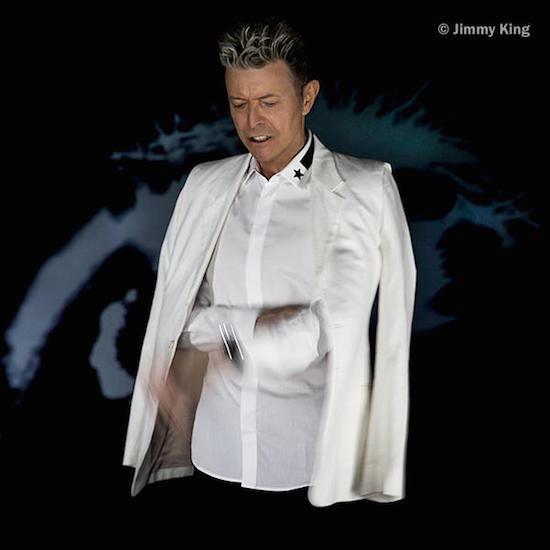
New album set for release on Bowie’s birthday in January; single arrives in November
Following rumours of a new album from David Bowie due in January, the news has now been confirmed on his website.
Blackstar will be Bowie’s 25th studio album following on from 2013’s The Next Day which marked Bowie’s first album of new material in 10 years. A statement on Bowie’s website says: “Contrary to inaccurate reporting on the sound and content of the album, only the following can be confirmed: The single will be released on November 20th and is not part of David’s theatre piece Lazarus. The album will be released on David’s birthday, January 8th 2016.”
Modular Monthly: Eurorack filter clones head-to-head
A rack of the clones! Want to get the sound of a classic synth in your Eurorack set-up? An authentic sounding filter is the ideal place to start. We examine the modular world’s best filter clones, from MS-20 emulations to 101-inspired modules, to see how they stack up head-to-head.
See more in issue 294 of Future Music: http://bit.ly/FMU294
Crystalline Plasma Radio Waves
Paul Normand Lebel captures a multi-platform modular soundscape performance, Crystalline Plasma Radio Waves. Lebel’s performance combines hardware synths & samplers, modular synth and touch-based sample mangling, details below:
I used two Barcus Berry contact microphones to sample this extremely simple music box I made from a 5 dollar player I bought on amazon. It comes with a hole punch to make your own chords and melodies. Each mic is processed through it’s on convolution reverb before being sampled via the Octatrack, Samplr and the WTPA2. The WTPA is being triggered by Medow Physics (controlled by the Monomer grid). This gets sent through the modular for processing via the 4ms SMR, Clouds and the Erbe Verb. I’m using a Korg Nano to mix the volumes of all 3 outputs (via the ESX 8CV) to create the textures. It took me hours to record this because I got so lost in all the textures the Medow Physics/WTPA/Modular were making.
Samplr is routed through the Cocoquantus and played live. The OT is running 6 chopped up versions of the sample which I’m constantly mixing with another Korg Nano.
LINKS:
Suscribe: https://www.youtube.com/subscription_…
Soundcloud Sonic Sketch Pad: https://soundcloud.com/a-box-in-the-sea
Instagram: http://instagram.com/paulnormandlebel
Street Photography: http://paulnormandlebel.com
AM102 Programmable Wavetable Oscillator for Reaktor Blocks
AM102 is a Block module for use with the Native Instruments’ Reaktor Blocks Modular System.
A Programmable Wavetable Oscillator, featuring a 16 Stages Wavetable with 3 selectable Playback Modes and 3 types of Output Curves, AM102 is a Shape Shifter yet to be rivalled.
For more information please visit:
amazingmachines.com.br
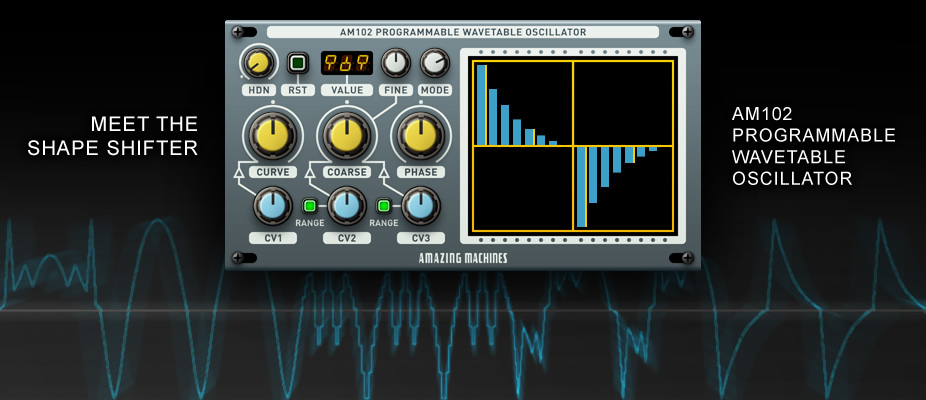
AM102 Programmable Wavetable Oscillator for Reaktor Blocks:
–
A Programmable Wavetable Oscillator, featuring a 16 Stages Wavetable with 3 selectable Playback Modes and 3 types of Output Curves, AM102 is a Shape Shifter yet to be rivalled.
–
Click and drag the faders in the Wavetable Display to draw your own Waveforms, use the CURVE and MODE controls to modify Waveforms even further, connect AM102 to a FREE AM103 Expander Module in order to control the Modulation Inputs of Stages 1, 5, 9 and 13.
–
AM102 also features a Pulse Waveform Output with a PWM Input, in Backward (BWD) and Forward (FWD) Playback Modes the Pulse Waveform is tuned 1 Octave below the Wavetable, serving as a Sub Oscillator or a Synchronization Source for other Oscillators.
–
Features:
–
– 1 Reaktor Block
– 16 Stages Programmable Wavetable
– Stages 1, 5, 9 and 13 with Dedicated CV Inputs
– Sync Hardness Control (HDN) with a Dedicated CV Input
– Reset On/Off Switch with Phase Control and Phase Modulation Input
– Wavetable Playback Mode Rotary Switch Selects between Backward, Alternating or Forward
– Curve Control Crossfades between Stepped, Linear and Exponential Output Curves
– Curve Modulation Input
– Coarse and Fine Tune Controls with 2 Independent CV Inputs
– CV2 and CV3 Range Switches to select between Semitones or Cents
– Additional Pulse Waveform Output
– PWM Input
DATAMASKIN

