
Sound Sculptures & Installations
Zimoun : Sound Sculptures & Installations
Compilation Video V2.8 / Last update: May 27, 2011
«The sound sculptures and installations of Zimoun are graceful, mechanized works of playful poetry, their structural simplicity opens like an industrial bloom to reveal a complex and intricate series of relationships, an ongoing interplay between the «artificial» and the «organic». It‘s an artistic research of simple and elegant systems to generate and study complex behaviors in sound and motion. Zimoun creates sound pieces from basic components, often using multiples of the same prepared mechanical elements to examine the creation and degeneration of patterns.» Tim Beck
«It is a poetic and humorous absurdity we find in Zimoun’s work, which opens up a wide, refreshing and enriching space for discoveries, associations and a multitude of approaches.» Nina Terry
«Zimoun is best compared to a watchmaker of a self-reproducing time constructing his own gauging station.» Radjo Monk
«The clean, elegant sound sculptures combine visual, sonic, and spatial elements in an organically balanced entirely artwork. Using simple and well- conceived mechanical systems, Zimouns‘s work transforms and activates the space.» Jury Prix Ars Electronica 2010
«Zimoun creates complex kinetic sound sculptures by arranging industrially produced parts according to seemingly simple rules. Using motors, wires, ventilators, etc.., he creates closed systems that develop their own behavior and rules similarly to artificial creatures. Once running, they are left to themselves and go through an indeterminable process of (de)generation.
These quasi autonomous creatures exist in an absolutely synthetic sphere of lifeless matter. However, within the precise, determinist systems creative categorioes suddenly reappear, such as deviation, refusal and transcience out of which complex patterns of behavior evolve.» Node10
«I perceive Zimoun’s work as a unique, playful, light-hearted, and utterly complex approach and examination of the present.» Tom Gray
«The components used in Zimoun’s work are simple, functional and raw, whereas only aesthetically high-level and purposefully chosen elements and materials are used in minimalist fashion. Through radical reduction, Zimoun creates works of art which allow for a plethora of associations without being pinned down to a specific direction. Radical abstraction functions rather like a code in the background of things, thus elegantly avoiding an insinuation of direct, concrete attribution. Thanks to the abundance of mechanical activity, the range of perception, possibilities and interpretations is wide open.» Amanda Neumann
«Indeed, one of the refreshing elements of this work is the immediacy with which one can understand the sound-making process, where each micro-event is present, visible, and concrete. Yet at the same time the resulting complexity of the total system, conjured before your eyes, defies any attempt to dissect it. You might find yourself feeling there is a «prime mover» at work behind the scenes, but in fact it is just the characteristic reaction of materials behaving together and in unison with the space of their activity. A magic of the real.» Xymara
«Minimal yet complex, monotonous yet varying constantly, these sound sculptures develop an uncanny strength.» Markus Spörndli
«Observing Zimoun’s work opens connections to nature and natural phenomena, physics, quantum mechanics, complexity, simplicity, vitality, individuality, evolvement and growth, but also to industrialization, robotics, mass production and social phenomena, to space, architecture, cosmic white noise, phantasms and highly enjoyable experiences popping up at any moment. Art is supposed to activate and focus our attention. Zimoun’s work seems to be a sweeping and beautiful example for this.» Anton Richter
«Zimoun’s primary instruments are entirely of his own making, each a large-scale installation of small mechanical devices — tables lined with whipping little bits of tubing, small sets of fetishistically situated mini- motors. They are architecturally precise and their beauty is forged by that precision. The meticulous engineering of Zimoun’s work is a set- up — not an end unto itself, but a staged step toward its end result, an orderly step enacted so as to let chaos flourish. His chaos takes place in close settings, in carefully defined spaces, in systems as thoroughly considered as a laboratory experiment. And the sound emited by them is not an after effect, or an afterthought. It’s a core principal of his practice.» Marc Weidenbaum
Euclidean Rhythms MIDI Pattern Demo
In this video:
This is a short demo of a Java application I wrote that generates polyrhythms based on a mathematical algorithm, also known as Euclidean rhythms. The application sends MIDI notes to connected soft- or hardware. In this demo MIDI is sent to four tracks in Ableton Live, where each track recives on a different MIDI channel.
The video serves as an illustration for an article about the software. Read it here:
http://www.hisschemoller.com/2011/euclidean-midi-patterns
Raul meets Wogglebug, Noisering, Doepfer A149-1 and 2, Borg and Dotcom
The “WoggleBug” is a random voltage generator with application in voltage controlled electronic music synthesizers. It is a continuation of “smooth” and “stepped” fluctuating random voltage sources pioneered by Don Buchla. Additional research was done by Serge Tcherepnin, who coined the terms “smooth” and “stepped”. The core of the circuit is based on the Buchla Model 265 “Source of Uncertainty” module. The design is expanded by using a CD4046 phase locked loop chip as a voltage buffer for Sallen-Key very low frequency smoothing filter. This adds a free linear VCO and ring modulator for your 40 cents. A novel method is used to get a 0-10 volt sawtooth out of the 4046. This is the source for the sample and hold, which makes the circuit “recursive” in some sense. The correlation control allows resampling of the S/H output and is another recursion level.
A new circuit, basically a phase locked loop which is tracking the “smooth” tone, is “kicked in the ass” every so often to cause the PLL to readjust the voltage for loop lock. The phase lock mechanism is a closed loop control system, and the lock voltage “rings” during readjustment, forming damped sinusoidal signals. At fast lock rates the ringing tones sound like plucked bass strings, at slow lock rates the voltages “woggle” and simulate string player vibrato.
Thanks to Don Buchla for inventing such a cool circuit, Dr. Mabuse for making RVGs so interesting, Bjorn Julin for the tip on the 4046 sawtooth output and Dan Slater for discussions of patching “lossy” FM telemetry systems, which lead to the “woggler” circuit.
An mp3 of two of the circuits feeding a mixer and Knight Kit spring reverb. WoggleBugDemo.mp3 (1.5M)
In this video:
excerpts from a compelling self playing patch. Recorded a good 3 hours worth. This is an excerpt.
Wogglebug VCO out mixed with Dotcom modular. Dotcom is modulated with random voltages from both the Wogglebug and the Doepfer A 149-1 and 2.
Eurorack with Doepfer Modules mixed and modfied with Doepfer A149-1 and 2, Borg Filter, Noise Ring , and Wogglebug.
Dr Who on the tesla coil
Last week we heard Lady Gaga being performed using the tesla coil, now it is time for Dr Who. The Dr Who theme is almost 50 years old – and yet it seems to have as many lives as the Doctor himself. Here, Austin, TX based Arc Attack performs the famous Ron Grainer theme (via Delia Derbyshire) on half a million volts of MIDI-controlled Tesla Coil lightning. The video is from Arc Attack’s performance at the 2011 San Mateo Maker Faire.
When Arc Attack isn’t doing covers of sci fi theme songs, they stay busy by doing electrocuting high school science teachers and otherwise educating students about the awesomeness of science.
Link:
Experimental – Minute of Listening
Minute of Listening is a creative learning project which encourages pupils and teachers to engage in 60 seconds of focused listening per day. The project is aimed at developing listening skills and introducing children to a wide range of new sounds. It is also anticipated that Minute of Listening will encourage creative thinking, class discussion and an inquisitive approach to aural experiences.
The project has emerged from Sound and Music’s aspiration to promote the joys and rewards of listening, and as a response to current debate around creativity and the importance of listening in a child’s learning and development.
Realtime sound visualisation made with custom software “Partitura”
Partitura is a custom software to generate realtime graphics aimed at visualising sound. The term “Partitura” (score) implies a connection with music, and this metaphor is the main focus of the project. Partitura aims to create a new system for translating sound into visual forms. Inspired by the studies of artists such as Kandinsky, Paul Klee, Oscar Fischinger and Norman McLaren, the images generated by Partitura are based on a precise and coherent system of relationships between various types of geometries. The main characteristic of this system is its horizontal linear structure, like that of a musical score. It is along this linear environment that the different classes of abstract elements are created and evolve over time according to the sound. Partitura creates endless ever-evolving abstract landscapes that can respond to musical structures, audio analysis and manual gestural inputs. It is an instrument that visualises sound with both the freedom of spontaneous personal interpretation/improvisation and at the same time maintaining the automations and triggers of mathematical precision.
Partitura defines a coherent language of its own for the creation of new contemporary abstractions. It is within this system that Partitura creates worlds that expand from a single dot to multiple galaxies, from minimalism to complexity, from rigid to elastic, from solid to liquid, from angular to smoothness, from tentative to boldness, from calm to agitation, from slow to fast, from desaturated to saturation, from dark to lightness, from predictable to unpredictability. Literally ‘everything’ and its opposite… just like a musical flow.
AMALGAM: remedy for the laptop performer blues
The problem I wished to attack, was the lack of visual communication in most of today’s electronic live acts. The artist usually stands on stage with a laptop, bobbing his head, and that’s it.
In acoustic music, even in the worst case scenario, there is at least some element of performance, since the instruments don’t play themselves. In electronic music, unfortunately they do.
So how can we bring the performance back into electronic music?
Short answer: I expanded the physical space into a virtual one, and brought back the physicality of the performance through clever (and magic) technology.
Long answer: Watch this video presentation.
Lady Gaga performed on Tesla Coils
Lady Gaga on a Tesla Coils is a real treat. Girl Talk (aka friend-of-the-blog Gregg Gillis) submitted his song “This Is the Remix” as part of an experiment by the Tesla Orchestra called the Open Spark Project. The venture asked musicians to hand over music that the orchestra could play on its giant Tesla coils.

Artists submitted MIDI files of their music, which the Tesla Orchestra then turned into spark tunes (many of them can be heard following “This Is the Remix” in the clip above). The orchestra performed the songs Saturday in Cleveland.
With the exception of Gillis’ track and a Bach song, all the music collected for the Open Spark Project was original and most of it was composed to be performed using Tesla coils, which can only play one note at a time. Using coils with those limitations made it harder to arrange Girl Talk’s track, said Tesla Orchestra music director Keith Lewis in a phone interview with Wired.com.
“Taking something where there’s chords and multiple melodies, you’ve got to pick and choose which ones you use for the coils,” Lewis said. “We pick out the main melody and usually the bass line or harmony line from the existing track and plug them into a standard MIDI track and send that information to the coils and then play the backing track along with it.”
The coils themselves were built by the Tesla Orchestra, which hails from Case Western Reserve University in Cleveland. The machines are designed to emit bolts of electricity that match the notes on a keyboard.
Buchla sound manipulation at its essence
Extend your performance technique beyond spaghetti tossing and knob twiddling to the caress of Thunder and the zap of Lightning.This three panel unit tactile sensor responds to a feather-weight touch, or to several pounds of pressure. An accompanying spatial sensor, mounted in the third row and occupying 1 panel unit, tracks the movement of the hands as they leave the confines of the surface. The tactile surface is normally mounted in the first row of a 201e-12 or 201e-18 cabinet: alternatively, it may be mounted in the recently announced 201e-3u frame, relieving spatial binds in crowded systems.
An ergonomic array of 27 keys sense pressure and velocity; fourteen respond to location in one or two dimensions. Arrayed into multiple user-defined groups ranging in size from 1 to 25 keys, they produce a variety of user-programmed control voltages.
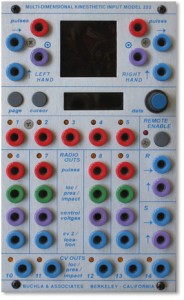
Location, pressure, impact and tuned voltages, as well as pulses, are presented at a total of 30 outputs. The LCD based user interface is remarkably simple and flexible. Trigonometric detection of 2 wireless rings provides spatial information in three dimensions, with additional data provided by ring-mounted switches. Charging of the rings is accomplished by plugging them into powered USB sockets. All settings, including key programming, can be memorized and recalled by the 225e or 206e preset manager
In this video:
exploring various ways of manipulating the sound of a single oscillator (261e) via the touch plate routings. For a high resolution audio of this performance go to:
soundcloud.com/user7621213/buchla-222e-touchplay
please excuse the ugly, loud click at 1:20 — must have hit something with my sleeve–it doesn’t appear in the soundcloud audio track.
Making computer noise can be fun – check out this video
Actually release some time back, but it was not until today that I have seen this video before. The Computernoismachine, a mechatronic art object by the artist Martin converts Well, the electromagnetic fluctuations of the computer processor in sound order.
DATAMASKIN

