
All about the new RED70 Electromusical Synthesizer for Reason
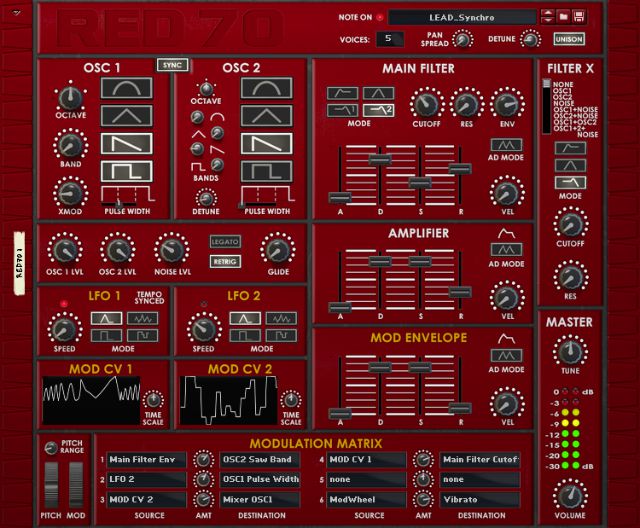
Red Rock Sound has released their new RED70 Electromusical Synthesizer for Reason. They say that it is not an attempt to recreate any specific model of analog synth but based on several classic synths.
Red 70 is available now in the Propellerhead Shop for US $49. Details below.
SYNTH SECTIONS:
OSC1
1. OCTAVE determines the pitch base. (two octave down and two octaves up from the main).
2. BAND Frequency band regulator.
3. XMOD Cross-modulation of the Frequencys of 2 Oscillators.
4. WAVEFORMS Four waveforms (sine, triangle, saw, pulse) with the ability to activate all of the waveforms simultaneously.
5. PULSE WIDTH controls the pulse width. (Pulse waves only)
6. SYNC synchronizes the triggering the OSC 2 waveform by the rate of OSC 1. When activated, OSC 2 BANDS controls affect only OSC 2 timbre, not its pitch.
OSC2
7. OCTAVE determines the pitch base. (two octave down and two octaves up from the main)
8. BAND Frequency band regulator for each waveform separately.
9. DETUNE detuning of oscillator 2 relative to the oscillator 1.
10. WAVEFORMS Four waveforms (sine, triangle, saw, pulse) with the ability to activate all of the waveforms simultaneously.
11. PULSE WIDTH controls the pulse width. (Pulse waves only)
ADDITIONAL OSCILLATORS & MIX SECTION
12. OSC1 LVL level control for the OSC1.
13. OSC2 LVL level control for the OSC2.
14. NOISE LVL level control for the noise generator.
15. LEGATO/RETRIG:
RETRIG controls envelope re-triggering. When activated, every note restarts the envelopes. (mode is clearly audible with 1-2 voices) In contrast to the RETRIG mode where every new note rearticulates the sound by restarting the envelope generators, in LEGATO mode the envelopes are not re-triggered if the new note is played “legato” (with the previous note still depressed). This causes the initial transient from the attack and decay phases to sound only once for an entire legato sequence of notes. Envelopes reaching the sustain stage remain there until the final note is released.
16. GLIDE determines the pitch sliding from one note to another.
FILTER X (Pre-filter, located ahead of the main filter.)
17. This switch selects a sound source to be processed by the filter: – OSC1 – OSC2 – NOISE – OSC1 + NOISE – OSC2 + NOISE – OSC1 + OSC2 – OSC1 + OSC2 + NOISE
18. MODE determines the filter type: – High Pass – Band Pass – Low Pass
19. CUTOFF controls the FILTER X cutoff frequency.
20. RES controls the amount of filter resonance.
MAIN FILTER
21. MODE determines the filter type: – High Pass – Band Pass – Low Pass 1 – Low Pass 2
22. CUTOFF controls the VCF cutoff frequency.
23. RES controls the amount of filter resonance.
24. ENV determines the envelope’s cutoff modulation depth. (You can set positive or negative values)
25. ADSR determines the filter’s envelope cutoff behavior after a note is triggered. – A (Attack) – D (Decay) – S (Sustain) – R (Release)
26. AD MODE The ADSR envelope switches to repeating Attack-Decay envelope.
27. VEL sets the envelope depth in relation to the Note On velocity.
AMPLIFIER
28. ADSR The VCA envelope controls the note level from trigger to release. – A (Attack) – D (Decay) – S (Sustain) – R (Release)
29. AD MODE The ADSR envelope switches to repeating Attack-Decay envelope.
30. VEL sets the envelope depth in relation to the Note On velocity.
MODULATION SECTIONS:
MOD ENVELOPE
31. ADSR The ADSR envelope generator that can be freely assigned to selectable destinations via the modulation matrix. – A (Attack) – D (Decay) – S (Sustain) – R (Release)
32. AD MODE The ADSR envelope switches to repeating Attack-Decay envelope.
33. VEL sets the envelope depth in relation to the Note On velocity.
LFO 1 (Tempo Synced)
34. SPEED controls the rate of the synced LFO, linked to the project BPM.
35. MODE offers four waveforms: – Triangle – Pulse – Noise – Sample & Hold
LFO 2 (Free)
36. SPEED controls the frequency of the free LFO.
37. MODE offers four waveforms: – Triangle – Pulse – Noise – Sample & Hold
MOD CV 1
38. This DISPLAY shows a graph CV signal coming through the input connector MOD CV1 on the back panel.
39. TIME SCALE controls speed of displaying information on the display (it does not affect the rate of modulation).
MOD CV 2
40. This DISPLAY shows a graph CV signal coming through the input connector MOD CV1 on the back panel.
41. TIME SCALE controls speed of displaying information on the display (it does not affect the rate of modulation).
MODULATION MATRIX
42. SOURCE determines the modulation source.
43. AMT sets the amount by which the modulation source affects the destination. Both positive and negative Amount values can be set (+/- 100%).
44. DESTINATION determines the destination for the modulation source.
The PITCH BEND and MODULATION WHEELS
45. PITCH RANGE sets the range of the Pitch Bend action.
46. PITCH WHEEL is a control on a synthesizer to pitch bend (portamento) — to vary the pitch in a continuously variable manner.
47. MOD WHEEL is a modulation wheel assigned as a source in the modulation matrix. (The Modulation wheel can be set to simultaneously control a number of parameters.)
GLOBAL and OUT SECTIONS:
48. VOICES determines the number of voices you can play simultaneously. The maximum number of voices is 8.
49. PAN SPREAD controls pan spread for the voices (not oscillators), when set to 0% all voices are centered. When you increase the Pan Spread the voices will begin to pan more and more to L/R in an alternative manner (i.e. If Voice 1 is towards the LEFT, then Voice 2 will go towards the right, etc). At 100% the voices will be panned hard L or R in this manner.
50. VOICE DETUNE determines the detuning of the voices in correspondence to each other.
51. UNISON is a mode in which several voices in the synth are assigned to play a single note.
52. TUNE controls global tune.
53. LED indicator for left & right outputs.
54. VOLUME is the main volume control for left & right outputs.
55. Patch browse.
56. Standard Note On indicator.
BACK PANEL:
AUDIO OUTPUT
RED70 has 2 outputs: LEFT and RIGHT stereo outputs.
SEQUENCER CONTROL INPUTS
The Sequencer Control CV and Gate inputs allow you to play RED 70 from another CV/Gate device (e.g. a Matrix or the RPG-8). The signal for the CV input controls the note pitch, while the signal for the Gate input delivers note on/off along with velocity.
CV MODULATION INPUTS
Two CV Inputs (MOD CV1 and MOD CV 2) can receive CV from external sources that will be available as Sources in the Modulation matrix. You can monitor the form of the incoming signal on the displays (38, 40) on the front panel.
CV INPUTS
- The LFO Speed allows CV to control the speed fo LFO1 and LFO2.
- The Main Filter allowsCV to control the CUTOFF, RES and ENV.
- The Filter X allows CV to control the CUTOFF and RES.
Modulations – Full Feature Film
MODULATIONS traces the evolution of Electronica music as one of the most profound artistic developments of the 20th century!
Cakewalk Rapture Pro Review
Tosh from Wij Productions take a look at Cakewalk’s new do-it-all virtual instrument.
Patterning In Depth : Standard Loop Mode
Learn about using Patterning’s standard loop mode to create sequences.
http://www.olympianoiseco.com/apps/pa…
Follow us:
@olympianoiseco
facebook.com/OlympiaNoiseCo
10 Mixing Mistakes Everyone Makes (FFL!)
For more info:
Learn more mixing techniques on our diploma courses :: http://ow.ly/Qie8z
Point Blank is The Global Music School, with courses in London, Los Angeles and Online. Voted ‘Best Electronic Music School’ by DJ Mag, learn Ableton or Logic via our online courses or in our state-of-the-art studios in London or LA :: http://www.pointblanklondon.com
Check out the brand new Patterning : Drum Machine
New iOS drum machine, all details below:
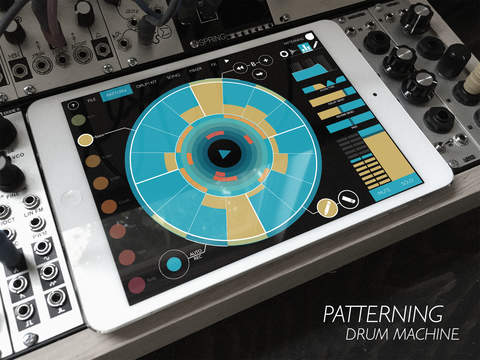
As beautiful as it is powerful, Patterning is a deep and flexible drum machine unlike any you’ve encountered before. With its elegant circular interface, Patterning transforms the iPad into a seriously inspiring tool for making beats.
Create dynamic drum patterns with the swipe of a finger. Make evolving, poly-metric rhythms, four-on-the-floor dance party jams, or laid back R&B grooves. Use Patterning’s independent loop settings to explore untapped rhythmic possibilities. Automate parameters to create intricate & complex beats. Arrange patterns on the timeline to construct songs. Use the built-in effects–delay, reverb, distortion, and 3-band EQ–to add atmosphere, shimmer and noise. Connect to other apps with Audiobus, Inter-App Audio, and MIDI.
Patterning comes loaded with classic drum machine samples as well as exclusive drum kits created and curated by contemporary producers and musicians. For the independent producer, it’s easy to create custom kits with your own samples.
With an extensive and uncommon feature set, Patterning redefines what an iOS drum machine can be.
Recommended for iPad 3 and newer.
For a complete list of specifications, please visit http://www.olympianoiseco.com/apps/patterning
https://itunes.apple.com/app/apple-st…
Available August 20, 2015
Sign up for our mailing list :
http://eepurl.com/LdQYr
Follow us:
@olympianoiseco
facebook.com/OlympiaNoiseCo
Bob Moog Foundation launches 2015 Minimoog Model D Raffle
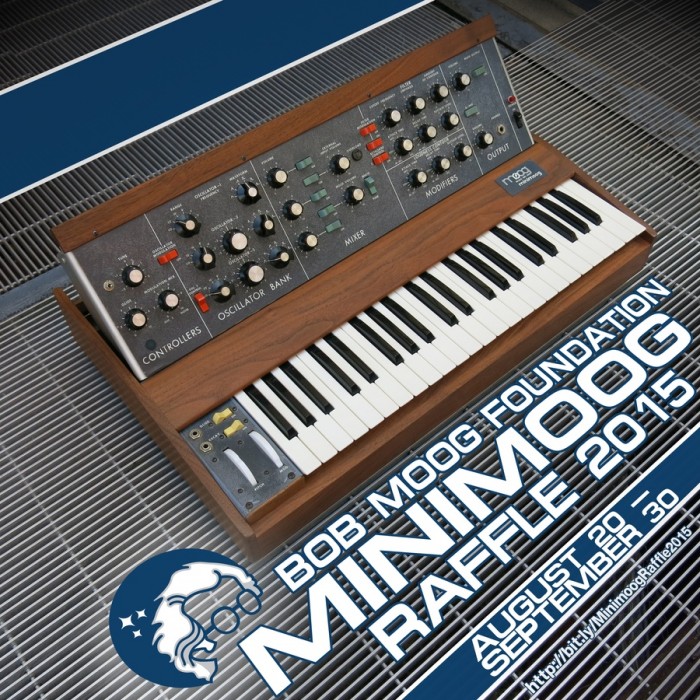
The Bob Moog Foundation has launched a raffle for a much sought after vintage Minimoog synthesizer.
Proceeds from the raffle will benefit the Foundation’s educational and historical preservation projects. Tickets to enter the raffle are $20 each, or 6 for $100 and can be purchased through the Foundation’s website: http://bit.ly/MinimoogRaffle2015. The raffle, which is open internationally, closes at midnight on September 30, 2015. Only 2,000 tickets will be sold.
The Minimoog Model D being offered, serial number 2120, was built at Moog Music’s Williamsville, NY factory in the early 1970s. It is in excellent technical and physical condition and has been serviced by a technician with expertise in Minimoogs. The instrument has been modified, although the modifications have been disabled to preserve and maintain the integrity of the instrument.
The Minimoog Model D is widely regarded as the most iconic synthesizer of all time, and was so recognized in an international voters’ poll by SonicState.com. When released in 1970, it represented a musical and technological revolution due to its combination of portability, affordability, accessible user interface, and innovative sounds and functions. Its robust construction has allowed the instrument to withstand the test of time. Minimoog Model Ds are coveted by synthesizer enthusiasts and regularly sell on eBay for $4,000-$7,000.
The raffle closes at midnight on September 30th, 2015.
Roland JX-8P Sounds II
The JX-8P is a decent analog polysynth. It has 6 voices of polyphony, great MIDI implementation and patch storage as well as an external memory cartridge slot. Though it is far more advanced than its predecessor, the JX-3P, the JX-8P has its drawbacks. Hands-on programming is sacrificed and reduced to assigning the parameter you want to tweak to a data-slider near the pitch/mod bender. Enter the PG-800 controller which gives you total control of all the JX-8P’s editable parameters with hands-on traditional slider control. Membrane buttons dominate the front panel of the JX-8P providing access to the various preset and user patches and to page through and assign editable parameters.
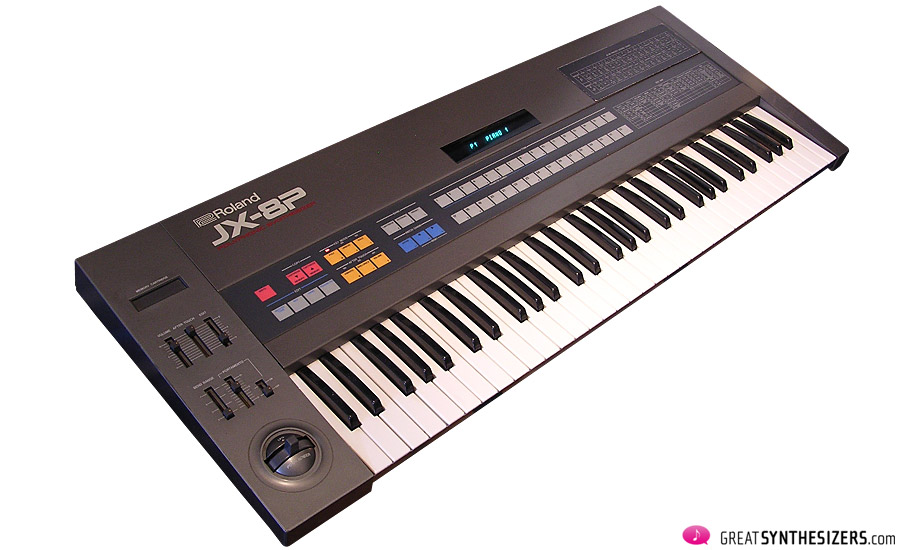
Professional features can still be found under the hood of the JX-8P. Its 61 note keyboard is velocity and aftertouch sensitive. Just like the Juno synthesizers it uses DCO’s for a very stable system, however its sounds are a little thin and bright. It also features portamento, unsion and solo (monosynth) performance modes.
Background video description:
All video and audio content by G-Strom Electro c.2015
http://gstormelectronica.blogspot.com/
JX-8P bank #1 with 30 original patches are now available on my blog. The bank includes all the sounds from demo part I and II. Be sure to backup your own patches safely before loading mine.
Japanese Auto Maker and Synth maker Roland to Co-Develop Electric Sports Car Driving Sound
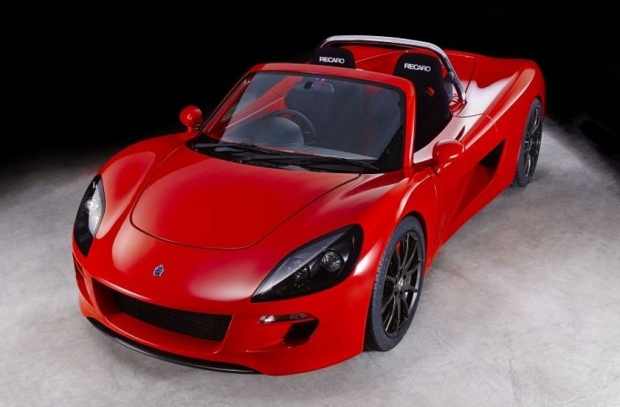
Interesting times indeed 
Roland’s SuperNATURAL synth engine is going to be providing the sounds for the new ZZ electric sports car from vehicle manufacturer GLM
Read the PR below:
Roland Corporation and GLM Co., Ltd., have announced an agreement to co-develop a neo-futuristic driving sound generation system for GLM’s electric sports car. In this unprecedented collaboration between the world’s leading electronic musical instrument maker and the manufacturer of Japan’s first mass-marketed electric sports car, the driving sound system will be designed using Roland’s renowned SuperNATURAL® synthesizer technology.
Herbie Hancock, Jimmy Page, George Duke and many more of the world’s most talented musicians have relied on Roland synthesizers to create music. The new driving sound system for GLM’s ZZ model will use this same professional synthesizer technology to produce sonically rich, studio-quality sounds. In addition to refined sound quality, the system will have the ability to change with each driver’s real-time driving experiences. GLM and Roland are committed to creating a driving sound generation system that provides a one-of-a-kind driving experience that rivals anything currently on the market.
Roland’s innovative SuperNATURAL* synthesizer technology will power the ZZ model’s sound generation system with dynamic and dramatic sounds that seamlessly change depending on real-time driving situations like acceleration, deceleration, and motor load variances on sloping roads. This exclusive technology is based on responsiveness, which is especially important when recreating the subtleties of acoustic musical instruments electronically. That same technology will be used to create ingenious neo-futuristic sounds that will give sports car enthusiasts the experience of driving a space ship on the road. Electric sports cars are more popular now than ever, and as environmental concerns escalate, some drivers are learning to appreciate quieter electric engines. Driving sounds are still crucial for many, however – especially drivers of high-performance vehicles and those who want to have a fun and fulfilling driving experience.
For decades, the industry standard for reproducing the sound of traditional musical instruments was PCM sampling. The challenge with sampling is that most acoustic instruments respond differently to how hard they are struck, blown or bowed – most acoustic instruments grow brighter as they get louder, for example. By meticulously modeling the subtle characteristics and responsiveness of acoustic instrument sounds, Roland was able to create the most realistic electronic music sounds. Roland’s SuperNATURAL technology makes it possible to recreate these nuances electronically, and will be used to create the best driving sounds possible in the electric sports car.
Main features of the Roland sound generation system:
- Generates driving sounds depending on the driving situation (e.g. acceleration, deceleration, and motor load variances)
- Roland’s acclaimed SuperNATURAL synthesizer technology is used to synthesize dynamic, neo-futuristic sounds, then reproduce them through the car’s stereo speakers
- Driving situations are detected by the system in real time through a car-mounted network that measures the car’s speed, pressure on the accelerator pedal, and load to the power system
- Drivers can select from several driving sound types based on their personal preference, including neo-futuristic options
The driving sound system option for GLM’s ZZ model featuring Roland’s sound-making technology will be available this fall.
*Adapted sound engine of Roland’s flagship digital synthesizer.
Avalon and TB-303 behavior on long notes with Slide
When playing long notes (longer than the default 16th note) a slide starts from the last tie. This is how the 303 is designed (it makes sense if you study the software and behavior). This is exactly how it is implemented on the Avalon.
DATAMASKIN

