
NAMM 2016: New Oberheim Mini Sequencer will debut at the 2016 NAMM Show
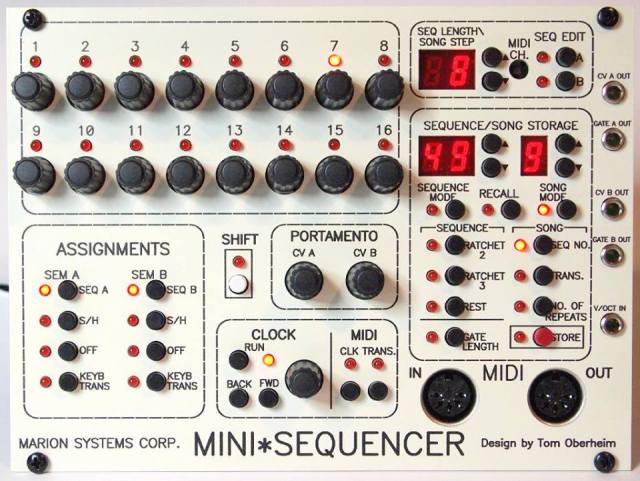
Marion Systems Corporation will be introducing the Oberheim Mini Sequencer at the2016 NAMM Show.
The Mini Sequencer is designed by Tom Oberheim and is a Eurorack format module.
Details, pricing and availability are to be announced. The 2016 NAMM Show is scheduled for later this week, Jan 21-24, 2016.
Modstep – new full-blown MIDI Sequencer for iPad
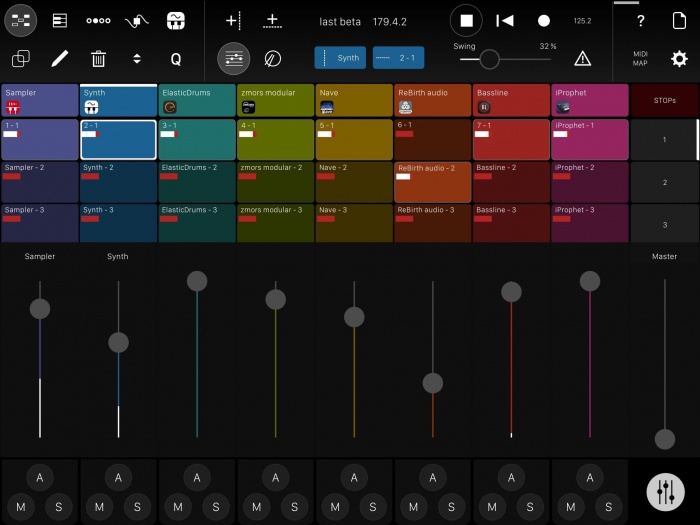
Modstep has launched version 1.0 of its app that allows you to create music and jam with your iPad.
Seemlessly combine your favorite tools no matter in what shape or format they come: IAA Apps, your MIDI hardware, Mac- and PC Software, as well as the internal drum sampler and synth. Modstep speaks MIDI, Inter-App Audio, can send a trigger-signal and stream MIDI and audio between your computer and your iPad with studiomux.
Use it as the centerpiece of your setup to create and perform music on the go, in the studio and on stage.Modstep is developed and designed by Christian Blomert, Benjamin Weiss and Pascal Kaap.
Modstep features
- Full-blown MIDI sequencer with Step Sequencer and Piano Roll.
- Unlimited MIDI tracks.
- Extensive Step Sequencer with active steps.
- Audio and MIDI streaming directly via the charger cable to Mac and PC using studiomux technology.
- Up to 128 MIDI CCs per Track can be modulated.
- Built-in drum sampler with filter, delay and reverb, fully modulatable.
- Built-in synthesizer with filter, delay and reverb, fully modulatable.
- Templates to control external MIDI hardware.
- Template editor to create your own templates for IAA Apps, desktop Apps and external MIDI devices.
- Supports all MIDI interfaces for the iPad.
- Core functionality controllable via external MIDI controllers.
- Use third party IAAs as instruments and effects within one app.
- Integrated IAA mixer.
- Trigger out.
Modstep is available for iOS 8 or later, priced at $19.99 USD. iPad 1 is officially not supported, though all MIDI functionality including MIDI-streaming via studiomux currently works on iOS 5.1.1. For audio and MIDI streaming to a Mac or PC, the studiomux server software is required.
A version 1.0.1 update will be available soon, featuring bugfixes and Ableton Link-integration.
Redux – new performance-oriented sampler and phrase sequencer
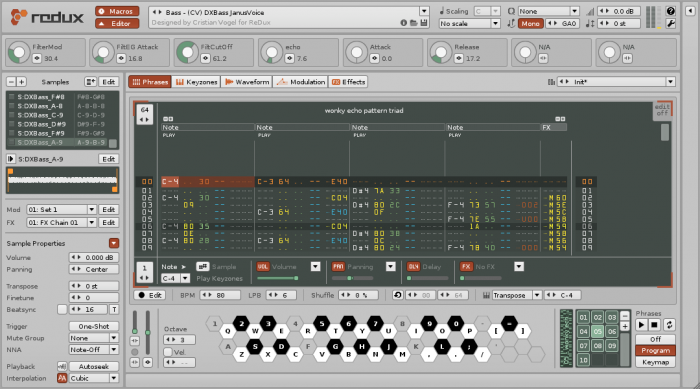
The Renoise team has launched Redux, a performance-oriented sampler and phrase sequencer for Digital Audio Workstations and other plugin hosts on Windows, OSX and Linux.
Redux is a powerful sampler, supporting virtually unlimited samples and effects, with RAM and CPU being the only real limits to your creative freedom. As a sequencer, it has inherited and expanded upon a unique set of features from its bigger brother, Renoise.
Redux features an integrated work-flow for composition and performance. You can record new sounds from within the program itself and use the built-in waveform editor to edit and adjust these recordings. You can specify in great detail how the samples are triggered via your MIDI keyboard. So no matter if you are a traditional keyboard player or prefer to trigger sequenced sounds via drum pads, Redux is able to meet those demands, either in-studio or on-stage.
The software comes with a number of ready-to-use presets to help kick-start your creative process. This includes expressive synth patches, drum-kits, and complex sound environments.
Redux (VST/AU) is available for purchase for 58 EUR / $65 USD + VAT for EU customers.
Pyramid Sequencer Demo – LIVE MODE + FX MANAGER
This video is an example of how to chain effects in the FX Manager, sequencing the DSI Mopho x4.
Each track can handle up to four chained up effects. As all effects are real-time processed, the recorded events will not be affected but the sound will change on the fly. In this video only one track is used, in LIVE mode exclusively (CHORD sub-mode). Its effect section contains two arpeggiators, one humanizer and one randomizer.
0:10 keypad used to play simple notes, an external keyboard controler could be used instead of the integrated pads
0:14 octave is set down to access lower notes
0:15 use of the smartpads in chord mode
0:21 tonality changed from Cmaj to Cmin and back to Cmaj
…
0:34 first arpeggiator added
0:38 octave set to -1
0:59 exit from the first arpeggiator with the following settings:
style = up/down
gate = 200%
rate = 1/1 (slow)
octave = -2
…
1:03 harmonizer added and set with +5 and -4 to create chords from the first arpeggiator outputed notes.
…
1:24 second arpeggiator added, playing around and finally setting a very high rate
…
2:54 second arpeggiator style set to “random”
3:05 second arpeggiator is bypassed
…
3:11 randomizer added, with param set to “velocity”
More information on :
http://squarp.net/overview.html#Quick… “Effect Manager”
http://squarp.net/overview.html#LIVE_… “Chord smartpads”
Checking out Mode Machines at Musikmesse
Mode Machines have some exciting new instruments and a new hands-on MIDI sequencer at Musikmesse 2015. Julian also shows me a new USB-to-MIDI interface, a MIDI Arpeggiator and a standalone VST Host box.
KOMA Elektronik Komplex Sequencer: Teaser
Some close up features of the upcoming KOMA Elektronik Komplex Quad Sequencer right before Musikmesse! Now, the sequencer length is displayed by the LEDs beneath each step as it is changed momentarily. The Komplex Sequencer is driving the pitch and filter cutoff of the Korg MS10 while the Volca Beats provides a rhythm. The KOMA Elektronik RH301 provides the master clock.
For more info and preorders visit: http://www.koma-elektronik.com
Elektron: Did you know? About parameter locking
Parameter Locking is Elektron’s name for their approach to step sequencing parameter automation. Parameter locks give you the ability to do per-step parameter changes on your sounds.
Squarp Instruments PYRAMID – Polyrhythmic Sequencer
Pyramid is a 100% standalone polyphonic MIDI & CV/Gate sequencer.
Easily produce your tracks from scratch thanks to powerful creative tools, such as a smart chord harmonizer, scales, beat repeat, hold and relatch, groundbreaking step sequencer, Euclidean sequencer, polyrhythms, polymetry and real-time effects.
Video: Théodore Sanchez – Les Films du Périscope – theodoresanchez@gmail.com
Music: Fabien Gaubert – http://www.shapingsounds.com/
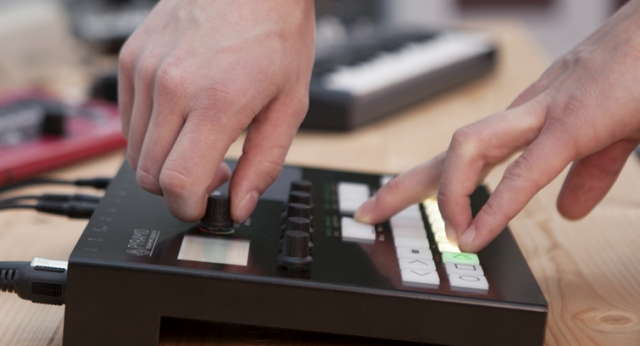
The Pyramid lets you directly sequencer a large range of electronic instruments.
- It includes two MIDI outputs to connect your hardware ger.
- You can also use the USB MIDI out to control your virtual instruments on your computer.
- Pyramid embeds a DIN sync output (configurable to Sync48, Sync24,…) that lets you synchronise your vintage instruments.
- For modular synth lovers, Pyramid can be a complete sequencing solution thanks to the full CV/Gate + ENV interface.
Koma Announces their new Quad Sequencer
The Dave Smith Instruments Pro 2 – Sequencer Introduction
Here is an introduction to an exploration of the Dave Smith Instruments Pro 2 Sequencer.
DATAMASKIN

