
Serge Space Sounds
Here’s a video featuring the classic modular Serge: Of the tiny handful of analog modulars out today you can buy as new, Serge stands out in a variety of ways. The modules are of extremely high quality, have wide parameter range, excellent tracking/stability, and low noise (except for the noise module). There are a lot of modules, over 65. Patching is done with rugged banana plugs; a little bit of a pain to interface with other gear, but once you’ve gotten used to stacking multiple bananas, you’ll never want to patch any other way again. Many control voltage inputs on Serge modules have clever inverting attenuators – at the twelve o’ clock position, you have zero gain, turn clockwise, you have increasing positive gain, turn counterclockwise, you have increasing invertedgain. There are many unique modules in the lineup, some obvious, some very strange. You can spend months and years exploring a Serge system and still discover new ways of using the modules. If you’re looking to get a few snappy ‘synth sounds’ with a press of a button, forget it. Go to the Best Buy and pick up a nice Yamaha MIDI keyboard. But if you’re looking for something unique and challenging, and if you’re crazy enough to spend thousands of dollars and wait months to have the system built and delivered, this is the one.
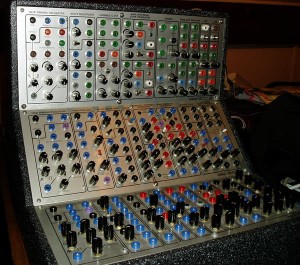
On a Serge, audio signals, control voltages, and trigger signals are fairly interchangeable and the system uses only one kind of patch cord. Audio signals can be accepted by trigger inputs, control voltage generators can be used for audio. Use control voltage mixers for audio, or run your sequencer at audio rates for wild, squealy, rippy noises.
Many Serge modules can be internally patched. What’s that mean? The modules themselves can be patch-programmed to do different things. For example, patching the GATE output to the TRIGGER input of a Dual Transient Generator turns the DTG into a voltage-controlled clock, LFO, or audio oscillator.
Which leads us to the extreme flexibility of the designs. You have to do a lot of thinking and experimenting on these things to really appreciate them. For someone used to the more conventional approaches out there, this can be a little intimidating.
Serge modules have a very high density of functionality. Every square inch of panel space is useful. You can put a pretty impressive system together in one or two suitcase-size boxes.
Serges are handbuilt to customer specification, and by handbuilt I mean that they’re put together by people who have spent years mastering the build process. I’ve heard people complain about the price of modules versus the cost of parts, and why should an oscillator cost ‘X’ when the parts cost ‘Y’. But the truth is, the nice juicy modules use a lot of discrete components, some laboriously hand-matched. Once the components are assembled, the module has to be calibrated, burned-in, and checked. A lot of skilled labor is involved, and expensive test gear.
Two Elektron Machines featuring the Oto Biscuit and Three Korg Pads
Elektron Monomachine SFX60+ Elektron Octatrack by sound artist & noise designer Zviij w/ Korg Kaoss Pad KP3 (x2), Korg Kaoss quad & feat. Oto Biscuit.
N.B.— Zviij’s singles “Bug Machines III, IV, V” are available for download on iTunes http://itunes.apple.com/us/album/bug-machines-v-single/id…
Zviij — (born Franck Smith) is a French sound artist, noise designer and electronic musician, active as a soloist, living and working in Brussels.
Background on the Elektron:
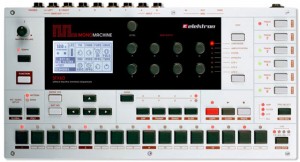
The Monomachine combines several types of synthesizers with an intuitive beat-box-style programming interface. Think of it as five synthesizers in one package with a flexible sequencer and plenty of real-time controls for a unique twist on desktop music machines! It has 6-part multitimbral capability which allows for up to 6 mono-synth sounds at once, or a single 6-voice polyphonic sound.
The SuperWave synthesizer, which is analog modeled, gives warm and thick sounds made from unique algorithms that makes sounds free from the artifacts normally associated with digital processing. Traditional (and 303-like) saw and pulse waveforms and sub-oscillators give you fat bass synth and lead sounds, while the ensemble is specialized in creating polyphonic textures, chords, and harmonies.
The Mono-synth SID is based on the synthesis of the legendary SID chip, from the Commodore 64. The SID 6581 machine offers one oscillator of high quality synthesis, complete with ring-mod and sync. Just like the original, the oscillators are derived from an extremely fast main counter, giving the crisp highly recognizable sound.
DigiPRO offers raw digital waveforms, which can be put into animated life. The BeatBox, which is a part of DigiPRO, offers a percussive toolbox shaped in the traditions of the Machinedrum E12 synth. The sounds of DigiPRO WAVE are harsh and electric and stand out in the mix.
FM+ is 21st century FM synthesis. It implements world class frequency modulation algorithms that address the complexity problem normally associated with FM. All three FM+ machines are based around a number of custom made FM blocks. The machines have been handcrafted, each with its own personality.
VO is inspired by classic voice modeling methods using formant synthesis. The goal was not to recreate any existing voice or speech synthesizer, but to create a new way of building and controlling a synthetic voice in a way that suits musicians. VO-6 is the VO incarnation of the Monomachine. User controllable between pulse or white noise, formant filters and a set of predefined consonant-like sounds.
While the Monomachine’s 6-part beat-box-style sequencer can be used to create your own synth grooves, it offers six additional MIDI tracks that can be used for controlling external MIDI gear. MIDI control data can be generated realtime, with parameter locks and with LFOs. Each MIDI track offers a full implementation of the Monomachine arpeggiator.
How to get started with analogue synthesizers, modular systems, stepsequencers and more
“The Testsalon inside Rough Trade East in London is the showroom installed by Schneidersladen, Berlin with the latest news in electronic hardware devices. The Video gives you an overview on how to get started with analogue synthesizers, modular systems, stepsequencers, drummachines, or filters from independent manufacturers like Doepfer, Sherman, MFB, TomOberheim, Makenoise, Cwejman, SND, Vermona and many others. All is connected with each other via Midi or cv gate and you can make some music easily .. if you are around. “
NEW Misa Kitara – Sustainer & ZynAddSubFx VST (shipping this month!)
There have been lots of requests for showing the misa kitara connected to an external software synthesizer via MIDI:
“So in this video I have connected the kitara to my PC running my favourite open source synthesizer – zynaddsubfx (I recommend checking it out, it has some really interesting features). Also in this video, I show you how to sustain notes – you just drag upwards and any strings you have pressed down will not stop playing when you release them. Pressing another button on the string will set the sustained note to the newly designated one.
Also you can see “tap mode” in this video, where the screen is red. in this mode you can press the buttons on the neck and hear a sound, without pressing the touchpanel. it’s good for two handed tapping technique (although you can see how important using the touch panel is to re-attack the notes you are playing).
ps. use headphones if you want to hear the bass!! :)”
DATAMASKIN

