
ARTURIA – Introducing Wurlitzer V
The Wurlitzer V is a high end software recreation of the classic Wurlitzer 200A electric piano.
Unlike sample libraries, its physical modeling engine reproduces the very acoustic properties of reeds, key action and amplification, bringing you high realism while offering maximum flexibility on sound.
As most producers know, the legendary bright and overdriven Wurlitzer sound heard on classic records also comes from the use of fine amplifiers, micing and processing. This is why the Wurlitzer V goes further by putting you in command of a studio from the 70’s, filled with vintage stompboxes and classic tube amps… everything you need to get a true classic vibe!
If you are looking for a lively electric piano combined with inspiring studio tools, the Wurlitzer V is the ultimate package.
More details here : http://www.arturia.com/evolution/en/products/wurlitzer-v

One of the most cult proclaimed keyboard instruments in the history of music is the Wurlitzer Electric Piano. With its rough and phat sound, the Wurlitzer has left an immense mark on several classic recordings with a variety of performers such as Ray Charles, Steely Dan, the Doors, Sun Ra and Queen just to mention a few.
The Wurlitzer’s basic principles were developed in America in the middle of the 1930s by a man named Ben F. Meissner (b. 1890). In 1932 he patent and licensed several new revolutionary electrical ideas e.g. several TV-components, electron pipes and the Wurlitzer principles (the string less piano). Meissner came up with the idea to place electromagnetic pickups on each string inside an ordinary acoustic piano. In order to achieve a more powerful tone he added reeds inside the piano which he blew air into. His concept caused great interest from different piano manufactures around the country, and his ideas were sold to the Everett Piano Company who came to develop his original ideas. They started to work on the concept but what from the start was supposed to be an electric form of a piano, instead became a more electric organ under the supervising of the Everett Piano Company. But the idea had now reached the big jukebox and organ company, Wurlitzer who realized that the invention had a far greater potential. They took over the development of the piano and instead tried to come up with a electric version of a piano more similar to the Rhodes, than to an organ. To achieve their goals they designed a felt dressed hammer which was placed in the piano in order to stroke the metallic reeds. The vibrations from the stroke on the reeds produced a big fat and rich tone, which was picked up by a pickup system converting the tone into electric energy and leading the tone out of the built in speakers on the front of the piano. The Wurlitzer Electric Piano was born.
The Wurlitzer was in some ways relatively similar to the Rhodes regarding it’s construction and it’s design, but it was also in many ways different. The Wurlitzer was a lot lighter than the Rhodes (who weights at least twice as much) and therefore a lot easier to transport and to carry on the road. It also had built-in speakers with a separate monitor speaker, and a built-in tremolo which early Stage models of the Rhodes did not have.
Wurlitzer released their first electric piano in the beginning of the 1950s. The piano received great attention from the branch organizations and in 1956 the first Wurlitzer album was made by Sun Ra and Demons at Play. Another contributing fact which helped launch the piano was Ray Charles elegant Wurlitzer playing on his huge hit “What I’d Say” from 1959 which gave the Wurlitzer increasing attention. The most famous models are the Wurlitzer 100 and its improved version, the Wurlitzer 200 which replaced the 100 in 1969. The Wurlitzer quickly reached great successes, in particular during the 1960s and the 70s. The piano quickly became popular among touring bands who found it to be a lot lighter than the Rhodes and that the Wurlitzer’s sound more easily could fit into a guitar based band than a Rhodes. The Wurlitzer proved to be useful in more pop and rock oriented music were the Wurlitzer’s thicker and rougher tone easily could be used as a replacement to the guitar. As the popularity of the Wurlitzer grew, keyboardists seemed to become more and more divided into two camps, Rhodes or Wurlitzer. The Wurlitzer however, do work very well in soul/funk music as well as in pop and rock. A great example of that is the soul and funk music of legendary Donny Hathaway, who easily fits the Wurlitzer into his music.
Today it is quite hard to get a hold of a Wurlitzer in good condition. They are sadly not the most frequently used keyboard instrument in the music industry and are quite rare these days. However, if you are not into to much rush, got a fat wallet, and are a bit lucky there are some for sale.
Arturia’s SPARK is here – 30 legendary drum machines in one go
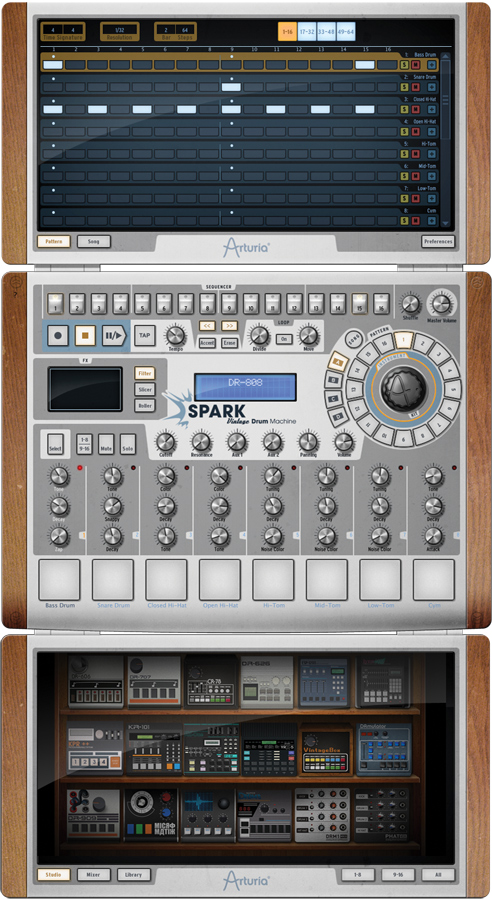
Arturia announces availability of its newly-developed SPARK Vintage Drum Machines (Standalone, VST 2.4 & 3 — 32-bit and 64-bit, RTAS and US — 32- and 64-bit) software instrument, placing 30 legendary drum machines at discerning musicians’ rhythmic fingertips!
As intuitive as it is powerful, SPARK Vintage Drum Machines represents so much more than typical sample players currently on the market; by mixing high-quality samples and virtual analogue synthesis based on Arturia’s advanced propriety TAE® (True Analog Emulation) technology, this software successfully captures the unique electronic musical soul of the 30 different drum machines it emulates: Roland’s CR-78, TR-808, and TR-606; Korg’s Mini Pops 7 and KPR-77; Ace Tone’s Rhythm Ace FR-2L; Yamaha’s MR10; Maestro’s Rhythm King MRK2; Boss’ DR-55; Casio’s VL- Tone and SK-1; Simmons’ SDS; Phatwerk; and Micromatix all get the TAE® treatment, while E-mu’s Drumulator and SP-12; Roland’s TR-909, TR-606, TR-707, TR-727, TR-626, and R8; Oberheim’s DMX; Sequential Circuits’ DrumTraks; Kawai’s R-100; Casio’s RZ-1; Yamaha’s RX5; the LinnDrum; Linn 9000; Pulsator; and Dirty-909 are all sample-based and/or physical modelling hybrids.
- 30 legendary drum machines including: Roland TR-808, TR-707, TR-909, CR-78, Korg KPR-77, Mini Pops 7, LinnDrum, Yamaha RX5, Maestro Rhythm King MKII, Simmons SDS V,…
- Easy workflow: one interface to learn, thirty drum machines to play
- Made for live performance: XY Pad, Beat Looper, Slicer, Real-time automation on all parameters
- 14 high quality effects : Multiband Compressor, Reverb, Bit crusher, Multiband EQ, Chorus, Delay, Distortion, Phaser, Plate reverb, Destroyer, Flanger, Space pan, Limiter, Sub generator
- Spark’s Step Sequencer makes track creation a breeze
- Perfect integration: 16 independant audio outputs, midi I/O
- Unparalleled sound quality based on virtual analog synthesis (TAE®) and high resolution sampling
- More than 1300 pre-programmed patterns
Arturia MiniBrute Sound Sources
A quick tour on the MiniBrute sound sources: no filtering, just plain oscillator straight into the old faithtul analog oscilloscope. Metalizing on triangle wave, PWM on square wave, HyperSawing on sawtooth, SubOsc square/sine, Noise…
Arturia MiniBrute Synthesizer Demo
Sweetwater’s Daniel Fisher demos the new Arturia MiniBrute Analog Synthesizer with a thorough walkthrough of its parameters and features. You can control it with CV, MIDI, or USB-MIDI, and it’s even got an external audio input to run signals through the amazing multi-mode filter and amplifier sections. Enjoy the demo, then learn more about the Arturia MiniBrute here: http://bit.ly/sw_MiniBrute
The Arturia MiniBrute – Introduction
Here is the introduction to a series of videos that demonstrate the sound and functionality of the Arturia MiniBrute.
MiniBrute is a revolutionary new analog synthesizer from Arturia. Featuring a pure analog signal path and a host of unique features, it sets a new standard for what a hardware synthesizer should be.
Its 100% analog audio signal path features a VCO wave mixer, the classic Steiner-Parker multimode filter, as well as numerous analog innovations such as the Metalizer, Ultrasaw, and the Brute Factor™. Boasting a complete MIDI, CV and USB connectivity, MiniBrute is right at home with your computer or your vintage synths, making it the ideal companion to deliver a pure analog blast anywhere you go.
Artists and ARTURIA #15 – Arnaud Rebotini
Arnaud Rebotini, the leading light of french electronic music is showing us how to make great techno tracks with Minibrute in an exclusive in-studio interview.
Arturia Spark Vintage Drum Machines
SPARK Vintage Drum Machines brings 30 legendary drum machines to the musician.
Intuitive and powerful, this software is much more than your typical sample player. By mixing high quality samples and virtual analog synthesis (based on TAE®), Spark Vintage Drum Machines manages to capture the unique soul of these instruments.
More details : http://www.arturia.com/sparkvdm
MAIN FEATURES:
- 30 legendary drum machines including: Roland TR-808, TR-707, TR-909, CR-78, Korg KPR-77, Mini Pops 7, LinnDrum, Yamaha RX5, Maestro Rhythm King MKII, Simmons SDS V,…
- Easy workflow: one interface to learn, thirty drum machines to play
- Made for live performance: XY Pad, Beat Looper, Slicer, Real-time automation on all parameters
- 14 high quality effects : Multiband Compressor, Reverb, Bit crusher, Multiband EQ, Chorus, Delay, Distortion, Phaser, Plate reverb, Destroyer, Flanger, Space pan, Limiter, Sub generator
- Spark’s Step Sequencer makes track creation a breeze
- Perfect integration: 16 independant audio outputs, midi I/O
- Unparalleled sound quality based on virtual analog synthesis (TAE®) and high resolution sampling
- 64 patterns pre-programmed for each drum machine
Soundcheck – Arturia Minibrute Analog Synthesizer
Checking out the sounds of the MiniBrute:
Mini Brute is the new Arturias analog synthesizer that is, with its completely analog signal path and its innovative features set new standards.
Its multi-waveform oscillator, and the classic, hands-multimode filter will breathe new life into your recordings. Outstanding features like Ultrasaw, and brute Factor Metalizer be supplemented with a flexible arpeggiator and LFO Sample & Hold incl. The Mini Brute has extensive USB / MIDI / CV terminals and a robust metal housing.
This is the full analogue broadside!
Pre-order now in the Music Store!
www.musicstore.de
Major software update from Arturia – ARP, CS-80, Moog and Prophet
Arturia has announced the release of 5 free updates for their software: ARP 2600 V 2.5.1, CS-80 V 2.5.1, minimoog V 2.5.1, Moog Modular V 2.6.1, and Prophet V 2.5.1.
The new versions come with enhanced performances in Analog Laboratory, faster User Interface and better export of preset banks. Particular attention has been given to the Moog emulations. The minimoog V now sports multiple MIDI port input, new MIDI control for switches and a brand new toolbar. Moog Modular V features better window resizing in Pro Tools (Mac OS X).

All updates are free for registered owners.
All updates:
- Compatibility with Analog Laboratory (for full plug-in editing mode on Mac OS X).
- More responsive UI (Mac OS X).
- Preset bank export issue fixed (Windows).
CS-80 V 2.5.1:
- Compatibility of Logic projects using version 2.0.
Minimoog V 2.5.1 :
- Multiple MIDI port input.
- MIDI control for switches possible again.
- Toolbar look harmonization respective with other plug-ins.
- Renaming of 64-bit DLL (Windows).
Moog Modular V 2.6.1 :
- Better handling of window resizing on Pro Tools (Mac OS X).
- Renaming of 64-bit DLL (Windows).
More info at arturia.com/downloads/updates
More on the Arturia Oberheim SEM V – Overview and demo
Sean Weitzman from Arturia goes over the Oberheim SEM V soft-synth, which delivers the sound and the feel of the original Oberheim SEM Synthesizer Expansion Module. It’s a dual-oscillator synth, and adds new features that weren’t present on the original Oberheim unit, like a sub oscillator and a noise generator. SEM V includes many of Arturia’s special touches, such as polyphony and 8-voice multitimbrality, effects, extensive modulation capabilities and much more. Enjoy the overview, then learn all about the SEM V right here: http://bit.ly/sw_SEMV
DATAMASKIN

