
Buchla 223e programming demo
Exploring programming different touchplates to different envelops in the 281e. Sound sources: Verbos 258v, 262v and Buchla 272e. Better audio at: soundcloud.com/user7621213/buchla-223e-touchplate
The 223e substitutes an innovative arpeggiator for the rings of the 222e
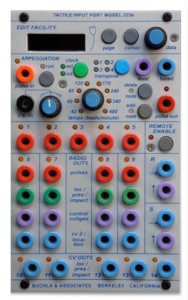
This three panel unit tactile sensor responds to a feather-weight touch, or to several pounds of pressure. An additional (1 panel unit) module houses the outputs, the arpeggiator controls, and the edit facility.
The tactile surface is normally mounted in the first row of a 201e-12 or 201e-18 cabinet: alternatively, it may be mounted in the recently announced 201e-3u frame, relieving spatial binds in crowded systems.
An ergonomic array of 27 keys sense pressure and velocity; fourteen respond to location in one or two dimensions. Arrayed into multiple user-defined groups ranging in size from 1 to 25 keys, they produce a variety of user-programmed control voltages.
Location, pressure, impact and tuned voltages, as well as pulses, are presented at a total of 30 outputs. The LCD based user interface is remarkably simple and flexible. The arpeggiator features multiple patterns, internal and external clocks, and many other sundry features.
All settings, including key programming, can be memorized and recalled by the 225e or 206e preset manager
Sputnik – Dual Waveform Generator Frequency Modulation
Sputnik Dual Waveform Generator Buchla 258 Inspired Oscillator + Plan B Model 13 Low Pass Gate + Doepfer A140 ADSR + Darktime Sequencer
Sputnik is a russian manufacturer by Roman Filipov. Sputnik’s first offering was a Dual Waveform Generator, which is basically a clone of the classic Buchla Model 258 triangle-core oscillator, supposed to be pretty good for FM.
A simple acid techno sequence on the Darktime to demonstrate the sonic capabilities of this amazing oscillator.
Thanks to Don Buchla, Mark Verbos and Roman Filippov.
The Voice of Saturn Synthesizer Euro format
Introducing the Voice of Saturn Synth in euro modular format! Modules available in limited quantity from me: recompas at gmail dot com
curiousinventor.com has pcbs, panels and vactrols for the DIY crowd.
The video demonstrates the basic sound of the unit by itself, then run through a filter (buchla 292c) with the VoS LFO modulating the filter cutoff. The CV1 input is demonstrated using a standard doepfer LFO. It has an attenuator on the panel and controls the rate of the VoS’s LFO. CV2 is fed an oscillator signal to modulate the pitch of the VoS. Towards the end of the video some interesting mod and sync effects can be heard utilizing these control inputs.
Benge’s Buchla in action
John Foxx companion Benge has a new Buchla video out, enjoy
For more info go see http://myblogitsfullofstars.blogspot.co.uk/
Buchla Boys heavy beats live patching
Part of the first set of the last concert at the 2012 Sirén Festival. This is a festival arranged by the students at the composition and individual programs at the Academy of Music and Drama, University of Gothenburg, Sweden.
Buchla Boys are David Sabel and Niklas Sjösvärd, and they’re performing on a 1980’s 5-panel Serge and a 18-size Buchla 200e, both belonging to the Lindblad Studios at the Academy. The patching is improvised, and there’s a crowd dancing behind them (too dark to film). This is part of a longer set, and there’s more photage coming, of higher quality.
This was filmed with a mobile camera.
Benge (working with John Foxx) has a new Buchla album out

Listen to it here:
“Abstraxa – exploring the outer reaches, using the Buchla Electronic Music Box
The six compositions featured on Abstraxa were realised on a Buchla modular synthesiser. Donald Buchla began makng electronic musical instruments in 1963, developing the first Buchla 100 series systems in conjunction with the San Francisco Tape Music Center. These first inventions coincided with the development of Robert Moog’s 900 Series modular systems over on the west coast of america, and as such belong to the very first generation of commercially available synthesisers. One intersting aspect is that Don Buchla is still developing and manufacturing his modular systems, using the same module format (now 200e series) that he introduced 50 years ago. The current 200e modules utilise a combination of analogue and digital components
The Buchla has a very unique way of producing sound, using electronic voltages to control the sound sources (oscillators and noise generators), sound modifiers (gates, filters, phase shifters, modulators, etc) and event timing generators (sequencers, random sources, pulse generators, etc). Systems can be built up from the available modules to suit the needs of the composer. The power of the system lies in the inter-modulation capabilities. This means that extremely deep patches can be set up with a myriad of connections interacting together in complex ways to produce evolving and self-generating soundscapes. It is anagolous to working with a living organism as opposed to a static machine, a brain rather than a computer
The pieces presented here were recorded to tape using overdubbing in places. Additional reverberation and delay lines were also incorporated into the system. See below for a full module list
Buchla 200e Electronic Music Box:
225e Midi Decoder (digital interface and preset manager)
227e System Interface (various audio mixing and panning functions)
251e Quad Sequential Voltage Source
255 CV Processor (octal slew and voltage source)
261e Complex Waveform Generator (dual digital VCO)
266e Source of Uncertainty (complex random and noise functions)
281e Quad Function Generator (quad LFO / envelope)
291e Triple Morphing Filter (three bandpass filters / VCAs plus sequencer)
292e Quad Dynamics Manager (four Vactrol lowpass gates)
077 (Eardrill) Pendulum / Ratchet (complex triggers and clock dividers)
254v (Verbos) Quad Voltage Processor
258v (Verbos) Dual Oscillator (clone of the 1970s Buchla analog VCO)
Boss DD3 Delay Unit (mono)
Ace Tone MP4 Spring Reverb (mono)
Track Listing:
1 – Alpha (4.55)
2 – Beta (4.22)
3 – Gamma (5.04)
4 – Delta (4.20)
5 – Epsilon (5.19)
6 – Zeta (Abstraxa) (6.21)
Total Duration (30.19)
Recorded at Benge Studios, London, February 2012
All Music and Design by Benge (c)2012 Ben Edwards (Benge)
All Rights Reserved
Cover picture adapted from NASA Images lunar photograph
www.bengestudios.com
www.expandingrecords.com
Blippoo playing a Buchla 261e
Basic test of a Rob Hordijk Blippo Box controlling a Buchla 200e.
This is a Blippoo Vers.2 – Lots of tricks as e.g. the proximity sensor are not used.
This is just as a quick vid for the muffwiggler brothers and sisters!
Rob Hordijk’s BLIPPOO BOX is an audio sound generator that operates according to the principles of chaos theory. By designing the Blippoo Box, he attempted to bridge a crossover space between abstract (sonic) art, music and artistic craftsmanship. In the hands of performing musicians the Blippoo Box becomes an electronic music instrument that invites performers to improvise with the chaotic nature of the box. Despite this chaotic behavior, the produced sounds have particular characteristics that are roughly predictable and enable a performer to build a performance around a composed scheme.
 The Infamous Blippoo Box
“By using a nonlinear feedback system, patterns are created that exhibit chaotic properties like attractors, bifurcations, etc. Second, the filter also uses a nonlinear feedback system that can go into ranges where bifurcations occur, which results in the creation of ‘undertones’, where the period doublings create harmonic partials that are lower in frequency as the signal fed into the filter.” Rob Hordijk
Buchla Electronic Musical Instruments Skylab Synthesizer and Press Conference
Synthesizer pioneer Don Buchla is back, under the aegis of a new company – Buchla Electronic Musical Instruments. This video shows the press conference introducing the new company, as well as provides information about Buchla’s latest products, the Skylab synthesizer.
Teenage Engineering – buchla op1w-desktop
“Just prior to packing all my stuff up ready for my return to London I wanted to try controlling the Buchla from my new Teenage Engineering OP-1 which I bought off Alessandro the other day. Its a beautiful little workstation, and even though it looks like a toy it most certainly is not. I hooked it up to my laptop with the USB cable, then from the laptop out to the Buchla 225e. I’ll post more on the OP-1 I’m sure, but for now heres a very abstract ‘proof of concept’ video”
Endless loop – Vocodrum Modular
Machines in action:
Modular Synth Clavia ddrum 4se & Nord Modular (Vocoder)
4ms Peg RCD
Alesis filtre
Analogue Systems RS 100 RS 110 RS 360
Boss RV 5 & SL20
Buchla System #1
Doepfer A 114 A133 A134 ……
flight of harmony choices
Kenton Pro solo & 2000 II
Line 6 Filter Pro
Mackie Mixer
Make Noise Maths Moddemix Optomix QMMG Wogglebug
Malekko AO Jag Uncle
Moog CP 251 FreqBox(bass) MP201
Simmons Clap Trap
Toppobrillo TWF
Logic sequence by Korg micro X arp
DATAMASKIN

