
DSI Poly Evolver Keyboard Demo
Background information:
Only using a single PEK voice. Oscillators turned on/off for variation parts, using Output Pan for stereo affects. Sequenced/recorded live, from the PEK. Tiny amount of compressions and EQ (bass rolloff). No external effects – delay is from the PEK. All drums from Jomox 888 / 999.

The Poly Evolver Keyboard is DSI’s flagship synthesizer, a nearly-knob-per-function knockout that sounds unlike any other synth out there—except another Evolver, of course! Don’t like a high-end hardware synth that requires wading through endless menus to program? Not an issue with the Poly Evolver’s 78 knobs—60 of them potentiometers—and 58 buttons, incuding a keypad for direct access of programs.
An analog/digital hybrid, the four-voice Poly Evolver features four oscillators per voice—two analog and two digital—in a unique stereo voice architecture with a real Curtis analog low-pass filter per channel. The digital processing does not simply add effects at the end of the signal chain, but is tightly integrated with the analog electronics for tuned feedback, distortion, bit crushing, and synced delays. It can also process external audio and has separate stereo outputs for each voice.
The Poly Evolver is capable of producing sounds ranging from classic analog to more brash and edgy digital sounds. It is also multitimbral, with the ability to play up to four parts simultaneously through separate stereo outputs. And it can process external audio.
The Poly Evolver is not a generic “slab” workstation. If you’re looking for realistic pianos and strings, keep looking. But if you want a truly unique, inspirational, real instrument, look no further.
- Each voice is a complete Evolver with four oscillators per voice, two analog and two digital.
- True stereo signal path with separate Curtis analog low-pass filters in each channel for each voice. Each voice has its own independent effects (feedback, delay, distortion, high-pass filter, etc.).
- Highly accessible sound control for easy, intuitive operation: 78 knobs and 58 switches.
- Clocked, pulsing blue LEDs and hardwood end-panels.
- Each voice has an independent 16 x 4 step sequencer. Everything (sequencer, LFOs, and delay) syncs perfectly to MIDI.
- In Program mode, all four voices play the same sound. In Combo mode, voices can be allocated however desired: stack all 4 for a huge unison sound, split or layer the keyboard in any configuration, and/or play one or all sequences at the same time. Each voice can respond to a different MIDI channel.
- Each voice has its own stereo output in addition to the mix and headphones outputs.
- Stereo audio input that can be routed to any or all of the voices, enabling parallel audio processing of external stereo or mono signals. The output of one voice can be routed to the input of another for interesting double-processing effects.
PongFu – Appear to disappear
Monomachine sequencing a DSI Tetra synthesizer and Tenori-on drum samples
apple + pear = appear
It appears Eve made the first pear by shaping an apple like a tear.
100% out of the Dave Smith & Roger Linn “Tempest” groove box
This track was 100% synthesized with a Dave Smith & Rogre Linn “Tempest” synthesizer.
“By the time i composed this track the Tempest was not fully MIDI implemented so there is only Note Triggering from my sequencer this time.
MIDI, Sampling(recording) and Mixing in Nuendo. Master in Peak with Waves and UAD softwares. The computer app. used in this production were 100% used by license. roCk and rolL”
edison – tempest test
Checking out the DSI Tempest:
“ust a quick mellow track i put together this morning…
got my new tempest from the nice folks at DSI
giving some sounds a try…
this machine is really inspiring and fun….
sounds great!
the tempest is master tempo…
ableton is providing backup percussion and melodies…
hope you dig”
Live DSI Tempest Improvization – Sound Design and BeatFlipping
Nice new demo of the Tempest in action:
My name is James Jaret Kojac / Syndicate Synthetique. I’m a Sound Designer and one of my latest projects has been working with DSI on the Tempest Drum Machine.
This video is primarily a showcase of what my friends and I have been calling “beat flipping” on the DSI “Tempest”. Beat Flipping is essentially an exercise in live improvisation to see how far one can take the same 4bar pattern on one device.
All Patches/Sounds and patterns are all designed from zero’d out custom patch initializations and designed by myself for DSI and/or Myself.
This video is 100% Live Tempest. It was recorded into an MBox2 into Reaper at 48/24 .wav with no pre- or post-processing except normalization.
In this video I demonstrate use of polyphonic synthesis, reverse, beat roll, pad pressure modulation routing and obviously a bunch more. As time goes on and I add them, the timed comments should go over a few things as I do them.
Enjoy! More to come…
– SynSynth
btw… the rest of the session can be found here: http://soundcloud.com/syndicate-synthetique/ss-tmpst-dubwelt-live-gearwelt
DSI Tempest – “Synth mode” test
Making a drum machine into a synth:
No flashy performances or crazy beat-mangling going on here. Just testing the Tempest as a 6-voice analog / digital polysynth.
Review: Tempest Analog Drum Machine – Dave Smith Roger Linn
A review of the latest partnership between two of the most well respected synth designers around. This is a 6 voice analog drum machinesynthesizer.
Dave Smith – Tempest – Live demo tutorial of features and sounds
And here are the background data:
I’ve had the Tempest for a few days and decided to share some of the things the Tempest can do live. All of the sounds in this video are from the Tempest. Nothing has been mixed (sorry I just threw this together on a whim). There are no external Effects or synths used. This is quickly turning into on of the best pieces of gear I’ve ever owned and the OS is still in Beta. OS 1.1.2
FX used
Roll
Delay
LP Filter knobs
LP Filter on the touch pad
ADSR to shorten the main synth sound
Reverse
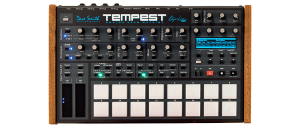
Tempest is a professional drum machine that generates its sounds using six powerful analog synthesis voices, and uses an innovative, performance-oriented operating system that permits an extraordinary level of control to create, edit, arrange, and manipulate beats in real time without ever stopping.
The performance-oriented operating system, ninety panel controls, and bright 256 x 64 dot OLED display work together to provide a tightly integrated, non-stop workflow.
- Record a drumbeat in real-time
- Switch to another drumbeat and use the lit pads to record it using step programming
- Switch to another drumbeat and record tuned keyboard parts
- Use the two touch controllers to to record real-time note sound animations or perform beat-wide sound changes
- Use the generous sound controls to edit any of the drum sounds
- Tweak the analog effects or drum mix
- Arrange beats in real time and record the live arrangement into a song
- And all of the above without ever stopping play
Each of the six analog voices has two analog oscillators plus two digital oscillators (with a large bank of included samples), the classic Curtis analog lowpass filter with audio-rate modulation, an additional highpass filter, analog VCA with feedback, five envelopes, two LFOs, an extraordinary variety of analog modulation routings, and stunning sonic quality, warmth, and punch. Although optimized for drum sounds, it excels at tuned sounds as well, and even doubles as a six-voice analog keyboard synth.1
Sixteen pressure- and velocity-sensitive lit pads are arranged in a 2 x 8 configuration, providing intuitive access to all your fingers and the ideal compromise between the popular 4 x 4 pad arrangement (popular for real-time programming ) and 1 x 16 arrangement (popular for step programming) because Tempest does both. The pads can be used to play thirty-two drum sounds2 (two banks), mute/unmute the thirty-two sounds on playback, play and arrange sixteen beats in real time, play one sound at sixteen tunings (in a variety of scales) or sixteen velocities, or as sixteen time steps for step programming. The ROLL button permits creating drum rolls or repeated groove patterns by varying pad pressure as the beat records, and doubles as a momentary “stutter” effect when the pads are assigned to play beats.
First Look at the DSI Tempest Drum Machine with Performance by James Jaret Kojac
Mark Mosher put out this nice demo of the tepest in action: “Sound designer James Jaret Kojac of Denver invited me over to take a first look and listen to one of the first Tempest’s to be released into the wild. James has nit #0026 which he got early so he could contribute to factory libraries. This is a video of James jamming with some of his sounds and really shows off the range and performance aspects of the DSI Tempest analog Drum Machine”
micronaut – experiment seven
“In the middle of beta-testing the DSI Tempest, I decided to knock out a quick movie showing the cool pattern-switching and ribbon controller abilities. Also in this video: MeeBlip and DSI TETR4, and Eventide TimeFactor. Recorded to and mixed from 8-track 1/2″ tape.”
Hardware feature The TETR4:
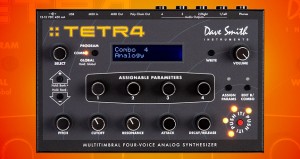
- Affordable, fully programmable poly synth with a 100% analog signal path.
- Classic, real analog sound—including legendary Curtis analog low-pass filter.
- Four-part multitimbral capability with four separate outputs.
- Combo Mode for huge unison patches, stacked sequences, and “modular-style” poly sounds.
- Expandable: poly chain with other Tetras, Prophet ’08, and Mopho for expanded polyphony
- Just 7.9″ x 5″ (20.07 cm x 12.7 cm).
- Free editor for Mac OS and Windows.
Overview
Tetra is our next-generation analog poly synth. Tetra takes the award-winning sound and features of Mopho, multiplies them by four, and packs them in a box less than half an inch larger!
Tetra has multiple personalities. It is a four-voice, analog poly synth, a sort of “mini Prophet.” It’s a four-part, multitimbral synth with separate outputs, essentially four Mophos in one very compact box. And it’s a voice expander for other Tetras or the Prophet ’08.
Outside the Box
Physically, Tetra is similar to Mopho, with four assignable parameter controls per program and a row of controls dedicated to the most commonly used performance parameters. All of the parameters can be accessed from the front panel and Tetra is fully programmable. A free, downloadable editor is available for Mac OS and Windows to facilitate more comprehensive tweaking.
Most of the rotary controls are detented encoders, but Cutoff and Resonance are potentiometers, allowing full sweeps with a single turn. The Push It button is a manual trigger to play notes and latch sequences on without the need for a MIDI controller.
Audio is output in mono, stereo, or per voice, via the four audio output jacks. There is also a headphone out. MIDI communication is by standard MIDI in and out jacks or USB. Poly Chain Out is a special, dedicated MIDI output to chain multiple instruments for increased polyphony.
Under the Hood
The voice architecture is based on the Prophet ’08, but with the addition of a sub-octave generator for each oscillator and a fully programmable feedback loop for each voice. That breaks down to two DCOs, a resonant low-pass filter, three DADSR envelope generators, four LFOS, deep modulation routing, an arpeggiator, and a 16 x 4 analog-style step sequencer per voice. Feedback is capable of producing effects ranging from mild distortion to fairly extreme harmonic instability. (That’s a good thing.) The possibilities are nearly endless. And the audio signal path is 100% analog.
DATAMASKIN

