
NOISY JELLY
This project is a fully working prototype made with Arduino and Max/Msp, there are absolut no sound editing in the video…
More picture at this flickr set (flickr.com/photos/raphaelplu/sets/72157629621382055/)
And download the Project pdf here (pluvinage.eu/NOISYJELLY_presskit.pdf)
Noisy jelly is a game where the player has to cook and shape his own musical material, based on coloured jelly.
With this noisy chemistry lab, the gamer will create his own jelly with water and a few grams of agar agar powder. After added different color, the mix is then pour in the molds. 10 min later, the jelly shape can then be placed on the game board,and by touching the shape, the gamer will activate different sounds.
Technically, the game board is a capacitive sensor, and the variations of the shape and their salt concentration, the distance and the strength of the finger contact are detected and transform into an audio signal.
This object aims to demonstrate that electronic can have a new aesthetic, and be envisaged as a malleable material, which has to be manipulated and experimented.
Author: Raphaël pluvinage (pluvinage.eu and twitter (twitter.com/#!/rpluvina)
& Marianne Cauvard (mariannecauvard.fr)
at L’Ensci Les ateliers (ensci.com)
Robot Band EOL covers Maroon 5 “Moves Like Jagger”
Background information:
In my previous videos I have received alot of comments requesting the vocal styles of Stephen Hawking so your wish is my command. This is song is based on the group Maroon 5’s “Moves Like Jagger” Please support the band and buy this song.
Vocals Digital DECtalk Express play both the male and female vocals (the same unit as Stephen Hawking used back in the 80’s) and it is controlled by a Genesi linux box
Robot Snare, Robot Bass Drum and Tambourine
Robot Keyboard and my trusty old HP Scanner
Check out this modified KORG – FrankenKorg 800 Demo
This Korg Poly 800 keyboard is modified with the Moog Slayer mod, FM 800 mod, 12/24 db filter switch, VCF external audio in, an Alesis Nanoverb, and a Toshiba Libretto laptop computer. An Alesis Nanoverb and a Toshiba Libretto have never been built into a Korg Poly 800 synthesizer, until now. In this video I play the FrankenKorg to demonstrate most of its features and sound possibilities. Every sound is generated inside the FrankenKorg; no external effects were used. At some points during the video, I use a foot pedal I designed that connects to the synthesizer and controls the internal VCF cutoff. The video was recorded with a Sony DXC-327 and the audio was recorded with Pro Tools. A Toshiba Libretto 50CT laptop was designed to fit where the programming decal was on the original Poly 800. The Korg’s midi out is connected to the input of the MPU-401 controller in the Libretto and the audio output of the Libretto is switchable to either the VCF ext. in or the input of the Nanoverb. In this video, I used the software wavetable and OPL3 FM synthesis chip in the Libretto. The Alesis Nanoverb circuit board sits underneath the Libretto’s keyboard inside the FrankenKorg. Controlling the Nanoverb is accomplished through five of the eight added knobs on the Korg’s casing. The Nanoverb’s audio out can be routed through its original 1/4 inch outputs as well as the headphone output of the Korg. The Nanoverb provides reverb, delay, flange, rotary and chorus effects.
Innovative Instruments – Ribbon Tube Synth demo @ MusikMesse
Nice demo of a new electronic instrument featured at this year’s fair in Frankfurt
Hand built, with a DSP based synth inside, it’s most unsual.
Mobile particles (AVAILABLE on AppStore)
This application provides an unique way to enter inside the digital artist protofuse’s world.
Protofuse proposes an unique iOS application providing visuals & audio.
It includes an EXCLUSIVE 13 minutes Ambient track which makes you relax, zen and quiet.
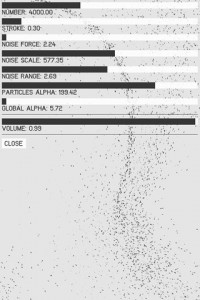
This minimal music application offers an amazing way to enter inside the world of this digital artist by listening an original 13′ track and by watching these strange particles clouds moving, grouping themselves, focusing in one or more point on the screen.
You can change 7 parameters in order to modify the global behavior.
This application is an unique experience inside the ambient & electronica minimal music world of Protofuse aka Julien Bayle
Available NOW on App Store : http://itunes.apple.com/us/app/mobile-particles/id509804829?mt=8
Synchronization Of Metronomes
Synchronization of Five metronomes using beer cans 
Sitar String Model
Video focusing on non-linear sitar interaction:
As a second challenge in the seminar on how objects vibrate, taught by Miller Puckette at UCSD, we were asked to simulate the non-linear way a sitar string interacts with the sitar bridge. In a typical string, like on a guitar, the string maintains a fixed length regardless of whether it is moving upward or downward. Since a sitar bridge is a wide, flat object, with tapered edges, the string comes into contact with different amounts of the bridge depending on its direction of travel.
This is a physical model developed in Max to simulate the sitar string.
Giant Speaker at University of Wisconsin
This is a giant speaker constructed for the UW -Madison Engineering Expo in 2011. It was built by a team of PhD students in electrical and mechanical engineering as a fun side project on a limited budget. The cone is made of polycarbonate and is 6 feet in diameter. The cabinet is 8ft x 8ft x 2ft or 128 cubic feet. Everything was custom made by the team, voice coil, magnet assembly, cone, surround, etc. Peak electrical draw is ~6kW. The video displays a chirp from 5 Hz to 500Hz or so. the speaker works best in the 5Hz – 50hz range. The video does no justice for the vibration this thing produces. We found the resonant frequency of the building it was in which caused “annoyance” for people several floors above us in the opposite side of the building. We were partially inspired by Doc Brown’s speaker from Back to the Future. A detailed history of the construction process may be found at http://www.ludoislabs.com/Giant_Speaker.html
#UNRAVEL Teaser
Coming soon #UNRAVEL – a new collaboration between FOUND + Aidan Moffat on the reliability of memory. As external conditions change, the music and narration distort, evolve and warp.
#UNRAVEL will be unveiled at Glasgow International Festival of Visual Art, 20 April – 7 May.
More information:
UNRAVEL opens to the public on 20 April – 7 May as part of Glasgow International Festival of Visual Art at Arch 24/ SWG3.
UNRAVEL is a collection of devices making up a gallery-based, reactive sound installation, through which the audience will attempt to unravel the truth about The Narrator’s life by playing records from his collection.
When we tell the story of a memory, how much of it is true and how much is shaped by who we are talking to? Once we’ve told the story many times, how do we even know what is true any more – what is constructed and what actually happened?
The installation is the work of Edinburgh based arts collective / experimental pop band FOUND, whose members include Ziggy Campbell, Simon Kirby and Tommy Perman and Glasgow-based author and musician, Aidan Moffat best known as one half of the band Arab Strap. FOUND and Aidan Moffat are signed to Glasgow record label Chemikal Underground.
At the heart of the installation is a vinyl record player and ten 7” records of familiar singles from pop music’s heyday. Visitors to the gallery are encouraged to select a record from the collection to be played. As soon as they drop the needle on to the record the installation springs to life. The vinyl controls a series of acoustic, self-playing musical instruments positioned throughout the gallery which soundtrack the story as the narrator recounts a memory he associates with that record. Each 7” record represents a different memory, but unlike conventional vinyl recordings they sound different each time they are played.
Just as a real narrator alters the way they tell a story depending on their mood, audience and context, the memories embodied in the installation will distort, evolve and warp depending on external influences: the time of day, the size of #UNRAVEL’s audience, the local weather, and what people are writing about the installation on twitter from moment to moment.
A year in the making, #UNRAVEL is the first collaboration between FOUND and Aidan Moffat and represents a major new body of work for both. The project required Aidan to write 10 short stories with multiple variations of each, to be soundtracked by a total of 160 new musical compositions by FOUND.
With Investment from Creative Scotland’s Vital Spark programme and New Media Scotland‘s Alt-w Fund with the support of the Centre for Design Informatics, Glasgow International Festival of Visual Art, SWG3 and the University of Edinburgh.
Digital Enhancement – sound installation
“Digital Enhancement” is an interactive sound installation consisting of an electrified Symphonion Brevet No. 28, a synthesizer, an amplifier and four headphones. The Symphonion musical box dates back to the beginning of the last century and its mechanical workings are combined with digital technology to convert it into a MIDI sequencer. The original music, embossed on steel plates, can be played on the synthesizer, which is programmed to mimic the sounds of the Symphonion. In order to operate the sequencer, a hand-cranked dynamo serves as a remote control.
Additional Information:
2011, interactive sound installation, hand-cranked dynamo, micro-controller, custom electronic circuit, hardware of antique musical box, embossed steel plate, antique wooden cassette, stepper motor, hardware synthesizer, headphone amplifier, headphones, misc cables.
Project website: mar.li/digital_enhancement.php
DATAMASKIN

