
Acid 64 in a new version

New
- Added native support for JSidplay2 and JSidDevice
Improvements
- Faster startup time
- Emulation improvements
- Copy file/directory added to context menu
- Many small improvements
Fixes
- ACID64 couldn’t start on some Windows 7 64 bit machines
- Turning filter off and seek back turned filter on
- Switching device and then seeking could silent the tune
- Fast forward could freeze GUI in some cases
ACID 64 Player – Commodore 64 Music Player for all HardSID devices.
First glimpse of the Mutable Instruments ShrutHI-1 digital/analog hybrid monosynth
A sneak preview of a new DIY synth project – the Mutable Instruments ShrutHI-1 digital/analog hybrid monosynth.
The video demonstrates some of the presets on ShrutHi-1 Kit #000.
Specs below. See the Mutable Instruments site for details.
2 digital oscillators
- band-limited sawtooth with adjustable phase
- band-limited square wave with adjustable pulse-width
- band-limited triangle wave with adjustable waveshapping
- phase-distortion emulation of a low-pass filtered sawtooth (casio CZ-101)
- phase-distortion emulation of a low-pass filtered sawtooth with high resonance (casio CZ-101)
- phase-distortion emulation of a low-pass filtered sawtooth in the Rocker Launcher’s world in which sine waves are turned into triangles (casio CZ-101)
- mysterious phase-distortion thing (could have been in the CZ-101 if the engineers at casio dared…)
- phase-distortion emulation of a Jew’s harp / Morsing (could have been in the casio CZ-101)
- stack of 4 detuned sawtooth waves (with aliasing)
- simplistic FM (1>2 configuration), with adjustable modulation index and frequency ratio
- wavetables, wavetables, wavetables!
- sweepable table of basic waveforms
- tampura transwave
- PPG harsh creature
- single cycle waveforms taken from D50 patches
- cello transwave
- slap bass transwave
- organ/drawbars single cycle waveforms
- male voice
- user wavetable, can be edited by SysEx messages
- 8bit-like harsh waveforms with wavetable scan
- sine wave with variable amount of bitcrushing
- poor man’s square with pulse-width modulation (plenty of aliasing but fat for basses)
- colored noise (sweep from low-pass filtered white noise -> white noise -> high-pass filtered white noise)
- lo-fi vowel synthesis (think “speak and spell”) with vowel morphing
Mixer
- adjustable oscillator balance
- mixing algorithms: simple sum, simple sum with synchronization, ring modulator, xor modulator, sum with post-mixing tanh fuzz
- extra sources: noise, sub-oscillator (triangle or square) or percussive attack generator (click, glitch, blow, metallic, pop)
Audio quality/resolution
- Internal digital audio signal processing chain: 39062 Hz, 8 bits.
- Internal digital control signals processing chain: 976 Hz, 8 bits.
- Digital outputs: 10 MHz, 1 bit.
Filter
- Exchangeable analog signal processing boards:
- CEM3379: based on the CEM3379, uses the same circuit as the original Shruti-1 with the “click filtering” mod
- SMR4: a 4-pole LPF (very SSM2044-like) and linear VCA built with the widely available LM13700 transconductance amplifier and TL074 op-amp
- SSM2044: SSM2044 4-pole LPF, SSM2164 2-poles HPF + linear VCA.
- (à suivre)
Modulation
- LFOs: 2, with square, sawtooth, triangle, sample & hold, and step sequencer shapes. Syncable to tempo. Adjustable “raise/attack” time. LFOs can be free-running, sync’ed to envelope retriggers, or retrigger envelopes.
- envelopes 2 ADSR
- modulation matrix: up to 12 source -> destination connections. Adjustable modulation amount in the -100% — 100% range
- modulation sources:
- LFO 1/2
- step sequencer
- first / second half of the step sequence
- arpeggiator gate
- mod. wheel
- aftertouch
- pitch bender
- DC offset
- CV inputs 1/2/3/4
- MIDI CC 16 to 19
- noise generator
- env 1/2
- random value resampled at each note on
- note velocity
- note number (eg for filter tracking)
- keyboard gate
- audio signal from the mixer output (decimated at 1kHz)
- modulation destinations:
- filter cutoff
- VCA gain
- pulse width/Parameter osc. 1/2
- wide pitch osc. 1/2
- pitch, applied to osc 1 & 2 simultaneously
- very fine pitch, applied to osc 1 & 2 simultaneously
- oscillator balance
- noise level
- subosc level
- resonance
- PWM CV output 1
- PWM CV output 2
- 2 bits digital value on CV output 1/2
- LFO1 FM
- LFO2 FM
Performance
Clock/tempo generator
- internal clock: 40-240 BPM, with some additional extra fast tempi for effects (270, 300, 360, 480, 600, 720, 960)
- external MIDI clock with divider
- 6 groove templates (swing, shuffle, push, lag, human, monkey) with adjustable amount
Arpeggiator
- 1-4 octave range
- up, down, up&down, random
- 15 preset rhythmic patterns + 1 programmable rhythmic pattern
- warp: creates complex rhythms by cyclical repetitions of steps (eg 1212343456567878 instead of 12345678)
- latch/hold
Sequencer
- 16 steps, with legato/slide, velocity, and modulation
- 4 modes corresponding to different interactions between the sequence and keyboard play: latch / transpose / loop recorder / override
Performance
- custom page in which 4 user-selectable parameters can be assigned to the 4 editing pots
- microtunings/key maps for arabic scales (1/4 tones) and a selection of hindustani ragas
- portamento, legato on/off
- master tune
System and memory
- complete MIDI implementation, including patch editing by CC or NRPNs, patch and sequencer data transfer, full memory backup, wavetable transfer
- MIDI out modes: off, thru, thru+knob movements sent as CC, sequencer/arpeggiator generated events only, polychaining, split (plays notes below split point, forwards the other notes)
- patch memory: 80 patches and 80 sequences stored in EEPROM (no backup battery required)
- firmware update by SysEx
Hardware and connectors
- power: 2.1mm connector, requires 7.5V-9V 300mA supply (can be unregulated). Center pin positive (+), outer collar negative (-)
- audio input/output: 6.35 Jack (Mono audio out), 6.35 Jack (External signal in)
- cv inputs: up to 4 CV inputs for easy experimentation with controllers ( might not be broken out on analog VCF/VCA board )
- cv outputs: up to 2 CV outputs ( might not be broken out on analog VCF/VCA board )
- MIDI: in, out
- serial: extra UART TX pin available on control panel board (might be used in future firmware updates to control extension boards)
- ISP connector for firmware development
- controllers:
- 8 facade LEDs (current page / modulation matrix visualization)
- 6 navigation switches
- 4 pots for patch editing
- clickable rotary encoder for fine parameter adjustment or navigationbacklit 2×16 LCD display
Free retro-style software synth plugin
Angular Momentum has released Retronix, a free retro-style software synth plugin for Windows.
The synth features 2 x 5 oscillators and one of them offers a wavetable mode with 135 waves.
The filter has overdrive, key tracking, an ADSR envelope and an extra High Pass filter to filter out unwanted low frequencies.

Ammonite, the latest Astralis Synth which builds on Bion


Homegrown Sounds has released a beta version of Ammonite, a virtual synthesizer instrument for Windows.
I’m pleased to announce the release of Ammonite, the latest Astralis Synth which builds on Bion but with a lot more power and functionality. Firstly, the TerraNova effects engine has been included which gives the synth a unique, diverse and powerful effects section.
Ammonite features (in comparion with Bion and Orgone)
- Modulation Matrix – Now has 7 destinations.
- Terranova FX Engine – Has up to 5 effects at once, 3 General purpose Modulators which can be many effects such as Flanger, Phasers, Pitch Shift, Filters, Mod Delays, Chorus, FM etc… Also includes SoundScaper, Stero Delay, Compressor, Drive with 4 modes, Graphic EQ, HIgh/Low Excfiters, Low Cut, Hi Cut and drag and drop Routing.
- A second LFO – Has two dedicated Destinations, used outside of the Modulation Matrix.
- Vibrato – With adjustable time and level, with a selectable source controller.
- Modulation Destination Quantizers – Allow each Modulation Matrix destination to quantize the signal to a defined amount, for glissando type effects.
- Global Pitch Shifter – Uses delay Pitch Shifting, can be set to Pre or Post FX.
- Two Envelopes dedicated to the Filters – With Level Control.
- 24 Note Polyphony – Max Polyphony is expanded to 24 notes (48 counting both synths). Custom Polyphony can be set to a lower amount using the Polyphony setting.
- Analog Mode – Four modes, each more extreme which apply distortion and random tuning to the sound, creating a warmer more analog sound.
- Low/Hi Frequency Exciters – Applies harmonic distortion to add Bass content or higher definition.
- Gate Sequencer 2 retriggers Modulators – Resets the Modulator LFOs for some interesting effects.
- Voice Reducer – Allows the total volume to be decreased with each note press to help balance the sound.
- 2 x XY Controllers – Can be assigned to a number of parameters, useful for recording automation.
- Built with SE 1.1 – Faster Graphics speed, Dual Core bug fixed,
- Keyboard Velocity Scales – 4 Different input characteristics to change the feel of the external keyboard controller.
- Bigger Envelope boxes – Makes grabbing much easier, especially with the release section.
- Better use of Display Area – The panel size is now larger resulting in a more logical layout and less pages.
- Master ON/OFFs for all sections – This is always visible at the right hand size for quickly enabling/disabling the main components.
- Flexibility – The oscillator and Modulators are designed so that it will be easy to add new modes in the future.
Ammonite will be free for Bion and Astralis Pack users. A beta version is currently available to download for registered users.
More information: Homegrown Sounds
VOCALIZER – the new vocal Production Synthesizer
SONiVOX Unveils VOCALIZER, a Vocal Production Synthesizer for both Mac OS and Windows.

Press-release:
New technology synthesis engine coupled with input based synthesis delivers creative new tool for vocalists and non-vocalists alike.
SONiVOX, Boston MA, based award-winning music software company today offered a pre-release preview complete with MP3 and Video examples of the first instrument from their new NEMESYNTH Audio Research Group, VOCALIZER – Vocal Production Synthesizer.
VOCALIZER is a completely new concept in modern music production that couples a new technology synthesis engine with an open input based architecture. VOCALIZER is one part effect plugin and one part virtual instrument. Vocalists, non-vocalists, & producers feed VOCALIZER any audio source, and it re-pitches, effects, and re-synthesizes the original source into a whole new sound.
Primarily designed for vocal use, vocalists will enjoy the vast options afforded by VOCALIZER to add previously unattainable dimensions to their voice. Inversely, non-vocalists will enjoy the opportunity to use their voices in musical ways that they previously thought impossible.
VOCALIZER also works well with other types of inputs. Drum & percussion tracks fed through VOCALIZER result in complex synth lines that perfectly sync to the original dry drum & percussion parts. Other input sounds afford a powerful and flexible new approach to sound design. VOCALIZER users can take any sound and use it as a shaping tool to be VOCALIZED.
The VOCALIZER marks the first release from SONiVOX’s NEMESYNTH Audio Research Group. Spearheaded by noted audio guru and scientist Jim Van Buskirk, pioneer inventor of the virtual instrument, modern computer driven sampling, and real-time low-latency convolution, SONiVOX’s NEMESYNTH Audio Research Group’s sole purpose is to discover, research, & develop revolutionary new enabling technologies for musicians everywhere.
VOCALIZER – Vocal Production Synthesizer is MAC & PC compatible and will work with most major DAW software as a VST, AU, and RTAS plugin.
VOCALIZER – Vocal Production Synthesizer is slated for a release date of October 1st 2010 with a MSRP of $149.99 and an estimated street price of $99.99
SONiVOX claims that VOCALIZER must be heard to be believed and invites all to checkout the VOCALIZER videos and mp3 examples at www.sonivoxmi.com
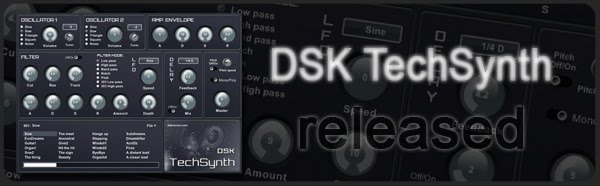
TechSynth, a free virtual syntesizer instrument for Windows
DSK Music has released TechSynth, a free virtual syntesizer instrument for Windows PC.
DSK TechSynth features
- 2 Osc with 5 waveforms.
- Amp. envelope and detune control.
- Advanced filter with ADSR and LFO.
- Delay filter.
- Pitch / poly control.
- +60 patches.
- Velocity response.
DSK TechSynth is available to download as a freeware VST instrument plug-in for Windows PC.
More information: DSK Music
Meet the Flintstones´synth
General review and demo of the Ciat Lonbarde Tetrazzi Organus, a touch-input synthesizer. Read more about it here: http://www.ciat-lonbarde.net/tetrazzi…
Tetrazzi sounds recorded directly to Samson Zoom H2, video and voice over captured by iPhone 4.
Read other reviews and watch other videos at my site: http://www.addictedtonoise.net/
http://www.youtube.com/watch?v=QbU-2GTJoJY
TubeOhm launches PURE D16/24 Grain synth
TubeOhm launches PURE D16/24 Grain, a VST synth for Windows.

“GRAIN is an experimental GRAIN synth with complete new sounds.
GRAIN works with the GRAIN SYNTHESIS. You can load you own Samples into
the synth, drive through the sample, modulate the grain or stop the GRAIN on a position in the sample.After the GRAIN oscillator you can use a ,normal‘ VCA,VCF, CHORUS, DELAY,
REVERB and a GATER function to design the sound. “
Features:
- – one GRAIN OSCILLATOR – static/dynamic mode
- – three LFO, mono, poly, host sync,pwm,phase
- – using you own samples
- – two different samples generate one grain
- – gater function
- – multimode filters
- – multistage envelope for GRAIN manipulation
- – VCA / VCF ADSR
- – effects unit with delay, chorus, reverb, arp
- – soft distortion
- – midi learn
Robert Rich discussing the Synth Tech MOTM synth
This is part 0 of musician Robert Rich discussing the Synth Tech MOTM synth he is using on his current live tour and general thoughts on music composition and the use of modular synthesizers for live performances. Additional info about Robert can be found on his web site http://robertrich.com/
I took the opportunity to record video clips of this evening on my Nikon D300s camera using an AF-S Nikkor 35mm lens. Sound was recorded just using the camera’s built in mic, which while not optimal, yielded reasonably good results.
Thank you for watching and don’t forget to watch the other parts! I created the first two installments from the middle of the lecture and I didn’t think I was going to do any more. But there has been some demand for more so I’ve now created four more parts. To keep things chronological so you can follow the lecture as it happened (minus all of the parts I missed due to camera limitations or I edited out ;-), the two parts that come before part 1 are named 0 and 0.5. The final two installments that come after part 2 are named 3 and 4 of course!”
Neuron sequencer coupled with 7 individual FM synths
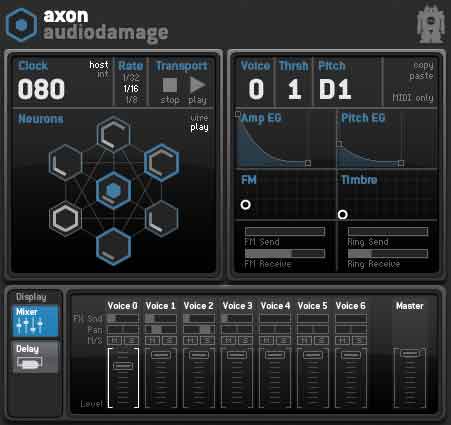
Audio Damage have released Axon which they describe as a Neuron sequencer coupled with 7 individual FM synths. Here’s what they have to say about it…
Axon is a strange creature, and we won’t tell you otherwise. Our goal was to come up with a new style of percussion sequencer/synth that wasn’t linear and x0xy, and we succeeded beyond our wildest expectations. The Neuron Sequencer in Axon is a fundamentally different way of thinking about rhythmic sequencing, and results in new patterns and styles that will bring your IDM, dance, and ambient tracks to another place.
Axon’s sequencer can either drive external synths and samplers or its own internal voices, seven of ’em, which are FM-based, but designed for quick and easy programming, and fine-tuned for percussive-type sounds. A full MIDI Learn complement allows external hardware control of both the sequencer and the internal voices, and an on-board stereo delay taken right from our fairly thick collection of delay algorithms extends the rhythmic possibilities right to the edge of what any sane person could possibly stand.
We’ll be the first to admit that Axon is an experimental tool, and isn’t for everybody, but if your interests lie in the abstract realm, and you want to take your rhythm and melody programming to strange new worlds, this might be just the thing.
NOTE: Axon for OS X requires 10.5.1 or greater, and is Intel only. Axon for Windows is both 32- and 64-bit.
Axon Features:
- All new Neuron Sequencer, a seven-node hexagonal counter sequencer.
- Seven FM percussion-tuned voices, also capable of melodic expression.
- Unique FM and Ring Mod busses for global FM and Ring Mod.
- Full MIDI output control (VST only) for driving external synths, drum machines, and samplers.
- Full internal mixer that also controls MIDI output velocity, with solo and muting.
- Internal stereo delay, taken from the best of Audio Damage’s delay algorithms, with low- and high-pass filters and a playable feedback control.
- Full MIDI Learn mode, for external hardware control of all Axon parameters.
Pricing and Availability:
$59
More information:
DATAMASKIN


