
Teenage Engineering – What Is That?
Teenage Engineering – What Is That? Cloud speaker explained
Everything you need is Built-In.
Inside the OD-11 you’ll find an integrated amplifier that delivers 100W. Combine this with integrated WiFi and a sound processor and you have everything you need to enjoy cloud music.
To make the user experience even greater we designed an amazingly simple volume remote with wireless communication built around the latest Bluetooth 4 Low Energy chip that allows the remote to run for years on a single button cell battery.
We also added a magnet on the back of the remote so you can stick it to anything from your fridge to the front of your OD-11.
Reintroducing good sound.
The original Carlsson OD-11 was introduced in 1974. Created by Stig Carlsson, the Swedish engineer that challenged the audio industry in the 60s and 70s by designing and refining his loudspeaker for real living rooms, as opposed to the common practice of developing speakers in perfectly damped rooms. Oddly, that contradiction is the same today.
At introduction the OD-11 was the most affordable HiFi speaker of its time. The Carlssons loudspeakers sold over 100.000 pairs just in Sweden and was instantly established as icons of it’s time.
Teenage Engineering on cloud hunting – Introduces the OD-11 Cloud Speaker

Here’s the background info:
World’s first Cloud Speaker.
Today, almost all music has moved to the cloud. We think this is great evolution. Sadly, the audio equipment needed to listen to music in the cloud hasn’t really caught up with this transition. We investigated the market closely, but we couldn’t find one system that delivered both great sound and a great user experience. So we had to build it ourselves. We have created a device that is built from the ground up especially for enjoying music in the cloud. We call this device Cloud Speaker.
Everything you need is Built-In.
Inside the OD-11 you’ll find an integrated amplifier that delivers 100W. Combine this with integrated WiFi and a sound processor and you have everything you need to enjoy cloud music. To make the user experience even greater we designed an amazingly simple volume remote with wireless communication built around the latest Bluetooth 4 Low Energy chip that allows the remote to run for years on a single button cell battery. We also added a magnet on the back of the remote so you can stick it to anything from your fridge to the front of your OD-11.
Reintroducing good sound.
The original Carlsson OD-11 was introduced in 1974. Created by Stig Carlsson, the Swedish engineer that challenged the audio industry in the 60s and 70s by designing and refining his loudspeaker for real living rooms, as opposed to the common practice of developing speakers in perfectly damped rooms. Oddly, that contradiction is the same today. At introduction the OD-11 was the most affordable HiFi speaker of its time. The Carlssons loudspeakers sold over 100.000 pairs just in Sweden and was instantly established as icons of it’s time.

The original Carlsson speaker.
Teenage Engineering has worked closely with the Stig Carlsson Foundation to build on the tradition of Stig Carlssons work and his life long mission for great natural sound. The result of this is OD-11. Carefully and meticulosly re-engineered by Teenage Engineering. Welcome to a great cloud music experience.
Teenage Engineering – The PSM x OP-1
Filmed at gHouse, London: Super talented artist, Pauli “The PSM” performs a fresh composition with sounds from the OP-1’s extensive sound banks and graphics captured from the OP-1’s OLED display.
Director: Rohan Blair-Mangat
D.O.P: Benjamin Thomas
Soundtrack: Pauli “The PSM” http://psmthepsm.com
Teenage Engineering OP-1: Tape Machine Troubles
This guy is experiencing ghosts on his OP-1, check it out, details below:
Today while working on a composition on the OP-1, this strange problem arose. Ghost audio segments. Watch the video and you will see what I mean. Anybody else out there have this problem? Yo, TE.. a little help!
OP-1 LEGO SONG and the LEGO beat sequencer
A little song made possible by the new Brick Shaft accessories!
SoundMachine is a 4 track 8-step drum sequencer that uses the LEGO Mindstorms NXT to scan a set of drum “notes” which are then played using Ableton Live. The NXT uses four colour sensors to detect the colour of 2×2 LEGO bricks as the plate is scanned in. A controller written in Processing interprets the colour pattern and sequences MIDI note messages to send to Ableton Live, which in turn plays the sounds you hear.
The music on the video was created by SoundMachine itself – music you can build!
Teenage Engineering’s Oplab explained
DIY triggering and connectivity playground on camera. The Oplab Musical Experimental Board allows you to interconnect virtually any electronic musical instruments. And finally it’s just plug and play. No more hassle with one box for MIDI and another for CV or a third for USB. Oplab has it all in one place. Just connect your cables, set the appropriate scenario and experience a perfect sync.
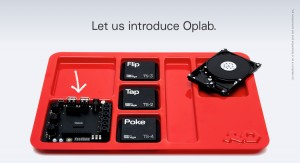
One of the fundamental ideas behind Oplab is to let you connect things, toys or junk that you already have around you and to make it interact with your electronic musical instruments. Grab a broken hard drive, rip it apart, connect and use it as a scratchpad. A simple one is to just connect a mouse. Eureka! The mouse is now a pitch bender.
New Teenage Engineering OP-1 Synth Accessory Demo
A short demonstration of the new accessories released for the Teenage Engineering OP-1 Portable Sampling Synthesizer.
Mind you, you still pay for the style – though these are just plastic, that design and packaging will cost you anything between €9 (crank or brickshaft) and €79 for the Soft Case.
More Information
Live OP-1 + Piano (Crank)
Tryggve Stakkeland is testing out the crank. OP-1 runs through el cap and cathedral. Polar controlling NI The Giant.
—-
soundcloud.com/trygvestakkeland
OP-1 Accessories Review – Unit Portables Bag
Presented here is DJ Thomas White’s review of the new Teenage Engineering OP-1 Accessories line including:
Brick Knobs
Antenna
Crank
Bender
Screen Protector
Accessory Bag
Unit Portables OP-1 Bag
Thomas provides a brief overview of each item with as much detail as he has at this time. His focus is on packaging, quality and basic application. In depth use and techniques may be presented in future videos.
“I love the bag! Get one now to protect your OP-1 from the elements. Thank you Teenage Engineers and also to you, the viewer for checking out another one of my videos. Happy music making!”
Bending and cranking the OP-1
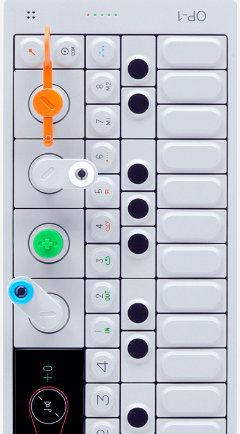
A simple little demo with the Teenage Engineering OP-1 and it’s new accessories the Bender and the Crank. There are a lot of things one can do with the Bender and the Crank, and the couple of things here aren’t even the most interesting.
The Bender is acting as an “LFO” on the parameters of the Digital synth of the OP-1. The Crank is operating the Endless Sequencer, like a music box.
Screenshot of these quirky little things below:
DATAMASKIN

