
OSA (Old School Arps) for Kontakt
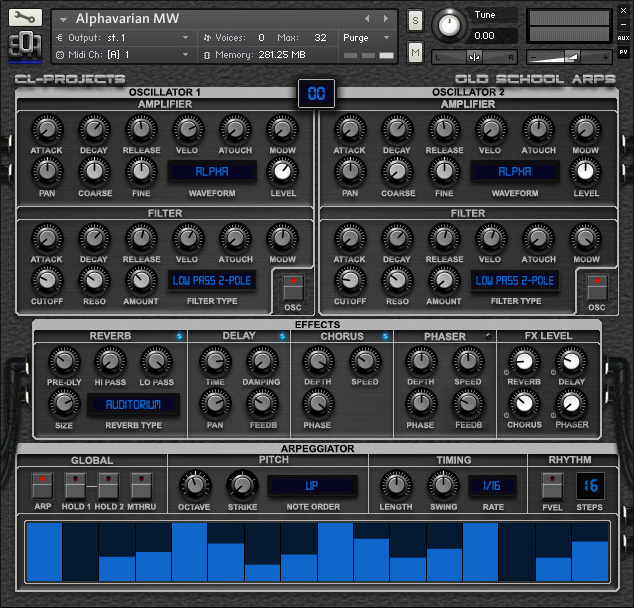
CL-Projects releases OSA (Old School Arps) for Kontakt 5.1 and higher.
Here’s what they say: “Imagine yourself in a cellar, filled with vintage synthesizers and analog sequencers, flashing lights, knobs and faders everywhere, playing Berlin School electronic music. If you don’t have any of that equipment to your disposal, this library is the next best thing. It tries to bring some of that sound and feeling to your home and studio by supplying vintage arpeggio patches.”
The Berlin School electronic genre of music was first made in Berlin in the 1970s, hence the name, by electronic music artists like Tangerine Dream, Klaus Schulze and Ashra. Typical for this type of music are the evolving, atmospheric and hypnotic layered sequencer textures. The sound consists basically of ambient elements combined with short, repeating sequenced runs of notes, which gives the music a rhythmic element.
OSA is a Kontakt 5 library aimed at this genre of electronic music from the 1970s and 1980s and consists of vintage arpeggios, and a few modern ones too. Inspired by musicians like Jean Michel Jarre, Tangerine Dream, Klaus Schulze, Michael Hoenig and countless others.
Library Features:
- For Kontakt 5.1 and higher (Full version).
- 24-bit 44.100 kHz ncw samples.
- 50 different waveforms per oscillator.
- 24 samples per patch, 12 per oscillator (76 notes).
- Velocity and Aftertouch responsive.
- 6 folders containing a total of 151 patches.
- Patches divided into Straight, Triplets and One Shot (separate folders).
- 4 Effects: Reverb, Delay, Chorus & Phaser.
- Time and Speed parameters sync to Host tempo (Delay, Chorus and Phaser).
- All parameters on 1 page.
Price: £19.99.
More info on the OSA product page: www.cl-projects-sound-design.com/osa
LinnStrument Pedal Steel
Roger Linn hasreleased a couple of videos that demo the LinnStrument – a new multitouch musical instrument. Both demos highlight the instruments ability to let you independently articulate each individual note.
The LinnStrument is currently in development. Pricing and availability are to be announced.
Modular Monday morning
This video captures a live studio performance on Synthesizers.com modular by Manuel Schulz.
Background video description:
After a long time, I have a new Dotcom live video for you. Again, there is no multitracking; just live performance of the Dotcom Studio 110. I have used a Boss DR-55 for the rhythm and an Electro Harmonix Small Stone phaser for the pad. The Lexicon PCM 96 does the reverb and the delay. That’s all. This time I recorded the music directly to disc without any microphone – so the sound quality should be much better now. If you wish, I can post another video with some explanations about the patch and how all this works. Just let me know.
Demo featuring the RSF Polykobol II
RSF Polykobol 2 demo.
All tracks are made with the Polykobol, except drums.
Cubase Vst used for the record, and synchronised with Polykobol arpeggiator
About RSF and the Kobol line:
The RSF Kobol was the French synth company’s first compact keyboard synthesizer, certainly inspired by the Minimoog. It is a much more compact instrument than the Modular Model 11 series of synthesizers they had been making thus far. It is a monophonic analog synthesizer with traditional controls, knobs, switches and two oscillators for a good solid analog synth sound. Initally released as a keyboard in 1978, a 3-unit rack-mount system was later released in 1979.
Although it is mostly a traditional analog synth with stable oscillators and lots of knobs that allow you to control the ADS envelope, the filter section and the nice LFO, it did offer some unique features for its time. Most notably, the oscillator waveforms can be continuously swept across for a very cool morph from square to saw to pulse, etc. This, as well as note on/off and other parameters can be controlled via CV/gate. External sounds can be processed through the Kobol filter and envelope sections too.
The rack version came in four different components. The Kobol Rack (Expander I) was essentially only the VCO/VCF/VCA/LFO sections of the Kobol in a rack module. The Expander 2 was an add-on to the Kobol that added some new processing modules such as ring modulation, sample-hold, and envelope followers as well as extra VCA and LFO modules. The Programmer rack module contained the memory circuits for storing patches and sequencing. And the KM8 was an 8-channel rack-mount mixer. The connections between modules were normalized but could be bypassed by external patches, similar to other semi-modulars like the ARP 2600 and Korg MS-20.
The Kobol looked and sounded great, and was quickly snapped up by the big names in synthesizers of the time. But being a small French company, RSF were never able to truly mass produce these on the same sort of scale that Moog, Arp, Roland or Korg could. Less than 200 Kobol keyboards were made, around 800 Kobol Racks, 200 Expander 2’s, 200 Programmer’s and only a handful of the KM8’s. This makes them quite rare and quite pricey too!
Fanfare for Absent Friends – Erik Norlander – A Tribute to Dr. Bob – Live in Asheville 2014
Erik’s kinetic rocker from “The Galactic Collective,” “Fanfare for Absent Friends” performed live at “A Tribute to Dr. Bob – A Benefit for Dr. Bob’s SoundSchool and the Bob Moog Foundation” on May 8, 2014 along with Jeff Kollman (g), Mark Matthews (b) and Nick LePar (d).
Erik plays the rare Moog Apollo synthesizer on loan from the Bob Moog Foundation for this concert. The Apollo is featured at 1:00 and 4:54.
http://www.thetank.com
http://www.eriknorlander.com
http://www.bobmoogfoundation.org
Dr. Bob’s SoundSchoool teaches children about the science of sound through the magic of music. To find out more and to support this innovative curriculum, please visit: http://bobmoogfoundation.org/projects…
Burial – Rival Dealer
DEALER
WRITTEN & DIRECTED: Ben Dawkins
PRODUCER: Jess Wylie
PRODUCTION: The Sweetshop // thesweetshop.tv
EXC PRODUCER: Spencer Dodd
PRODUCTION MANAGER: Lisa Mesgian
1ST ASSISTANT DIRECTOR: Andrew Vanneck
2ND ASSISTANT DIRECTOR: Virginia Lipinski
DOP: Olivier Cariou
FOCUS PULLER: Guy Hazel
CAMERA ASSIST: Harry Young
SOUND RECORDIST: Mustafa Bal
PRODUCTION DESIGNER: Russell De Rozario
ART DEPARTMENT ASSIST: Rosie Paynton
ART DEPARTMENT ASSIST: Miles Lacey
STUNT COORDINATOR: Lee Sheward
COSTUME DESIGNER: Michelle May / Tottie Oclee
MAKE-UP ARTIST: Ezana Ove
CASTING: Kharmel Cochrane
EDITOR: Paul Hardcastle
SOUND DESIGN: Munzie Thind @ GRAND CENTRAL
MUSIC & INSPIRATION: ‘RIVAL DEALER’ by BURIAL
hyperdub.net/releases/view/258/HDB080
Made with the kind permission of William Bevan aka BURIAL. Thanks to Will, Marcus and all the good people at Hyperdub for their enthusiasm.
POST: GLASSWORKS
POST SUPERVISOR: Misha Stanford-Harris
TELECINE: Duncan Russell
STARRING:
CURTIS: Osi Okerafor
JENNIFER: Jacqueline Alcarva
HOLLY: Princess Dadson
TRIAD BOSS: Bruce Wang
TRIAD MEMBER #1: Bruce Chong
TRIAD MEMBER #2: David C Cheung
TRIAD MEMBER #3: Jim Lui
STOCKBROKER: Martin William Askew
RICH KID: Rob Soar
RICH KID: Silvia Bususioc
AU PAIR: Rose Williams
PETER: Andrew Caley
CELEB: Brooke Burfitt
DANIEL: Nick Ofield
THUG #1: Kaz Ove
THUG #2: Darius Alexander
Mathon – Lieus Pers
Mathon «Lieus Pers» | er_dlp_063 (double vinyl incl. fotobook)
Video and copyright by Stefan Flükiger (behance.net/stefan_fluekiger)
«Lieus Pers» is an extensive photo-series by Stefan Flükiger. The Bern based photographer sought out abandoned industrial areas and subterranean canals that have been gradually retrieved and sprawled by nature.
These pictures of deserted industrial spaces inspired the music collective Mathon for their new – already 6th – release «Lieus Pers». The photographs show places such as the old town-hall canal of Bern, dating back to the 17th Century, which was allegedly used as an escape route for the city government.
These pictures of lost places are overlaid with nature imagery from Domleschg, there where the village of Mathon is located. Mathon core members Thomas Augustiny, Pete Aurel Leuenberger and Roger Stucki have created 12 sound researches for «Lieus Pers».
Ambient sound researches for which, the three musicians visited these submerged and meanwhile lost places, scattered all across Switzerland. Electro-acoustic tracks emerged, recalling these dystopian constructions and echoing a potential contemporary soundtrack for Andrei Tarkovsky’s film-opus «Stalker».
Layers of time and space interfere on the album «Lieus Pers» for which Mathon also invited musical chums and companions such as Mich Meienberg, Maria Capelli, Nicolas Kellner, Julian Sartorius and the band Digitalis to contribute to the oeuvre.
Combined with the digitally alienated photographs, the album is a quest for traces, conciliating graphics and sound, past and present, nature and technology.
«Lieus Pers», Rhaeto-Romanic for «lost places», is an impressive contemporary document by Mathon collective, whose tracks already featured on «The Wire Tapper» CD-series by UK music magazine «The Wire».
A document that transforms strange industrial and nature architecture into cleft soundscapes.
mathonmusic.ch
urbanexploration.ch
Buy:
everestrecords.greedbag.com/buy/lieus-pers/
On Lieus Pers, Augustiny, Leuenberger and Stucki have created 12 soundscapes, inspired by dystopian landscapes. According to the group, “the album is a quest for traces, conciliating graphics and sound, past and present, nature and technology.”
Modular: Madrona Labs Kaivo on a Touchscreen Monitor
Kaivo is a semi-modular software synthesizer that combines two powerful ways of making sound: granular synthesis and physical modelling. A capable software modular synthesizer – running on a touchscreen. The system is running WIndows 8.1, Ableton Live & using a Lenovo 1423p monitor.
Spark! – “Mittsommernacht (feat. Blitzmaschine)”
Spark! celebrates midsummer with this new video, enjoy
From their upcoming album Spektrum!
MIDIFlow – new iOS app for MIDI routing control
Johannes Doerr has introduced MIDIFlow, a new iOS app that lets you send MIDI from app to app in a similar way to what you already do with audio.
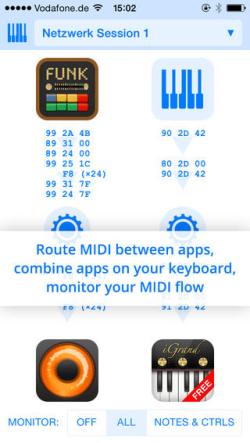
That way, you can sync apps with each other or send MIDI parts from a sequencer app to different synth apps.
You can also route the MIDI from your keyboard to apps and assign different key zones to them.
In addition, all MIDI transfer can be monitored in order to find problems or just to learn what MIDI is doing (normally) behind the scenes.
MIDIFlow is available for US $4.99 in the App Store.
DATAMASKIN


