
Amazing machines: Moog Sub37 & DSI Pro2
The Moog Sub37 & DSI Pro2 together with the GrooveAgent (Cubase)
I don’t wanted to show wich one is better – but how good they play together 😉
this was a special wish from someone of the german forum for better comparing the two…
The Dave Smith Instruments Pro 2- Introduction / Analog Sound
Background video description:
Here is the first in a series of videos which demonstrate the sound and functionality of the Dave Smith Instruments Pro 2 synthesizer.
In this first video, I demonstrate how to get analog-sounding sounds out of the digital oscillators.
Hey, do you enjoy all of these videos I’ve been putting out all of these years? Do you ever feel like you might want to help support them? Please visit my Patreon page at http://www.patreon.com/automaticgainsay
Dave Smith Instruments Pro 2 – Best synth ever?
Stack explores using the Pro 2s sequencer. Here’s what he hast to say about it:
The Dave Smith Instruments Pro 2 is the most useful synth I’ve ever played. I got to borrow one for a short while and it quickly became the central control and performance hub of my analog and digital gear. In addition to its great internal sounds, with four assignable CV Outputs (and four inputs!), it (much like the Moog Multi-Pedal) is able to lend new functionality to your older existing gear.
For example, a Moog Voyager sounds great but it has (for all practical purposes) no MIDI clock synced features. Pair it with a Pro 2 though and you can control things like the Voyager’s filter cutoff, volume, pan, wave shape and more with the Pro 2’s clock-synced LFOs, step sequencer tracks, envelopes and a variety of other elements.
I had a lot of fun connecting to multiple synths, starting the sequencer, and tweaking knobs. This video does not go into minute detail on showing how I did all this. It is meant as a quick look at some amazing possibilities. Think of it more as an “inspirational” than a “tutorial”. I wish I had more time to explore applications of the the Pro 2 while I had it.
See, hear and learn more at www.experimentalsynth.com
Just finished spending some short quality time with the Dave Smith Instruments Pro 2. With USB/MIDI and assignable CV Ins and Outs that can be sent to or from just about anything in its architecture, It’s like a great synth that fits into any electronic music workflow.
Leipzig vs Evolver (Monosynth Industrial Jam Session)
Analog Solutions Leipzig-s and Dave Smith Instruments Mono Evolver battle it out in this mini jam. Love these synths!
DSI Mono Evolver Keyboard + Moog Sub 37 Synth + Korg Wavedrum
Another work-in-progress demo of the Dave Smith Instruments Mono Evolver Keyboard, the Moog Sub 37 Tribute Edition synth, and the Korg Wavedrum Global Edition. Recorded into Ableton Live 9 Suite with additional Piano track played using the Ableton Push controller.
Video shot with the Fujifilm X-E1 camera. Edited in Final Cut Pro X. Atomic blast footage is from a public domain film found at the Prelinger Archive.
Audio only version of this song can be found at – https://soundcloud.com/genshi/untitle…
Evolver Editor – iPad patch editor for the DSI Evolver synth
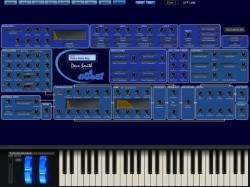
SoundTower has introduced Evolver Editor, a dedicated iPad patch editor for the Dave Smith Instruments Evolver synthesizer.
Evolver Sound Editor is an editor and sound development tool, created specifically for Dave Smith Instruments Evolver synthesizer.
Evolver Sound Editor displays all Evolver Program parameters in a single graphical interface.
Features:
- Real time editing of all Evolver parameters
- Program Bank manager
- Load/Save of Program Banks
- Transmitting and receiving of Program Bank data
- Sequencer editor
- Resizable on-screen keyboard
- Direct USB/MIDI connection with Apple iPad Camera Adapter
- Wireless connection possible using MIDI network
- Magnified editing panels
The Evolver Sound Editor is available for US $24.99 in the App Store.
Out now: Dave Smith Instruments Ships DSM01 Curtis Filter Module
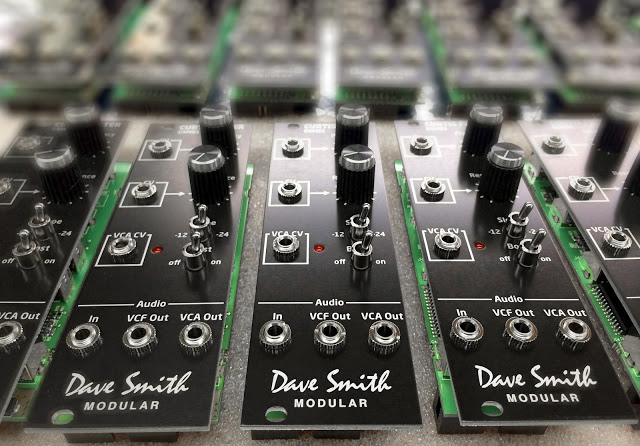
Dave Smith Instruments today began shipping the DSM01 Curtis Filter module, their first product for modular synthesizers. The module takes its name from the filter chip originally designed by the late Doug Curtis, which has been an integral part of the sound of Dave Smith’s instruments from the classic Sequential Circuits Prophet-5, all the way up to recent synths such as the Evolver, Mopho, Prophet ʼ08, and Prophet 12.
The DSM01 features a switchable 2/4-pole, resonant low-pass filter, as well as its own VCA. It is a standard 8HP wide, Eurorack-format device with interconnections made using 3.5 mm phone jacks. A carefully designed set of inputs and parameters allows voltage control of filter frequency and resonance. Filter slope is selectable between -12 dB and -24 dB. The module’s VCA features two separate outputs for the filter—one pre-VCA and the other, post-VCA. A unique feature of the filter is a Boost function that introduces harmonic distortion into the signal for more aggressive coloration.
“Having the widest tonal palette possible has always been the goal for modular users,” said Smith. “This product is our first—but significant—contribution to that world. We wanted to give modular users easy, affordable access to the classic Curtis filter sound, which I’ve always found very versatile and expressive.” The Curtis sound has often been described as saturated, brash, and powerful, and has also been fundamental to such vintage instruments as the Oberheim Xpander, Rhodes Chroma and Polaris, and Elka Synthex.
“The DSM01 packs a lot of sound-shaping power into a small package. We think modular users are going to get a lot of sonic mileage out of it,” said Smith.
The DSM01 Curtis Filter module is available now with a MAP of $179.
Dave Smith Instruments Pro 2 Preview
Background video description:
I was able to spend a couple days with the new Dave Smith Instruments Pro 2. Here’s a small sample of what’s to come.
Summer NAMM: Dave Smith Instruments Pro 2 Synthesizer Demo
Carson from Dave Smith Instruments presents the Pro 2 synthesizer, at the Summer NAMM 2014 show in Nashville, TN. Enjoy the demo, then click the link above for even more on the Pro 2 synth!
I dreamt of being a polyphonic synth – Multitracked DSi Mopho
Background video description:
A song I did by Multitracking a DSi Mopho. All sounds from the Mopho. I also used the Mopho as carrier signal on my Vocoder Syntovox 222 & on my Banshee Rocktron Talk Box. Long Live the Mopho!!!
Music & lyrics composed by Val Solo 2014
DATAMASKIN

