
The impressive Kurzweil in action
The Kurzweil K2000 is a 16 bit sampler with a complex synthesis architecture by Kurzweil Music Systems, similar to the EMU Emulator III. The K2000 features a technology dubbed V.A.S.T., which stands for “Variable Architecture Synthesis Technology”, a marketing term for the K2000’s digital signal processing (DSP) based sound processing system. It is variable in that the user can select different signal paths, which contain different DSP functions, for use in creating and shaping a sound. V.A.S.T. also includes an extensive modulation system, similar in concept to that of analog modular synthesizers. A wide array of modulation sources can be assigned to various parameters within a signal path, and modulation sources can be combined to create new modulation sources.
In this video:
Here’s some personal examples of the K2000’s easy editing to create huge VA sounds in minutes. The first four are post edits, while the fifth was done in real time to show dynamics, richness and the K2000’s massive features.
For vintage hard core synth fans – sounds of the KORG MS10
The MS-10 is a cool & classic analog synth known for its great bass and percussive sounds. It was released by Korg in 1978 as an entry-level, simple monophonic single-VCO analog synthesizer. With the authentic look of a mini-modular its single VCO is patchable using standard 1/4 inch patch cords to the VCF and VCA. It really is a powerful little mono-synth with plenty of knobs and a compact 32-note keyboard. It is CV/Gate controllable. A very cool feature is its external input to filter which allows you to filter external sound sources! Following the MS-10 came the double-oscillator version, the MS-20.
In this video:
Korg MS-10 demo
all sounds including drums from the MS10
Sound Cells app – Midi Clock Sync demo
Sound Cells is an interactive generative music app. Just touch the matrix to create some moving cells and see them interact with each other and generate sound in realtime. If a cell hits the wall, it creates a sound. If a cell ends up in the same location as another one, they change directions. You can remove cells by touching them or by hitting the cell removing button.
The app comes with the 2 different sounds, which can be controlled in realtime for very expressive effects.
Also the app can generate MIDI output, so you can hook up a midi capable instrument for endless possibilities.
On the newest version, it is possible to choose the scale that the app will use, the tempo and the key. This allows the app to be able to become a performance tool, where it can play along different musical settings.
This is a universal app and on the iPad, it will use the full available resolution for a rich visual experience.
This app is inspired by the web app Otomata at http://www.earslap.com/projectslab/otomata, which also has a iOS version in the works, so make sure to keep an eye for it.
In this video:
This is a demo of the new Midi Clock sync feature that I’ll be adding to it soon. In this video, the Drum Machine (Korg ER-1) is sending the clock signal to Sound Cells. In turn, Sound Cell, is sending midi note data to the DSI Tetr4 synth to make sound.
The app can be found in here:
http://ow.ly/5azwj
Akai MFC42 Analogue Filter Demo
The MFC42 is a true analog filter module designed by Akai for their MPC-series gear. However, you can use it to process any sound source since it has basic 1/4″ inputs and outputs and MIDI! It has genuine analog filters for that warmer tone with Lowpass, Highpass, Bandpass, and Notch filter types. It consists of a MONO filter section and STEREO filter section. The MONO section offers 2-, 4-, and 8-pole filter slopes. The STEREO section offers 2- and 4-pole filter slopes. The MONO 8-pole slope utilizes the whole filter circuitry so the STEREO section is not active. Likewise, the MONO section is inactive when the STEREO section is in 4-pole mode. But when both sections are used simultaneously, they can be linked so that the MONO filter’s control knobs control both MONO and STEREO sections. The link can also be inverted so the two sections sweep in opposite directions.
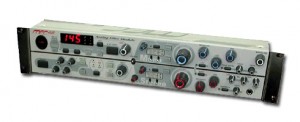
Other features include one ADSR envelope for the filter’s contour. This envelope can be triggered by MIDI and Trigger button, but not by audio unfortunately. The LFO is essential to bringing this filter to life! It has four waveforms including sawtooth, square, triangle and random. It can be synced to MIDI clock and can modulate to 16th, 8th, 1/4, 1/2, whole, double-whole, and triplet notes in tempo with your MPC (or MIDI) sequences! Or use the “Tap” button to tap in the tempo in real-time. A large numeric display shows the current tempo and there’s also an EQ on-board for global sonic fine-tuning. Effects include a very harsh (in a good way) Distortion and stereo analog Phase Shifter. The ins-and-outs consist of three 1/4″ inputs (mono/stereo), stereo phono (RCA) inputs, stereo 1/4″ outputs, stereo phono (RCA) outputs, and MIDI in, out and through. All pertinent knobs and buttons can send and receive MIDI control.
In this video:
This is a brief overview of the features and functionality of the Akai MFC42 Analogue Filter Module. For this demo I have used a simple disco loop backed by some TR-909 drums and I have tried to cover all the functions of the unit while keeping the video as brief as possible. As I am sure you will have gathered by the end of this video the MFC42 has almost endless configuration possibilities to produce a huge array of filtering effects and I have only touched upon these possibilities in this video.
For those interested the Loop comes from the Akai S900 seen just below the MFC42, the drums are from a Roland TR-909 (with the exception of the hand clap which is from the TR-707 (because my 909 clap needs repairing)). Everything is sequenced with the Akai ASQ10 and the whole mix is liberally compressed by an Alesis 3630 for that ’99 Montmartre sound.
Comparing Faderfox LV controllers
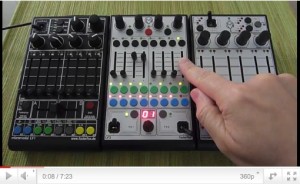
This demo compares the new Faderfox LV3 with previous versions. FaderFox has introduced a new controller for Ableton Live, LV3. FaderFox LV3 is designed to be an all-in-one compact controller for Live. The device can control track volumes by faders, rack parameters by encoders and joysticks and global parameters like tempo, quantization & cue/master-volumes.
The FaderFox LV3 is priced at 250 Euro (incl. VAT).
Here are the details:
Features:
- Controller for Ableton Live (also suitable for other DAW software)
- Automap setup files for Live 8 are shipped with the controller (no manual mapping necessary)
- USB interface – class compliant / no driver necessary
- Controls 8 tracks with possibility to shift the 8-track-window to further tracks
- 24 programmable buttons for all track functions
- About 280 commands – all freely reassignable (each track sends on separate MIDI channel)
- Select and start/stop of scenes/clips with dedicated encoder (clip-scroll in session view)
- 4 mulifunctional push-encoders to control rack parameters in the selected track
- 2 non-centered joysticks to control rack parameters in the selected track or in send tracks
- Global control of several global parameters like tempo, quantization and master / cue volumes
- All controls with double function by holding down the shift button
- 33 LED’s in different colors to display various informations like clip states etc.
- 2-digit-display to show current scene number and track window
- USB bus powering – consumption less than 500mW / 100mA
- Very compact design in a black, plastic casing (desktop format 180x105x70 mm, 350 g)
- High-quality faders and encoders from ALPS
- New rubber knobs for best tactile feeling
System Requirements:
- PC or Mac with a free USB port (1.0 or higher) or any USB hub
- Ableton Live 8 or software which allows user assignments of continuous parameters (CC)
Demo of the Catgirl CGS01 Suboscillator/Harmonic Sequencer module
Another demo of the Catgirl CGS01 Suboscillator/Harmonic Sequencer module. A Ken Stone design.
This time the module was repaired and working correctly. I demonstrate the Harmonic Sequencer aspect of the module. I have Channel A and B receiving a low range LFO pulse width waveform from two Q106 VCO’s. Using the Multiplier mode on the CGS01, I sent both the normal and inverted outputs to a pair of signal processors, then two a quantizer and then on to two more Q106 VCO pitch inputs. Messing around with the suboscillator divisions knobs created moving voltages for the two final VCO’s. I filled in with some sketchy keyboard notes on a Yamaha DX7II. Reverse echo and reverb were added.
This module is very musical and astonishingly useful as a sequential device. There are so many things that can be done with it besides just this demo but I really enjoy this feature.
Reason Control Voltage to MIDI Out – MaxMSP5
Reason maestor Peff has uploaded a nice demo on Control Voltage. Showing some early tests of routing Reason Note and Gate CV data from a Matrix Pattern Sequencer to MIDI note data.
this is still experimental and needs a lot more finishing before it will be viable, however early tests work with both internal and external hardware synths.
The Poly-Ana Controller
In this video:
This is a short videoclip, of the Poly-Ana Hardware Controller, where i tested the keyboard function. The full video of the Controller is coming soon.
KORG iMS-20 & iElectribe Gorillaz Edition DEMO
KORG Bloggers Meeting 2011 at G-ROKS, Tokyo. Demonstrater is a KORG engineer Mr. Ohta.
Two iPad are syncing.
Richard Atkinson takes a look at the New England Digital Synclavier II
The first version of the Synclavier appeared in 1979 but was soon replaced by the Synclavier II with a new “partial timbre” sound editing feature (it tweaks the harmonics), built-in FM and additive synthesis, sampling, 64 voice polyphony, 32MB of waveform RAM (expandable to 768), 32 outputs, music-notation printing, multitrack sequencing, and digital hard-disk recording. In 1984 a third model was introduced and became the most infamous version of the line-up. The new features included a full sized and weighted keyboard with velocity and aftertouch which replaced the previous model’s plastic keyboard, and 128 voices polyphony. An optional DSP effects package including time compression/expansion was available for the Synclav as well. There was also a standard onboard arpeggiator and a robust sequencer with up to 200 tracks and its sampler had the ability to record and output at up to 100 khz!
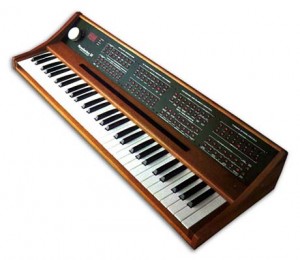
The typical Synclavier system consists of a durable 76-note keyboard peppered with 132 illuminated buttons and a single control knob, connected to a rack-mounted CPU running NED’s own 16-bit ABLE operating system plus the nostalgic mid-eighties looking mono-chromatic computer monitor/keyboard. Patches, sound files, sequences and samples are stored to 5.25″ diskette, hard disk or in some models, magneto-optical drives.
It should be noted that there are all sorts of ‘sub-revisions’ of the hardware component of the Synclav II, and these make each version capable/incapable of doing certain things. Some lower-end versions are not capable of using the ‘Timbre-frame’ timbral scanning programming method. Others are not capable of handling a MIDI retrofit. And all of these have different ‘top versions’ of the OS that they can handle, making the purchase of a used Synclav system a dicey affair. You can’t always be 100% sure of which variation you’re buying without some extreme care being paid to which hardware it has and what versions of the OS it’s capable of running. You could therefore be buying anything from a high-end sampling/sequencing workstation unit to a rather complex 12-op FM/additive synth, and several possibilities in between.
From its specs alone it can be seen that the Synclavier is a masterpiece digital sampler / synthesizer workstation which was the first of its kind, and way ahead of its time. They command prices well into the thousands ($25,000 to $200,000) and are only used by those who can afford such. New Synclavier systems (including new hardware, software, and Mac OS X emulations of the Synclavier operating system) service, and support are currently available through DEMAS, the company created after the fall of New England Digital in 1992.
Synclaviers have been used by The Cure, New Order, George Duke, Pat Metheny, Sting, Stevie Wonder, Paul Simon, Foreigner, Michael Jackson, Pink Floyd, Kraftwerk, Depeche Mode, Genesis, Kim Wilde, The Cars, Soft Cell, Geoff Downes, Frank Zappa, and film composer Alan Silvestri.
DATAMASKIN

