
OSC Physics Demo
OSC Physics sending data to Max/MSP and Ableton Live.
Max receives OSC messages from the iPad and visualizes and converts it midi. Midi messages are sent to Ableton Live to control audio effects.
KORG PROPHECY sound demonstration
The Korg Prophecy is considered one of the earliest (mid-nineties) “virtual analog” (a.k.a. VA) synthesizers, although its synthesis capabilities went beyond many of its VA contemporaries.
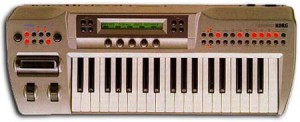
Along with the Korg Trinity, this little synth is a direct ancestor of the ill-fated OASYS project. It was a small 3-octave monosynth, a pioneer of the late 1990s “return-to-analog” trend. Offering assignable knobs, a “log controller” (a mix-up of a modulation wheel and ribbon controller assembled like a “sausage”) and many other control sources, it invited players to tweak and shape the sound both easily and quickly. Deep editing, however, wasn’t as straightforward, because the sound engine contained no less than 13 DSP-modeled oscillator types, each one offering too many parameters to adjust. Probably, the most valuated and used DSP models were the analog model (based on the classic osc+filter+amp scheme, although with many powerful enhancements), the VPM model (some sort of FM synthesis which cleverly avoided Yamaha’s FM patent) and the “physical modeling” algorithms. The latter deserves special mention. In the mid to late 1990s, it was believed that digital “physical modeling”, which recreated the sound of acoustic instruments (brass, strings, woodwinds, etc.) using DSP algorithms instead of samples, would eventually replace sample-based synthesis of those instruments, because of its unprecedented realism and expressiveness. As time passed, physical modeling seemed to lose its appeal to both manufacturers (because of the cost of investigation and implementation) and final users, who complained about the realism of the models and limited polyphony. Also, more complex playing techniques were required to play the models in a convincing way. Nevertheless, the Prophecy’s low cost and broad implementation of sound generation techniques earned it a significant place in synthesizer history.
Technically, the Prophecy offered one-note monophony, a decent set of effects (including distortion, wave shaping, delay/reverb and chorus/flanger), and 128 memory locations for user sound programs. No disk drive or sequencer was included, but its integrated arpeggiator was a source of “instant gratification”, as some magazines put it. Standard MIDI features and a pair of audio outputs were also offered.
Korg made a major breakthrough at the time, offering a low cost expansion card for Trinity users, which incorporated the whole sound engine of the Prophecy into the already powerful workstation. Gone was the arpeggiator and some minor features, but the editing was much improved through the Trinity’s big touchscreen, and the workstation’s effects processing was a huge improvement over the Prophecy’s basic set.
Sequetron 8.06 Virtual Test Drive
Shows how to install the free LE version from scratch, and configure it for your MIDI playback device.
Uses a virtual keyboard so you can try it out without having to connect a real one.
General Overview of the Beat Thang
http://youtu.be/kQEWT4zuaDs
Beat Kangz Electronics’ Cool Rev gives you a general overview of the Beat Thang. Learn about the basics including the various sections and modes. Available for pre-order on BestBuy.com now! http://ow.ly/5gzub
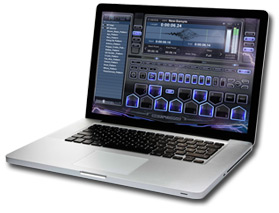
BEAT THANG VIRTUAL combines sampling, sequencing with an easy to use performance interface into one portable, powerful weapon of mass creation. Over 3000 original sounds and chops were custom created for this extraordinary library. It doesn’t matter if your style is Hip-Hop, Reggaeton, Soul, Funk, Electronica, Rock, or Alien, Beat Thang has the sounds you need to create bangin’ tracks. The Beat Kangz lived in the studio for two years painstakingly recording and tweaking the sickest sounds from classic drum kits, vintage instruments, rare electronics, exotic percussion, and many improvised sound sources. All were performed and recorded through a menagerie of high-end digital and analog devices, meticulously preserving each sample’s warmth and character. The Beat Kangz mastered each sample so you have trunk bangin’ drop, aggressive kicks and snares, rich strings, chunky guitars, tripped out synths and tons of grit, depth, and low end to create with. You can also load or record your own samples to create custom kits and unique instruments of your own.
From the vintage archives: Bode (Moog) Vocoder 7702 Demonstration
The sounds of the legendary Bode Vocoder,, Related to the Moog Vocoder,, check out the beautiful melodic sounds that it produces,, One of the top 3 Analog vocoders, right up there with EMS and Sennheiser. In 1979 Moog released a vocoder of their own, although its design and architecture is almost identical to the Bode 7702 vocoder. It’s a 16-band analog vocoder which separates a given synthesizer sound (carrier signal) into seperate frequncy bands ranging from 50 to 5080 cycles per second. It does not have any internal oscillators so it is designed to be used as a processor for external carrier and modulator wave sources. The modulator is typically a vocal or drum beat used to modulate the carrier/synth sound being processed.
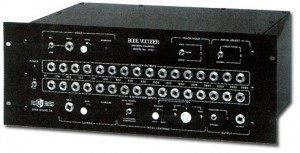
It has microphone and line inputs as well as 16 synthesizer inputs (1 for each frequency band) and 16 outputs. This 16 channel cross-matrix patching system is cumbersome, but useful during the modular synth era, allowing for full external patching between synth and vocoder sections. Other features include a high-frequency bypass, a short 6ms response time for capturing fast percussive sounds, sample-and-hold, and a global bypass switch to turn off the vocoding effect. Unfortunately there is no output mixer, MIDI or CV/Gate.
Akai Synthstation 25 Demo
Nevada music has made this short demo of the Akai Synthstation:
The Akai SynthStation 25 transforms iPhone or iPod touch into a portable music production studio for mobile music creation. The AKAI SynthStation 25 MIDI keyboard controller gives your handheld device a two-octave set of piano keys and professional audio outputs, and it works with the Akai Professional SynthStation Studio app. The SynthStation 25 is powerful enough for professional musicians, yet virtually anyone can use is to easily create music.
This 25-key synth keyboard features a built-in dock for iPhone or iPod touch. The SynthStation 25 gives you two octaves of velocity-sensitive, synth-action keys, pitch and modulation wheels, and octave up and down and sound-bank buttons. The SynthStation 25 has a stereo pair of RCA line outputs and a headphone output for connection to recording and sound reinforcement systems. You can use the SynthStation 25 with Akai’s SynthStation Studio app as well as virtually any MIDI music software on your computer or with MIDI hardware devices such as sound modules, samplers, and MPCs using its USB/MIDI output.
Available exclusively through the Apple App Store, SynthStation Studio gives you three powerful synthesizers for creating and modifying sonic textures used for melodies, chords, and bass lines. Built around Akai Professional?s history in synthesis and drawing on the newest MINIAK synth, the SynthStation Studio app sounds great and offers wide-ranging sonic flexibility with its virtual analog synthesis.
25-key MIDI keyboard controller with integrated dock for iPhone and iPod touch
Velocity-sensitive, synth-action keys for expressive performance
Pitch and modulation wheels, octave +/-, and sound-bank buttons
Stereo RCA line outputs and headphone jack
USB/MIDI for virtually any MIDI music software or MIDI hardware devices
Seamlessly compatible with Akai SYNTH STATION app
iPhone and iPod Touch NOT Included
Inside the KORG Kronos manuals – system approach
“This is Part 1 of our video manual for the Korg Kronos Music Workstation, focusing on basic navigation. For more details, please visit www.korg.com/kronos.”
Kronos Highlights
* 9 Sound engines, each offering a unique sound-creation technology (see list below)
* 16-part Combis allow all engines to function together in perfect harmony; Dynamic Voice Allocation keeps the polyphony high.
* Available with 61, 73 or 88 keys. The 73 and 88 key models feature Korg’s finest RH3 Graded Hammer Action. The 61 key model borrows the responsive synth action from the Korg M3-61.
* Comprehensive interface, based around a new large 8” TFT TouchView™ display
* Virtual Memory Technology (VMT), aided by a fast SSD (Solid State Disk) provides high polyphony and massive, ultra-long, and unlooped samples; offering unheard of performance from a hardware instrument
* Smooth Sound Transition: this often-requested feature allows held or sustained notes to keep sounding when changing sounds or modes.
* Set List mode: Organize the Programs, Combis, and Songs you need to perform your set in a single, easy-to-select screen – including performance notes!
* Use up to 16 premium-quality effects at once; individual effects rival dedicated units
o 12 Insert effects
o 2 Master effects
o 2 Total effects
* On-board sequencer offers 16 MIDI tracks + 16 audio tracks (24-bit, 48kHz recording quality)
* Open Sampling System – Instant sampling and resampling from any mode: Program, Combination or Sequencer.
* Sophisticated KARMA® technology generates infinitely variable performance-driven phrases, musical effects, and backing tracks to catalyze your creativity
* Expanded Drum Track for play-along grooves and inspiration
* Signature sounds created with guidance from world class musicians
Creating Generative Music with the Mixtikl
This is the first of two tutorials on Mixtikl. In this video, I show you how to use Mixtikl’s library of midi loops, FX, and synthesizers to create generative music. Be sure to check out my website for more tutorials: flamingstylus.blogspot.com or follow me on twitter: @flamingstylus
Soviet synths: ELEKTRONIKA EM-25 Demo
Electronica EM – 25 is a synthesizer-strings that has 3 timbre sections: stringed – contrabasses, violoncellos, violins, organ-registers (“16′”,”8′”,”4′”,”2′”), wind-trombones, trumpets.
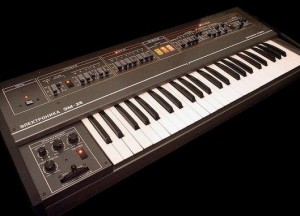
Stringed and organ sections:
- polyphonic attack and release of sound with duration control
- switching decay mode
Wind instruments section:
- generator of curved with controls: ATTACK, DECAY, SUSTAIN.
- modulator with controls: RATE, DELAY, VIBRATO
- controlled filter with controls: ENVELOPE, MODULATOR, CUTOFF, ACCENT
- filter run mode -mono or polyphonic
There is also a possibility to split the keyboard to 2 section (with setting up different timbres of sounding)
More info:
“Elektronika” was the so-called brand name for any former Soviet electronic product made in any former Soviet factory more or less involved in the manufacturing of any electronic devices and there were a whole range of electronic products released in Russia (watches, TV sets, amps, speakers, tuners, and more) that used this ‘trademark’. Bizarre but true!
Wherever it originated, the EM-25 was a polyphonic synth specialising in strings, organ and brass. Like other such instruments, it was of the ‘divide-down’ variety to give a totally polyphonic generator through a single filter, amp and envelope.
The strings section had mixable contrabass, cello and violins with variable attack and decay and the obligatory chorus unit for the rich ensemble effect.
The organ offered variable footages at 16′, 8′, 4′ and 2′ with variable attack and decay whilst the brass section offered trombone and trumpet. Of course, none of these sounds were ‘realistic’ but there were plenty of controls and facilities to coax some sonic mileage out of this trio of sounds.
There was an LFO that could be used to sweep the apparently fiercely resonant, self-oscillating filter and all the sections could be mixed and balanced – even split across the keyboard range – and so, in that respect, the EM-25 was not unlike the Moog Opus, Korg Trident and other such keyboards. To the left was a performance section with a pitchbend lever that appears to have been lifted directly from Roland’s ‘bender’ design!”
Nice patching with the CGS01 Sub Oscillator and Harmonic Sequencer
A demonstration of a patch involving the CGS01 Sub Oscillator and Harmonic Sequencer. It is generating the two voices heard at first. The I mixed in a few other voices coming from the Q960 and Q119 sequencers. The sequencers are shifted by the events going on in the CGS01 unit.
I recorded a tune with this patch as a basis but I thought the patch in itself was pretty fun so I made a video of it for people to see.
DATAMASKIN

