
Roland SH-101 and CR-8000
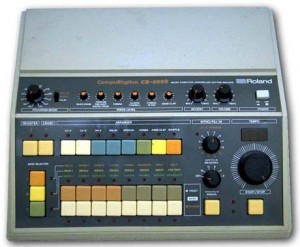
The CR-8000 produces classic electronic drum sounds that hint back to the famous CR-78 and TR-808 drum machines. But none of these sounds are editable and there is only one mono audio output making this machine less of a studio-piece of gear and more of a collector’s item. Aside from these limitations it, like other CompuRhythms, has a series of preset patterns in many different styles as well as programmable patterns with 8 storage patches. While the CR-8000 is usually sampled for today’s applications, the thing about the CR-8000 that cannot be captured by sampling the sounds is the swing/groove feel which has its own control knob. The intervals between beats are variable, but also the timbre changes.
In this video:
Short (minimalistic) demo made only with SH-101 and CR-8000. Delay was provided by Boss DE-200. I should note that i modified my CR-8000 with individual outputs. Therefore, your CR-8000 might not sound like this, as each channel was separately EQ-ed (on a Soundcraft desk). No compression was used.
Hammond SK1 Organ – Exclusive Demo
The Hammond SK1 is the first “Ultra-Portable” organ in its history, weighing in at just 15 pounds, and the first Hammond portable to feature a wide range of Extra Voices. The “Drawbar” section is a complete Hammond Organ with all the traditional features: Real Mechanical Drawbars, Chorus Vibrato, Touch-Response Percussion, and the most authentic Digital Leslie we have ever offered. “Vx” and “Farf” combo organ models are also available, as well as an assortment of fine classical Pipe Organ voices derived from our 935 Church Organ. Acoustic and Electric Pianos, Clavs, Accordions, Vintage String Synth, Wind Instruments and Tuned Percussion round out the specification.
http://www.production-room.com/hammond/hammond-sk-1-organ/
Testing the capabilities of the Kenton Pro-2000
VERY short demo of the Kenton Pro-2000 together with the MS-20. Programming the Pro 2000 is extremely simple. In ‘Parameter’ mode, the Inc/Dec buttons scroll through the available parameters. Once the parameter to be changed is displayed on the backlit LCD, pressing the ‘Select’ button then allows that parameter’s value to be edited by the Inc/Dec buttons.
The range of control offered by the Pro 2000 is extensive. Each of its CV/gate channels is completely independent, with parameters for MIDI channel, note priority (low, high or oldest), single or multiple trigger mode, ±24 semitones transpose, ±12 semitones pitch-bend, portamento rate, and portamento controller (including a permanent ‘on’ setting). The Pro 2000 will work with most synth gates, including Moog’s S-trig system, and it allows for 5V or 15V pull-up triggers.
Kenton have endowed the Pro 2000 with two internal LFOs, which may be freely assigned to modulate the channel CV outputs or any of the Auxiliary outputs. The LFOs sport a selection of nine useful waveforms, including triangle, sawtooth, pulse and ‘sample and hold’, although I would like to see a noise modulation option to get that distinctive MiniMoog screech. Each LFO will happily sync to MIDI clock messages, with a variable divide ratio for synchrosonic sequencing between a semibreve and a demisemiquaver triplet!
In this video:
I bought my Korg MS20 in 1995. Back then I didn’t have time money to buy a MIDI/CV converter. I have always recorded it live. Today 2011-07-07 I finally got a Kenton Pro-2000 and this is the first test after hooking it up. For the first time since 1995 I can play fast, tight bass line. 😀
FEATURES
• Two Gate/CV outputs
• Six auxiliary outputs
• Sync24 output
• Clock-pulse output
• Optional expansion port (KADI/Wasp or DCB)
• Optional rack-mount ears
• Dimensions (mm): 280 x 132 x 42
• Weight: 2.5kg
ENSONIQ ESQ-1 VINTAGE SYNTHESIZER 1986 DEMO
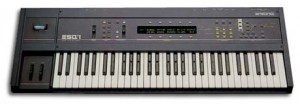
The Ensoniq ESQ-1 is a hybrid synthesizer from 1986. It has 32 digital waveforms and analog lowpass filter. It is flexible, since it employs 3 oscillators, 4 envelopes and 3 LFO’s per voice. Also it has a built in pattern sequencer.
“The ESQ-1 is a mostly digital (It has analog filters) 8 voice polyphonic, synthesizer with multitimbral (8-part) capabilities and MIDI. Sounds can be split or layered. One nice feature is that changing the sound while the previous sound is still playing doesn’t cut the first sound off. It can store 40 sounds internally, and another 80 to cartridge. Sounds and sequencer data can also be stored via cassette tape.
Each sound, or timbre is constructed with up to three Oscillators. Using all three oscillators can give very thick, rich string pads and brasses, especially as the sounds can be de-tuned and panned in a variety of different ways.
Each oscillator draws upon a bank of 32 hybrid digital/sampled waveforms including sawtooth, sine, square and a variety of conventional waveforms such as piano, human voice and organ. This may not sound very many in comparison to today’s synths, but there are enough editing features to independently change these basic waveforms in an almost limitless fashion.
One of the strongest parts of the ESQ architecture is the filter section, which features analog four-pole (24dB/octave) resonant filters. The filter covers a broad sonic range, and can be modulated via a number of inputs including key velocity, modulation wheel, any of the three LFO’s and any of the four Envelopes.
The ESQ-1 comes standard with an 8 track 2400 note sequencer which can be expanded to 10,000 notes. The sequencer features a flexible ‘pattern play’ facility for chaining patterns one after the other in any order. The ESQ-1 sequencer does all the usual stuff, but has one extremely useful feature: You can record a sequence (or Pattern), comprising of up to 8 independent tracks (Bass drum, Snare, hats, synth, strings, bassline etc) and copy this to another location. You could then for example, remove the bass drum track from one of the sequences, but leave it in the other. While the sequence with the bass drum track is playing, you can select the one without the bass drum track, which will start to play with seamless integration once the first sequence has played to the end. This method of letting you chain any of the sequences in any order you like, continuously and seamlessly, means that you have total freedom with song arrangement. After trying out arrangement ideas this way, the 8 track sequences (of which 30 can be stored) can finally have their ‘play order’ fixed into a Song. I haven’t come across another sequencer that gives you the ability to play a looped sequence as many times as you want before selecting another sequence, without first having to save the order in which you want them to play. This is a very useful feature in Dance music and Techno music where the song is generally built up over time in the same key, but with additional instruments coming and going. You are not limited to using only the ESQ-1 sounds on the sequencer, as each track can be made to play the ESQ-1’s internal sounds, external sounds over MIDI, or both.”
Getting the grips with the Korg microSTATION
The compact and portable microSTATION none the less features our 61-key Natural Touch mini keyboard, numerous effects, dual arpeggiators, and a 16-track sequencer to transform musical ideas into polished productions – wherever you are! New sequencer features such as Loop Recording and visual Grid Sequencing have been added to benefit the first-time user and to jump-start any type of music production. This Video Manual will provide an overview of the microSTATION, with plenty of in depth info showing how to get the most of this powerful keyboard. Not just a synthesizer filled with great Korg-Quality Sounds, the microSTATION also offers complete workstation features, including effects, sequencing and more.
Expert Sleepers ES-4 Demo – Teaser
A demo of the basic features of the Expert Sleepers ES-4 and ES-4 Gate Expander modules.
The ES-4 is a Eurorack format module which converts a standard S/PDIF input to five channels of control voltage. Two of the five channels are calibrated to provide over 5 octaves of 1V/octave pitch CV. The remaining three channels are general purpose outputs (for use as e.g. gates, envelopes, LFOs) and each have a nominal range of 0-10V or ±5V (user selectable). Since S/PDIF is a stereo-only format, the encoding of the five channels on to two is handled by software to be provided as part of Expert Sleepers Silent Way. The ES-4 will connect to any audio device using the S/PDIF standard. This includes the digital audio output provided as standard on all recent Macs.
Features:
- Panel width: 8HP
- Module depth: 51mm
- Digital input: coaxial S/PDIF
- Digital output: coaxial S/PDIF
- Analogue outputs: 5x 3.5mm jacks, DC-coupled
- Output voltages
- Channels 1-2: 0-5.3V (when trimmed for 1V/octave response)
- Channels 3-5: 0-10V or ±5V (jumper selectable per channel)
- D/A conversion: 8 bit, using high precision Analog Devices DACs
- Indicators: LED for S/PDIF sync lock; 2 LEDs per channel on channels 3-5 indicate output voltage (+ve/-ve)
- Expansion
- 5 headers for connecting ES-4 Gate Expander modules (see below)
- Digital audio I/O header (I2S format) for future expansion
Vermona Mono Lancet Demonstration
The Mono Lancet is a compact synthesizer with big sound, easy user interface and charm. Two analogue oscillators take care of a solid sound foundation. Oscillator one creates triangle-, sawtooth- and square waves and can be set one octave lower than the second oscillator. The latter produces white noise instead of the triangle wave. The pulse width can be modulated through the modulation wheel (MIDI) and/or an external control voltage (see Extension). The glide generator has a legato mode or can always be active. The voltage controlled lowpass filter has a slope of 24db per octave. On high resonance settings it starts to self-oscillate and produces a stable sine wave that can be played in a range of about 2 ½ octaves.
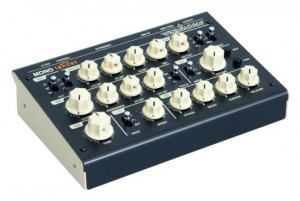
On MIDI site the cutoff frequency can be controlled by velocity and/or aftertouch. There’s a good sounding VCA inside the Mono Lancet that can be modulated by the ADSR- or a fixed organ-like envelope. On demand it additionally can respond to velocity. The classical ADSR envelope generator can modulate the VCO- and VCF frequency and the VCA. The LFO generates rectangle- and triangle waveform as well as sample & hold and is modulation source for VCF and VCO.
In this video:
Just a quick video to show my Vermona Mono Lancet in full working order. It’s sequenced by a Yamaha RM1X and the drums were also created with the Lancet and sampled into an Akai S5000 for sequencing.
Rob Fabrie using Rob Papen plug-ins
Artist testimonial by Rob Fabrie aka Waxweazle, aka Headbanger. Rob Papen’s virtual synthesizers define the cutting edge of contemporary music production: powerful instruments and plug-ins that bring together innovative design, uncompromising sound quality, and musical, production-grade presets to make your tracks shine. At the age of 15 Rob started with the Korg MS-20 synthesizer and a SQ-10 sequencer. On these machines he learned how to program synthesizers and they inspired him to compose music. He did study also electronic organ and b.t.w. loves Bach….Through groups like Tangerine Dream, Kraftwerk and artist like J.M. Jarre, Georgio Morroder, Vangelis and Klaus Schulze he started making electronic music, also at the age of 15.
www.robfabrie.com
Getting in trance with the Nord Stage 2 synth
Mogar demonstrating the potential of the new powerful synth section in the Nord Stage 2, including the new Arpeggiator and the Master Clock sync-features!
Read more about the Nord Stage 2 here: http://bit.ly/nordstage2
Nord Stage 2:
The Nord Stage 2 is compatible with the Nord Sample Library and also the Nord Sample Editor software that lets you create your own sample instruments, for infinite possibilities! Combined with Nord Piano Library compatibility the Nord Stage 2 is an instrument that offers huge expandability.
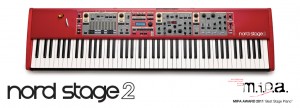
The Stage 2’s powerful new synthesizer engine was built from the DNA of the Nord Wave. Capable of classic analogue synthesis, three operator FM synthesis, Wavetable synthesis and, crucially, compatibility with the Nord Sample Library. The Nord Sample Library not only give Stage 2 owners access to the huge free library of world-class sounds, including the famous vintage Mellotron and Chamberlin samples previously only available to Nord Wave and Nord Electro 3 users, but thanks to the included Nord Sample Editor for Mac and PC, allows user-created samples to be loaded into the instrument and thus opening up a whole new creative world of sound. The Synth engine itself features classic analogue synthesis with dual saw, hard sync and pulse wave modulation, three-operator FM synthesis with 32 different modulation frequencies, Wavetable synthesis with 62 waveforms and Sample based synthesis. A new great-sounding multimode filter features 12 and 24dB low pass, high pass, band pass and notch filters. And with an Amp envelope, Modulation envelope, an LFO, and Unison control, the Stage 2’s synth capabilities are hugely powerful, delivering amazing on-stage sound.
The Synth section also features a new Arpeggiator that can be easily synced to the Stage 2’s Master Clock for perfect timing with other elements of the Stage 2, including its effects.
Demonstrating the Mochika XL sequencer section
This video demonstrates the sequencer section of the Mochika XL, showing the 8 different modes including the oscillator mode and the midi synchronization. you can hear the raw mochika sound with no effects, the drums are made with a computer running FL studio, synchronized using a USB to Midi cable.
Specifications
This synth features one analog square and saw waveform VCO (voltage controled oscillator) with a huge pitch range, from subsonic to ultrasonic sound. Glide effect with a large range for radical portamento effect. One square and triangle waveform LFO (low frequency oscillator), that modulates the VCO for the vibrato effect or the VCF for a tremolo effect, creating old school arcade Atari-like sounds. White noise generator that triggers the VCO and can create percussion like sounds, or mix the the noise with the VCO. Also, it has a built in vactrol based Low Pass and High Pass Filter with cut off and peak controls and a envelope generator with decay control to create a wide sort of timbres and sound possibilities.
Built in 8 step sequencer with global gate time control, note on/off switch and pitch slider for each step.
The built in sequencer also has 8 playing modes:
Oscillator mode, the Mochika becomes a drone oscillator, you can switch in real time between the 8 notes tweaking a knob.
4 step, 6 step, and 8 step sequencer mode.
4 step, 6 step, and 8 step forth and back sequence mode.
Random mode, it generates a large pseudo random sequence, seed of chaos!!!
The Mochika XL features a MIDI input to sync it any midi device sending midi clock signals, the mochika can sync 1, 2, 4 and up to 8 times the tempo of the master clock midi device. All the Mochika sequencer modes, except oscillator mode, can be midi synchronized. Also the instrument is ligthed with 1 bright red led that indicates the LFO Rate, and 8 red leds to indicate the step that is being played. Very useful when you play it on a dark stage.
The Analog Sequencer is packed in a cool laser cut clear acrilic case that shows all the hand made analog circuitry. The instrument is powered directly from 110V or 220V AC depending of the country. Dimensions: 177mm(W), 228 mm(D), 80mm(H. incuded rubber feet and knobs)
DATAMASKIN

