
Neurohedron is a unique music instrument and modal software controller
The Neurohedron is a unique music instrument and modal software controller, conceived of as a nonlinear sequencer.
The simplest traditional sequencers may employ eight steps that return to the first step after reaching the last step; in contrast, the Neurohedron is a three dimensional sequencer with twelve nodes arranged as a dodecahedron. With this structure, there is no clear or de facto path that the progression from one node to the next may take.
Yep – it’s a D12 music sequencer!
Each face on the Neurohedron is both a touch-switch that sends input triggers to software, as well as an electroluminescent panel that displays feedback from the software.
Each face is connected in a graph to the 5 faces adjacent to it. Each of the edges between these faces is then weighted between 0 and 1, and the progression from one face to another follows the highest weighted edges.
Each node (face) in the network is then mapped to a MIDI note. These mappings are described by a variety of musical modes. Thus, a sequence on the Neurohedron will send patterns of MIDI notes to a synthesizer platform (Ableton Live, in this case).
See the liminastudio site for more information on the Neurohedron.
More on the Spectrasonics instruments
Hot off the Spectrasonics site is this very cool video showing Larry Mitchell playing the Trillan VI from a MIDI guitar, it has to be seen to be believed.
The “Artist Video Series” showcases some amazing artists using and playing Spectrasonics instruments from a huge variety of different genres.
In this video, Grammy-winning Producer/Guitarist Larry Mitchell talks about the making of the videos showcasing the possibilities of triggering Spectrasonics Trilian Total Bass software virtual instrument from his MIDI Guitar. Drummer Tony James jams live with Larry to create three killer original tunes…Enjoy! 
Wusik EVE 3 has been released
Wusik EVE V3 has been released for both Windows (VST) and MAC (VST/AU), plus, both Full and Demo versions now come with a complete library of sounds. The new Xenos Soundworks and the old Famous Keys sets 1, 2, 3 and 4. (LoFi Retro Sounds). And Wusik will keep bundling the Mellotronix, Zvon and the DBear Genesis sets, (each set has its own ZIP file).

EVE takes these vintage sounds and this early approach to ‘electronic’ music production as a starting point, bringing this general philosophy and sound into the modern virtual environment with an intuitive and powerful interface. At the core of the EVE approach to sound design is the basic structure of 3 sample-playing layers, 2 multi-effect racks, and a selected library of multisampled ‘electric keyboards’.
This enables the blending of several waveforms and instruments into a vintage wall of sound, or alternatively, the use of the 3 layers multi-timbrally as a vintage workstation. These layers can then be further processed through EVE’s powerful multi-effect racks.
EVE features a well designed system of parameters for tweaking instruments and effects towards musical results, with all parameters accessible on a single page for easy and intuitive sound design.
Using EVE is just like having the vintage boxes at your fingertips. If only it was this easy back in the day!
The Nlog for iPad has arrived
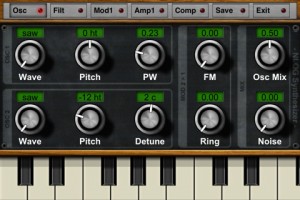
Tempo Rubato has announced Nlog MIDI Synth (App Store link) – a new iPad synth that they describe as a “professional virtual analogue synth”.
NLog MIDI Synth is based on the company’s NLOg synth, but adds hardware MIDI support, via the Line 6 MIDI Mobilizer. Tempo Rubato says that other interfaces, like Akai’s Synthstation, will be supported in future updates. The app is also usable without MIDI interface with an on-screen keyboard, as shown above.
NLog MIDI Synthesizer includes full hardware MIDI implementation for note on/off including velocity control, pitch bend, sustain pedal, modulation wheel and assignable MIDI controller.
NLog MIDI Synth turns an iPhone, iPad or iPod touch into a hardware synth for $8.99, which is a very interesting development. We’re expecting MIDI support to become a de facto requirement for iOS synths in the next few months.
Here’s what Tempo Rubato has to say about NLog MIDI Synth’s features:
ENDLESS options for SOUND EDITING
- Over one hundred parameters and options
- More than your beloved hardware synths might offer
- Store up to 96 own edits in 3 user banks
- Exchange sounds with your friends by email
STUDIO QUALITY sounds
- Professional 44.1 kHz Stereo CD quality
- Internal 32bit floating point engine
- Highly efficient sound algorithms
- Enabling maximum CPU performance of your iPhone / iPod devices
STAGE safe KEYBOARD implementation
- Fully customizable keyboard to your personal style
- Keeps all settings automatically in your preferences
- Famous SLIDING keyboard and LOCK options
- Double manual option: two independent keyboards on screen
- POLY, MONO & LEGATO modes
- Optional velocity control
- Four different key sizes
- Full range of 6 1/2 octaves
Fully customizable EXPRESSION CONTROL
- Realistic PITCH BEND and MOD WHEEL implementation
- X/Y two dimensional controller
- Four fully customizable PERFORMANCE knobs
- Keyboard with VERTICAL modulation control
Incredible FAT & RICH:
- New filter implementation for SMOOTH and JUICY control with 7 FILTER types
- Incredible UNISONO mode for up to 4 parallel sounds with detune, delay and panning control
Sound Editing Features:
- 2 Oscilators with 20 waveforms:
- classic analouge SIN, SAWTOOTH, TRIANLGE and SQUARE
- and 16 additional carefully designed wavetables
- True PWM pulsewidth modulation
- Modulated by LFO or envelope
- Frequency modulation
- Sinusoidal and complex waveforms
- Modulation by LFO and envelope
- Ring modulation
- Noise generator
- 7 filter types
- Low Passes, High Passes & Band Passes
- Finest sweeps and smoothest cutoff tuning
- Carefully resonating
- 12 & 24dB option for steepness
- 3 Envelope generators
- Classic Attack, Decay, Sustain and Release
- Velocity controlled attack time
- 2 Modulation LFOs
- 4 waveforms
- Sample & hold
- Fade in delay
- Rich set of modulation parameter
- Organized into 3 modulation pages
- Exclusive modulation envelope
- Multi-effect section
- Stereo delay with cross-feed and damping filter
- chorus
- distortion
Carlos Gamma – a microtonal tuning system developed by electronic music pioneer Wendy Carlos
These videos demonstrate that it is possible to move from one keyboard to another with relative ease even though they do not share the same note layout, as explained on the above mentioned article. In fact I had never played those two keyboards at the same time before and, as you can see, their position is not particularly ergonomic, nevertheless it is feasible, at a glance, to conjure up some music. You can hear that I move back and forth from a somehow major to a somehow minor tonality.
The usefulness of this technique lies in the different spatial placement of notes the two keyboards permit. Simple phrases on one of them are usually very hard on the other one and vice versa.
Interesting demo of an unusual instrument
Designed from first principles, the Eigenharp brings truly expressive musical performance to every musician. Its astonishing versatility, sensitivity and ease of use make it the most rewarding instrument you will ever play. Available in three models – the Alpha, Tau and Pico. The Eigenharp is the ultimate instrument for musical performance.
Layer multiple sounds, change key, scale and tempo, build beat arrangements live, record and loop as you play. Play all your favourite sampler and software instruments, AU’s, apple loops, midi sounds and soundfonts. You can even control video playback and lighting.
impOSCar 2 meets Gforce
Second Video of the impOSCar 2 Controller. This time with the original sound of the impOSCar 2 VST Instrument from GForce Software.
First live performance of the Nintendo DSi Music product “Rhythm Core Alpha”
This is the first live performance of the Nintendo DSi Music product “Rhythm Core Alpha”, performed live at the Kulak’s Woodshed open-mike night in April 2010.
All the music being played is being created live in front of the audience. Even the tune is written on the spot.
What’s unique about this application is that it emphasizes real-time production. Sound playback never stops during editing. The crowded interface packs some fairly powerful-looking features:
- A Drum Grid with 12 tracks x 64 beats x 122 sounds
- A Note Grid with 8 tracks x 64 beats x 166 sounds
- A Solo Mode that places six octaves of notes onscreen for playing
- A 1000-step pattern mode with chord, drum, and note modes, plus looping
- 7 velocity levels for everything (okay, not a lot, but that provides simple velocity control)
- Quite-nice scale mapping (see screenshots) to keep you in tune – and yes, it’s also possible to override them
See the video demonstrations below.
Pricing is 500 Nintendo Points, or US$5. Naturally, you’ll need to have a DSiWare-capable handheld in a location with access to the store, but assuming you’ve got a newer model, this is much easier than the homebrew route, and pricing is similar to iOS apps.
Get to know Prism
This introduction provides an overlook of this new Reaktor instrument. It also gives a short glimpse into the basic principles of modal synthesis, its underlying structure.
Prism produces a sound that can be dramatically modified via internal or external sources. The result is a wide-ranging synth, equally powerful for hard basses and digital leads as organic soundscapes, percussive keys, flutes and bells.
Daft Punk interactive music tool

Not new but quite fun if you have not seen it before…
http://www.youtube.com/watch?v=kdanwXiicp0
DATAMASKIN

