
Mellotron M4000D Hands-On
We go hands-on with the digital Mellotron re-creation that the keyboard world is abuzz about. Boutique one-trick pony? Maybe, but it does that one trick so exceptionally well that it’s getting attention from the likes of Rami Jaffee (Wallflowers, Foo Fighters).
Some specifications:
It is a 24 bit digital uncompressed audio playback unit with ca 100 Mellotron and Chamberlin sounds built in. Extra cartridges will be available with 100 sounds each. It has a custom built full Mellotron style wood keyboard with depth sensitivity and polyphonic aftertouch out via MIDI. The front panel user inteface has 2 TFT-displays of high quality and are capable of showing pictures of the actual instruments. The dimensions of the cabinet are 34″x19.5″5.25″ (86x50x13.5cm) (WxDxH).
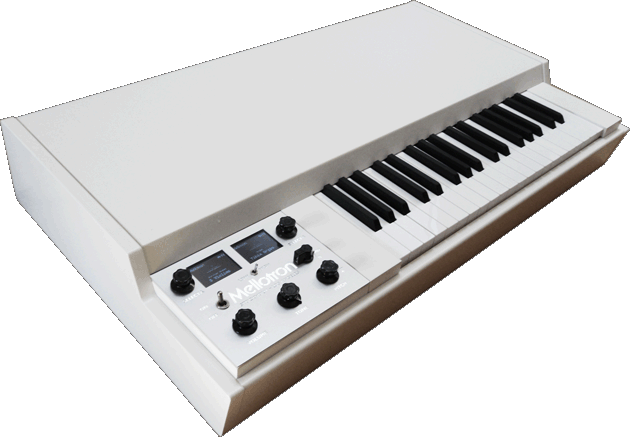
Here is some more info about the M4000D:
- Mellotron style wooden keyboard with depth sensitivity and polyphonic aftertouch via MIDI out.
- 100 original Mellotron and Chamberlin lead sounds included, with IMMEDIATE access.
- The sounds are taken from the original first-generation tape library giving the same sound quality as the original Mellotrons made in the 60s and 70s.
- It has our very advanced and in-house developed streaming technology for uncompressed 24 bit audio reproduction.
- The software and audio engine has taken 3 years to develop, but our concept of the digital Mellotron has been in development since the mid 90s. We bought parts of the original inventory from a company called ‘Mellotron Digital’.
- Furniture quality cabinet with hinged lid.
- Expansion slot gives you 100 extra sounds on special compact flash cards, all from the original archives. There will be ca 8 expansion cards released with a large variety of sounds.
- Two high-quality TFT displays and a backlit laser cut front panel.
- Our very advanced and in-house developed streaming technology for uncompressed 24 bit audio reproduction.
- Three gold plated balanced XLR outputs, all other connectors are gold plated for maximum reliablilty.
- Dimensions: 859x501x135 mm, weight 17.5 kg.
Casio Privia Pro PX-5S Stage Piano Demo with Mike Martin
Mike Martin from Casio demonstrates the Privia Pro PX-5S stage piano at Kraft Music.
Specification:
| Keyboard | 88-key, Tri-sensor Scaled Hammer Action II |
| Maximum Polyphony | 256 Notes |
| Number of Tones | 370 Preset / 350 User Keyboard Instrument (including Electric Piano) – 60 Preset, 50 User Hex Layer – 50 Preset, 150 User |
| Stage Settings | 100 User Stage Settings / 4 zone configurations |
| Controllers | 4 knobs, 6 sliders, Pitch & Modwheel, 2 Pedal Inputs |
| Arpeggiator | 4 simultaneous programmable 16 step Arpeggiators |
| Phrase Sequencer | 8 Tracks, up to 1,000 phrases |
| Storage | USB / File & Audio Recording |
| System Effects | Reverb, Chorus, Delay, String & Damper Resonance |
| Insert Effects | 4 simultaneous / Equalizer, Compressor, Limiter, Enhancer, Early Reflection, Phaser, Chorus, Flanger, Tremolo, Auto Pan, Rotary, Drive Rotary, LFO Wah, Auto Wah, Distortion (w/ Amp Simulator), Pitch Shifter, Multi Chorus, Ring Mod, Delay, Piano effect |
| Master Effects | 4 Band EQ & Compressor |
| MIDI | Independent USB & MIDI I/O |
| Audio Terminals | 1/4″ L&R Input & Output, 1/8″ Audio Input |
| Dimension | 52.05 x 11.26 x 5.31 (inch) |
| Weight | 24.47 lbs (W/O Battery) |
Super Synthesis’ “Super37” Powered Euro Case and Keyboard
Switched On is now carrying the Super Synthesis “Super37” powered Eurorack modular case and keyboard. Simply plug in a custom array of Euro modules and build your super synth. The keyboard feels excellent to play and is velocity sensitive, it’s very portable, and it has midi out. The onboard midi sends out polyphonic data as well!
It includes one module that allows for switching octaves, velocity out, trig,gate, and of course volt per ocatve out. The modules single LED bulb also indicates the amount of velocity being sent from the keyboard by how luminous it is. And last but not least it can slew voltage from the keyboard to create glide effects.
It features 104HP of high quality Tip Top Audio Z-rail space, includes a Tip Top Audio powersupply, and has a well crafted aluminum chassis with stained wood sides.
They are made by Super Synthesis in our hometown of Austin, TX and we are pleased to be carrying them.
Read more about the Super37 and purchase HERE.
http://www.switchedonaustin.com
Casio Privia Pro PX-5S Introduction Video
A tour of the Privia Pro PX-5S Stage Piano from Casio. All audio recorded direct on the PX-5S using factory presets and the USB Audio Recording feature. For more information on the PX-5S visit: www.casiomusicgear.com
Music from 0:30–1:30 written and performed by Tom Brislin – www.tombrislin.com
About the synth in Casio’s own words:
The new Privia PX-5S redefines the stage piano category with unprecedented sound quality and performance features in a lightweight design that is supremely portable. Featuring tone editing, insert effects, MIDI controller capabilities, an 88 Key, Tri-Sensor Scaled Hammer Action II Keyboard and weighing only 24 lbs., the Privia PX-5S is ready to take stage.
At the heart of the PX-5S Stage Piano is Casio’s proprietary AiR sound source which provides incredible realism, detail and expression for grand piano sounds. In the PX-5S, the power of AiR has been expanded to provide stunning fidelity and control over other instrument tones and effects with 256 notes of polyphony.
Keyboard Tour – all Jordan Rudess’ keyboards in the studio with Dream Theater
Jordan takes us on a quick tour of his studio showing of his keyboards
You can view Jordan’s PledgeMusic campaign at:
www.pledgemusic.com/projects/jordanrudess
Roland VR-09 Combo Keyboard First Hands-On
Keyboard magazines first hands-on time with Roland’s surprisingly affordable (under $999 street) new combo keyboard, which puts organ sounds first but also does great piano, EP, Clav, and synth sounds. It also offers lots of controls for realtime parameter tweaking (with the drawbars doubling as filter and envelope controls on synth sounds–cool!), and super-easy splitting and layering on the fly. Read the full review in our July 2013 issue.
Korg microSTATION Demo
Dan “Polymoog” Stesco demos the new Korg microSTATION keyboard, showcasing some of the sounds he engineered for it.
http://www.korg.com/microstation
Keio organ – Korg
MicroStation offers unprecedented portability, the stunning sound of Korg’s EDS-i synth engine (M3, M50), dual arpeggiators, and phenomenal effects; all the tools you would expect in a keyboard/workstation housed in a smaller – and extremely affordable – package.
Whether performing or composing, the on-board sequencer can be anything from an extra set of hands or a powerful drum machine up to a full-blown MIDI production suite. Loop Recording, Grid Sequencing, Song Templates, and One-Step recording features make it easy for anyone to achieve professional results.
Roland presents the BK-9 Backing Keyboard
Roland says:
A World of Music at Your Command
The BK-9 Backing Keyboard is the new flagship instrument in the acclaimed BK series, bringing together sensational sounds, top-class rhythms, and an incredible selection of premium features.
For more details: http://www.rolandconnect.com/product….
Yamaha SK-15 Demo
Yamaha’s SK-series are combo-keyboards with synthesizer, organ, brass and string sections. The SK-10 was the first of the SK-series, released in 1979 – the SK-20, 30 and 50D followed in 1980, and the SK-15 in 1981, possibly as a replacement for the SK-10. The SK-10 is the only one in the series that does not incorporate a synth section, but has organ, brass and string sections that can all be played together for more interesting combinations. Very sturdy casing, 4-octave and fully polyphonic the features also include a leslie simulator, vibrato, attack and sustain rocker switches, a slider for ‘brilliance’ and a one-octave transpose switch. Not exactly feature-laden, but a lovely string synth sound. Interestingly, they are often referred to as ‘analog’, but in fact do have a digital section. Its organ has one of the early implementations of Yamaha’s FM technology in a very limited form, concurrent with the GS-1/2 development platforms which eventually led to the DX series.
“Just a quick-and-dirty demo of the Yamaha SK-15 Synthesizer. Please excuse my poor playing skills, I was just making stuff up to show off the various sounds the machine is capable of making. This particular machine I stripped down and nearly completely rebuilt, making more than a few changes in the audio pathway.”
Dave Smith Instruments Mono Evolver Keyboard drone
The DSI Evolver in action, details below:
Single patch drone on the DSI Mono Evolver keyboard, one shot recording, no editing.
VCA is held open with max VCA level with tweaking and editing of various parameters during recording. More details below..
Making extensive use of the modulation routings of all 4 LFOs, FM and RM of the digital oscillators and one of the sequencers switching the wave shape of one of the digital oscillators. Strange pitching effects courtesy of S&H modulation of the delay time on 2 of the delay lines built into the MEK. Nastiness courtesy of the tuned feedback circuit.
All running through Sonnox Oxford reverb for a bit of atmosphere, shame I didn’t have a Roland Space Echo.
Film is edited segments of Voyage to the Planet of Prehistoric Women courtesy of http://archive.org/details/Voyagetoth…
This one goes out to Atomic Shadow. – http://www.atomicshadow.com/
DATAMASKIN

