
Exploration: B100 2 sketch
Exploring the buchla 100 video 2.
see http://myblogitsfullofstars.blogspot.com/2013/01/exploring.html for more info
Here are a few patches on the Buchla 100. They are mostly based on the semi-random patch from the original user manual which involves using the random voltage source to control the sequencer speed and also the touch plates to add some expression. I didn’t realise how important the 191 sharp cutoff filter is in the system 100 sound, which you can hear most prominently in example 5. I am still waiting for the spring reverb tanks to arrive from Atlanta, so for now I am using a combination of several early digital reverb units (Yamaha Rev7, ART DR1, MXR DR01) blended together
EMW Modular System – demonstration
Some sounds and sequences of our new line of Eurorack modules.
Cynare Demo
The CGS747 is one of a family of 3 CGS drum simulators from Ken Stone. It generates a single drum sound that can be adjusted to sound like a cymbal, hi-hat, snare drum, electronic drum, or numerous other percussive sounds. It is a complete dedicated synthesizer in its own right, including six oscillators, a noise source, a mixer, an envelope generator, a VCF and a VCA. – elby-designs.com
Background video description:
If you are new to DIY synths and are wondering what modules you should delve into then hopefully this video will help you decide on Ken Stone’s fantastic Cynare. A complete synthesizer on one board, the Cynare has a wealth of options that return a lot of fun for your investment of effort.
Check out http://www.cgs.synth.net for more info.
The Three Black Beauty Boxes perform Linus and Lucy
The Three Black Beauty Boxes perform Linus and Lucy by Vince Guaraldi commissioned for CBS Television in 1965.
Signal chain as follows
==================
Melody CV:
Pittsburgh Modular MIDI2 CV Out –> Endorphines Furthurrr Generator* –> KOMA Elektronik VCF-201 –> Pittsburgh Analog Delay*
Endorphines Furthurrrr Generator Modulation:
Pittsburgh VILFO –>
Pittsburgh Modular Analog Delay Modulation:
Pittsburgh Modular Oscillator –> Pittsburgh Modular Analog Delay
Melody Gate:
Pittsburgh Modular MIDI2 Gate Out –> Dave Jones Design O’Tool –> Steady State Fate Positronic Transient Generator* –> KOMA Elektronik Vactrol VCF-201
Steady State Fate Positronic Transient Generator Modulation:
Bubblesound uLFO –> Manhattan Analog CVP –> Positronic Transient Generator
Bass CV:
Pittsburgh Modular MIDI2 CV Out –> Endorphines Furthrrrr Generator –> Malekko Heavy Industry Wiard Borg Filter 1
Bass Gate:
Pittsburgh Modular MIDI2 Gate Out –> TipTop Audio Z4000 VC-EG –> Malekko Heavy Industry Wiard Borg Filter 1
Recorded with on board digital camera microphone.
Klaus Schulze inspired modular synth – KX POLYMOD
KX-Polymod is a free modular synth for Windows, inspired by Klaus Schulze, who the developer calls “my electronic music reference.
Features:
- Stereo routing.
- Up to 6 voices.
- 15*12 Matrix controlled by 5*5 Sub matrix, include 4 Kxmod sources!
- 5 Vcos with 5 waveforms, include the TriSaw, with Phase modulation and Sync (Vco1 only).
- Oscillators 100% compatible with the Kx-Modulad’s waveforms (med, 498k).
- 1 Stereo SF2 player (16 and 24 bits).
- 1 SF2 drum set (24 bits, 12 samples, 3.3 Mo).
- 4 Keyboard traking (-10 to 10) for the Vcos and the Vcfs.
- 1 Ring Modulator with EQ.
- 1 Noise Generator with EQ.
- 1 Monophonic LFO with ADSR.
- 2 Mulitmode VCFs (20) with oversampled processes.
- 4 Polyphonic EGs with curves for each segment, velocity and Kbd controls.
- 1 X Y joystick controller.
- 1 Sample & Hold.
- 10 host sync clocks.
- 1 compressor.
- 1 oversampled Distortion.
- 1 Soft Vintage EQ.
- 2 Delays with sync, multimode filter and modulation oscillator with sync.
- 1 Scope with 10 ms of buffer size.
- 1 Frequency display.
- 1 Note pad.
- Full Midi learn.
- Internal Fxp and Fxb management.
- 128 KX’s presets, very 70′s!
KX-Polymod is a free download here >>
Background video description:
Sometime I like to do some improvisation like K. Schulze,
just because this author is my electronic music reference.
I give my apologies for the listeners because
this is not really always correctly played!
It’s just some ideas, a moment, not really solid …
All tracks are done with the Kx-PolyMod, also the drum tracks with its SF2 player.
The way to do this kind of music is always to start with a simple sequence.
I transpose all tracks with the bender, it is limited but I can do that when I feel it.
I used the Kx-MidiFilter to create a bender track.
I used few Kx-synth-x16 voices to do the background sequence (x16)
and one track of the X16 sequencer is used to control drums
with a plate reverb does with the Mverb.
Some sample and hold fx chord tracks are synchronized with the tempo.
The lead is an imaginary Moog lead like KS’s albums of 70’s.
Spacemen and Technosaurus Synths
Showing off the new machined base plates I made for the ABG and Nebulaphone kit builds. Had some fun syncing the IR units on these two. Nebulaphone is going thru the Synth Tech E560, modded by the Wogglebug slow CV. ABG is going thru the Korg KP3 effect with a motion pad recorded. Wogglebug woggle audio straight out. Doepfer R2M to a single square wave voice, no filter.
Technosaurus Microcon I, Microcon II, Effexon and Cyclodon small wonders series syths, effects and sequencer. All Technosaurus, no effects other than the Effexon in the first segment. All analog synths from Swiss creator Juerg Oldani. Late 80’s to early 90’s manufactured.
Radial Engineering has announced the SixPack Workhorse
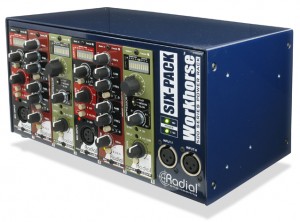
Radial Engineering is pleased to announce the SixPack, the latest Workhorse power rack designed for the popular 500 series module format.
500 Series Range
The SixPack is Radial’s sixth power rack in their ever growing 500 series range. Add this to the 15 modules that are currently available and it is clear: Radial has certainly taken a most proactive stance with respect to building and supporting the 500 series standard. According to Radial President Peter Janis: “Given today’s ever changing digital environment, recording studios must be agile for them to adapt and they must also bring a higher level of creativity and uniqueness to the recording process. We believe that the 500 series is perfectly suited for this new reality as it is compact and easily transportable. And when you consider the hundreds of modules that are now available plus the tremendous patching options that can be put to use, there has never been a more exciting time to be involved in music production.”
Six Slots Rack
The SixPack is a 6-slot power rack designed to accommodate all 500 series modules including older ones made by API. It features a hefty 1600 milliamps of current for more than 265 milliamps average power per slot. This lets you mix and match solid state and tube modules without concern about powering. The external supply also provides 48V phantom power for mic preamps. Protective circuitry in each slot safeguards the SixPack and other connected modules against malfunction or short circuits.
The design begins with 14 gauge steel construction for added durability and improved shielding against noise. Modules may be patched in series using the FEED switch and stereo mated using the LINK function. Extra connectivity includes ¼” TRS connectors wired in parallel with the XLRs for cross-patching and parallel processing. These are also wired in parallel to a set of D-Sub connectors for easy patching to and from the workstation. Two front panel XLR convenience jacks let you access channels 7 and 8 on the D-Sub or may be assigned to channels 1 and 4 to create a stereo channel strip. Separate ground lugs on the rear panel enable the system tech to incorporate star grounding or other schemes into the studio design. Optional mounting hardware lets you recess the SixPack into the workstation or angle mount it for a more ergonomic set up. The same hardware works double duty to enable the SixPack to be mounted into a standard 19″ rack.
(Via GJs)
The SixPack will start shipping January 2013. For more information on the SixPack
EMW – Playing with the VCF-M101 self oscillation
A simple demonstration of the new 24db/oct self oscillating VCF. No external effects or any other resource was used.
Prokofiev’s ‘Dance of the Knights’ for Analog Modular Synthesizer
This is the intro to ‘Dance of the Knights’ done just using the Modcan Touch Sequencer. There are 4 rows of 8 x 8 note sequences driving Modcan & Bubblesound VCOs. The filters used are the Intellijel Dr Octature, AmSynths JP8 and Doepfer A-106-5. This will be the last of my classical videos as I am busy on a new project. Some new material coming soon.
I Dream of Wires: Chris Carter, the extended interview
I Dream Of Wires is an upcoming documentary about the resurgence of modular synthesizers. In June 2012, the I Dream of Wires team visited the Norfolk UK studio of pioneering industrial and synthpop musicians Chris Carter and Cosey Fanni Tutti, founding members of seminal outfits Throbbing Gristle, Industrial Records, and Chris & Cosey, to name but a few. We interviewed Chris Carter about his long history with DIY electronics, modular synthesizers, and the role they’ve played in his storied musical career. Busy putting the finishing touches on X-TG’s recently released “Desertshore / The Final Report,” an album initially intended to be Throbbing Gristle’s final recording, Carter expressed his enthusiasm for the current crop of eurorack modular synthesizer modules, and how he integrates them with modern tabletop FX units, to create a present-day, cutting-edge revision of his early Throbbing Gristle set up.
chriscarter.co.uk
chrisandcosey.com
industrial-records.com
throbbing-gristle.com
DATAMASKIN

