
Live modular performance – Muon Dependency
Would love to spend some time in this dude’s studio 
A live performance. A 137 space modular synthesizer, Waldorf MicroWaveXT, Dave Smith Prophet 08, Nord Lead 2X, Yamaha TX816, DX7II, and Oberheim Matrix 6.
All synthesizers are controlled either with Numerology 3 Pro or from the modular synth on-board sequencers. Recorded in Cubase 4 from Steinberg.
I played a single line at various times on the DX7II. Everything else is fully automated including a pseudo-random sequence generated by a Catgirl Synth Suboscillator/Harmonic Sequencer module by Ken Stone.
The baseline is the Prophet 08 controlled by a midi output from the synthesizers.com Q172 midi output of a Q960 8 step sequencer pattern.
Background info on the Numerology 3 Pro:
Numerology 3 is a music sequencing and audio plugin environment which uses an innovative approach to electronic music composition based on modular step sequencing. With version 3 Numerology now comes in two flavors: a Standard Edition for anyone that wants an economical step sequencing addition to their studio, and a Pro version with advanced features for users looking to make Numerology a cornerstone of their compositional workflow. Another major addition is an AudioUnit version of Numerology that allows users of supported hosts to add advanced step sequencing to their DAW-based workflow. The Numerology AU is the first Audio Unit plugin to offer sample-accurate MIDI scheduling and built-in latency control.
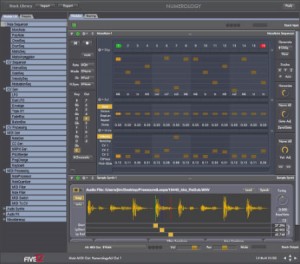
Other highlights of Numerology 3 include new generative sequencing options, a completely revised user interface, a preset playlist, a humanize function, Audio and MIDI recording for every part, and several new and updated modules. These features expand and complement the capabilities provided by Numerology’s extensive list of sequencing and signal processing modules. With version 3, Numerology’s library of modules now numbers more than 50, not including hosted Audio Units.
The Generate and Evolve features in Numerology 3 allow users to explore new compositional territory by using generative algorithms both to create new patters, and to make transformations to existing patterns. The Generate feature includes 18 algorithms for generating new patterns, and is setup to allow users to easily control the musical context in which the pattern is generated. Evolve goes a step further by allowing users to program specific algorithmic changes to a sequence. These changes can be triggered directly, or setup to automatically repeat for regularized pattern modulation.
Features specific to the Pro version of Numerology include multi-output support for hosted AudioUnits, monophonic audio routing support, OSC support, custom scale quantization, and several new modules specifically oriented for building advanced sequencer setups. Included in that set are gate generator and clock offset modules, a CV To Audio module for driving an analog synthesizer directly from Numerology (with a DC-capable audio interface), and a pair of operator modules supporting a total of 61 functions.
Both the Pro and SE versions of Numerology 3 come with much improved synthesis options for the built-in sample-based SampleSynth and DrumKit modules. These modules now include a multi-mode filter, 2 AHDSR envelopes, a beat-synchronized LFO and a modulation matrix. Complementing these additions are a new set of built-in audio effects, including tempo-synchronized delays, multi-mode filtering, and a ring modulator.
Two new features in Numerology 3 greatly expand user options for storing and sharing presets and patterns, the Stack Library and Module Presets. The Stack Library is a new centralized location for storing part-oriented sequencing and synthesis setups. The Numerology 3 download comes with a library of stacks that include a variety of demo tracks, examples and core sequencing templates. In addition, the new module preset function in Numerology 3 allows users to easily store and load settings for any module. This feature is particularly handy for keeping track of sequencer patterns as well as building preset libraries for the SampleSynth and DrumKit modules.
Modular Sequenced with Ribbon Controller
http://youtu.be/IFYlz-Onto0
Background information:
Using a hybrid 5U modular synthesizer, this recording is a live performance with a Walking Stick 500mm ribbon controller solo. The synth is running multiple sequencers, oscillators, filters, and envelopes, in order to play all of the parts at once. A dotcom Q119 sequencer is used for three lines of sequence, and it is triggered by a STG Trigger Store. Nothing is multi-tracked.
Folktek Luminist Garden & Modular System
Folktek Luminist Garden & my modular system
First Session with this great instrument. All sounds (except the Luminist Garden) from my little modular system.
Sequencing: Pittsbsurgh Timetable, Doepfer A-155, MakeNoise Pressure Points & Brains, Malekko Wiard Noisering
Drums: Malekko Wiard Borg Filter, Doepfer A-117
Noise: 4ms Noise Swash, Bubblesound VCOb, MakeNoise Wiard Wogglebug, WMD Gamma Wave Source
Mello: Bubblesound uLFO
Recorded with Logic Pro.
Here you can find a hi-res photo of the patch: http://www.klirrfaktor.com/images/Klirrfaktor_patch26_Luminist_Garden.jpg
More @ http://www.klirrfaktor.com
Klirrfaktor
Modcan 3VCO Polyphony
Seeing if the 3VCO can be used effectively as a polyphonic device playing chords. It can if you use a MIDI-CV device that can send 0V on the unused channels when needed. This is because the second and third oscillator of the 3VCO can only be offset from the first oscillator, not individually controlled.
Girl going modular
Background info:
My girlfriend taking over the Modular while I’m at the gym.
*************************************************************
Gear used:
Synthesizer: Theis Modular System
Sequence: Doepfer MAQ 16/3
FX: TC Electronic M300
Using Korg SyncKontrol (iOS) as a modular clock
Here’s how to use the free iOS app SyncKontrol from Korg with your modular synth.
At the very least you will need to amplify the output and ideally use something like a Maths to control the pulsewidth of the clock, though it will work without one if amplified.
Minimum Viable Modcan
More on Modcan can be found here >>
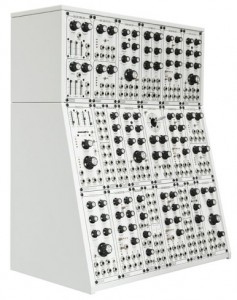
“A guy suggested one could have quite fun with just three modules of Modcan, the 3VCO, the Dual Multimode Filter and the Quad Envelope. This thanks to the amplitude input on the 3VCO which in fact works like a VCA for that module. Works like a charm and packs quite some punch into very little panel space! In fact, if you go for a rack space system, you can fit two more modules into one row. This will definitely get you started though!”
New Beta version of the Sonigen Modular soft synth is released

Sonigen Modular is modular software synthesizer which gives you the freedom and flexibility of classic modular synthesis with high quality sound and efficient cpu usage.
Features
- Fully modular with as many modules and patch cables as you want.
- A fast and intuitive user interface. Layout is mostly automatic, cables indicate signal flow, and our (unique as far as I know) dynamic input handling reduces the need for extra mixer modules, and also reduces screen wastage from unused input terminals / knobs.
- Modular voice and modular output effect processing both cleanly integrated in one window.
- Everything is processed at full sample rate, there is no lower “control” rate. This means pretty much anything can be plugged into anything else. It also means higher quality modulation control and processing.
- Just in time (JIT) assembly. The audio engine is written entirely in assembler, it is dynamically assembled and optimised in real time with no interruption in the audio processing. This allows a whole class of optimizations that cant be done with pre-compiled binaries.
Pricing and Availability:
Free download
More information:
Flowers in the dark – modular jam
2 Malekko Unkle VCO’s multi wave outs mixed through SubMix7 into ModDemix (vca mode), from ModDemix into the new Intellijel Corgasmatron dual Filter. Various modulations to the filter done by clocked Wogglebug and Pressurepoints. The new Corgasmatron is a great filter! lots of great sounds possible! I also just fixed up my SH-101 and have that being clocked off the SEQ01/808. It’s providing the acid sounding bassline. Everything is being mixed via the Unify Mixer by Circuit Abbey then ran through the Lexicon Time Factor delay pedal.
Pitch CV is being generated by the STG Graphic Sequencer running through the Intellijel uScale which is also being shifted by a 4 step sequencer from the z8000. All of the clocks are being generated by the MFB SEQ01 which is being slaved by the Cowbell trigger output of the 808.
“At some point through the video I crank up the Res controls and let the filter oscillate with the incoming FM modulation happening at the same time. It can be touchy and you will need to practice with it but it can be a really cool thing. I have the filters in series, first is in LP and 2nd is in BP. Jumper settings are NOT in the “vintage mode” I have yet to try vintage modes. and am curious how that will effect the resonance controls.”
Going modular percussions with the Intellijel Corgasmatron
This is a 2-part video demonstration of the Intellijel Corgasmatron eurorack VCF, using it’s screaming resonant filters for percussive / subbass / metallic mayhem. No audio signals (VCOs / noise) are being passed through the VCF – what you hear is coming strictly via the Corgasmatron’s self-oscillating filters.
All of the sequencing is done via a Make Noise setup — Brains, 2x Pressure Points, and clocked by a MATHS.
In the first part, only the LPF is used. It’s being modulated by an MFB ADSR, and the Make Noise B+PP. The MATHS is being used as a slew/portamento occasionally.
In the 2nd part, Make Noise B+PP is also sequencing a Jomox MBase01 kick, and a Snare part created with MS-20 white noise into a YuSynth Arp VCF. The Cogasmatron’s signal path is set up just like an MS20 – HPF into LPF in series. HPF is being modulated by PP+B (FM2), + a Tip Top Audio z3000 mk2 VCO (FM1). I used the z3000’s sine wave out (I think). The z3000 is also being sequenced by the PP+b. LPF is being modulated by MFB ADSR (FM2), and PP+B (FM1).
Key features:
-16HP and shallow (two pcbs in parallel so it is skiff friendly)
-two independent filters, each with LP, HP and Notch modes.
-Unique resonant (Q) drive control
-A Switch links the two filters allowing both parallel and serial routing via normals to input B (which can be broken by inserting a cable at input B).
-Oscillates very easily and can be used as a dual sine VCO. Using the resonant controls this Sine shape can be colored.
-1V/Oct inputs
-Built in full featured cross fader allows voltage controlled xfading between the two filters. The Xfade has a switch to select either unipolar (e.g. envelopes) or bipolar (e.g. lfo) control of the xfade position. There is also a switch to select direction. With nothing plugged into the Xfade jack the xfade knob controls the fade position. When an external CV is patched in the same knob acts as an attenuator for the control signal.
-Jumpers on the back to select “modern” or “vintage” resonant modes (two different feedback paths for the resonance that use different diodes)
-expansion jacks for adding additional filter inputs and VC control of resonance
DATAMASKIN

