
First test of the Neutron Shield modulator
Testing early programs in the first module made with Neutron shield modulator. arduino powered synth module. 4 of 8 possible modes are shown. Simple Sequencer, Advanced ADSR, Retrig LFOs and Dual ADSR.
The board converts and processes arduino signals to work at normal Modular synthesizer voltage levels , and converts synthesizer voltages to work with Arduino. There is also provision to work in tandem with the Gameduino Shield, as well as MIDI I/O, MCP4822 Dual channel SPI DAC output, And Neutron ControlEX Control expander card. To be compatible with smaller modular synthesizer formats, The card is only slightly larger than 2 arduinos side by side. The project uses all through hole components for ease of construction when builders do not have access to SMD tools.
One Man Band Electronic Jam
“By the way a clip to see me jaming with some of my equipment. The used instruments are:
A-100 Analog Modular System
Mopho filtered by EBBE & FLUT
Novation X-Station
Korg Kaoss Pad”
Messing around with an Analogue Systems “French Connection”
Given that it was an early electronic instrument, the Ondes Martenot was singularly playable, so it’s not surprising that composers such as Barry Gray (see the box on the penultimate page of this article) continued to experiment with it throughout the ’50s, ’60s and 70s. Even today, its unique method of control and expression attracts musicians keen to develop new sounds and playing styles. So when Johnny Greenwood of Radiohead asked Analogue Systems to develop a Martenot-style controller for his modular analogue synthesizers, the company was keen to oblige.
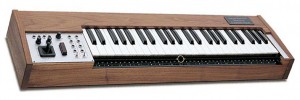
Named the French Connection, Analogue Systems’ design adopts the control mechanisms of the classic Martenot, but leaves the sound generation out, and packages everything in a neat unit designed to sit in front of any of the company’s RS Integrator modular synths or, for that matter, similar modulars produced by other manufacturers. The keyboard itself is four octaves wide, and in front of this you’ll find the wire controller with the small ring through which you insert your index finger. The wire (which is actually a fine nylon cord) is stretched above a fingerboard in which you’ll find small circular depressions that represent the white notes on the keyboard; and protruding metal studs that mark the positions of the black notes.
To the left of the keyboard and the wire controller, there’s a control panel reminiscent of those that you’ll find on other Analogue Systems products. To the far left of this, there’s a sprung X/Y joystick that returns to the central position when released. Above the joystick itself you’ll find two knobs that determine the output range for each axis, with a maximum maximum (if you see what I mean) of approximately 10V. There are four joystick outputs, two each for the ‘X’ axis and for the Y axis. These, like all other Analogue Systems devices, use 3.5mm sockets. To the right of the joystick you’ll find the large, sprung wooden button that also harks back to the original Martenot. If left untouched, this sits in its uppermost position, and generates an output CV of 0V. As you depress it, the CV rises progressively to a maximum of approximately 10V. Again, a knob located above the button itself controls the actual range of operation.
There are just two further controls on the French Connection, and these are the switches located immediately to the left of the keyboard. The first of these determines whether the pitch CV is controlled by the keyboard or by the wire controller. The other determines whether the keyboard produces a conventional trigger and gate, or whether the button produces an amplitude CV. There are eight physical outputs for these – three pitch CV outputs, three button CV outputs, a trigger output, and a gate output. And that’s all there is to it. Add an IEC mains input and an illuminated on/off switch to the right-hand side of the unit, and mount everything in a gorgeous, polished wooden case, and you have a French Connection.
In this video:
I had the oppurtunity to mess around with an Analogue Systems “French Connection”, an imitation of an early electronic instrument called the Ondes Martenot. This controller is CV’d up to an MFB Kraftzwerg. Just a demonstration of some of it’s capabilites. I’ll make a more musical video soon.
How to get started with analogue synthesizers, modular systems, stepsequencers and more
“The Testsalon inside Rough Trade East in London is the showroom installed by Schneidersladen, Berlin with the latest news in electronic hardware devices. The Video gives you an overview on how to get started with analogue synthesizers, modular systems, stepsequencers, drummachines, or filters from independent manufacturers like Doepfer, Sherman, MFB, TomOberheim, Makenoise, Cwejman, SND, Vermona and many others. All is connected with each other via Midi or cv gate and you can make some music easily .. if you are around. “
Jam with the Kraftzwerg as a stand alone modular
“My first jam with the Kraftzwerg, being sequenced by the Revolution via midi. Drums are from the Vermona drm Mkii (best drum synth in the world!!) all being driven by the MPC1000. Its a 2 bar loop again! with modulation of primarily frequency on both machines and a couple of hits of the remix button on the Revo. They make a formidible pair!”
Background info:
MFB-KRAFTZWERG is the semi-modular version of MFB’s Synth-II. It trades memory locations and MIDI-control off for 37 patch connectors that allow breaking and modifying the internal routing. Put single KRAFTZWERG components under analog sequencer control or let the whole unit interact with your existing modular-synthesizer-system.
MFB-KRAFTZWERG works as a stand-alone synthesizer without the need to patch any cable. The classic formation of VCO-VCF-VCA is pre-wired internally, complete with essential modulations. Therefore, you can play the KRAFTZWERG just like any other synthesizer using its MIDI-input. In addition, it may integrate into a full analog environment using control voltages – and benefit, unlike MIDI, from infinite continuous parameter resolution.
MFB-KRAFTZWERG offers a complete set for powerful and versatile synthesis: three VCOs with hard-sync, 24-dB-lowpass-filter with resonance, noise generator, ring-modulator, two envelope-generators, two LFOs and VCA. Technically and soundwise KRAFTZWERG is identical to MFB’s euro-rack-modules. However, the MFB-KRAFTZWERG comes in a compact format that is easy to take with you and faster in use. Your ideal analog partner on stage!
The unit need a power-supply AC/AC 12V 500mA.
Genome MIDI sequencer goes modular
Using the Genome Midi sequencer for the iPad to sequence a modular synthesizer. The ipad is sending midi out thru the Alesis iDock to the Encore Expressionist for midi to cv conversion for the modular. The Metasonix D1000 is receiving its triggers from the 4MS Rotating Clock Divider clocked by ch 5 of the Genome app. Recorded into Ableton Live in one take.
Checking out some new Moduls
Checking out some new Moduls, like the 4 ms Shuffling Clock Multplier and the Synthesis Technology E-580 Delay. The synthesis technology e580 resampling mini-delay emulates the classic sounds of digital, bbd and tape-based delays with 4 parameters under voltage control. the 14hp wide euro module accepts either +-12v euro standard power or +-15v motm/frac power. using a 40mhz dsp and 24-bit codec, the e580 recreates the pitch-shift modulating of bbds with the variable bandwidth and noise floor without costly bbd ics. in tape mode, wow& flutter, tape saturation and non-linear distortion model classic tape units without the bulk and maintenance. there are 2 simultaneous audio outputs: a straight delay and a variable tapped delay. the tap position is a percentage of the main delay time. this allows very short delays (<350us) as well as long delays (750ms). both tap position (‘offset’) and main delay time are voltage-controlled over a -5v to +5v range.
feedback is jumper-selectable from either the tapped position or the main delay. this flexibility can generate standard ‘rhythmic’ delays (feedback from main delay) or a series of ‘pre-delay reflections’ (tapped delay) which sound very different from each other.
The first big Reco-Synth
Probably the first analogue modular synth ever built in Brazil. The first big Reco-Synth.
Features:
The Jolymod is the first Modular Reco-Synth.
It has :
4 x 16 steps sequencer
4 x voltage quantizer
6 x VCOs
2 x noise
2 x 12 db filter
2 x 24 db filter
2 x LFO
2 x sample & hold
2 x AR envelope
2 x ADSR envelope
1 x double VCA
1 x midi to CV
1 x ring modulator
1 x phase shifter
1 x multifunction module
1 x spring reverb
1 x stereo auto pan
1 x analog VU
1 x tube VU
This Modular has PCB’s from : MFOS, PAIA, OAKLEY SOUND and RECO-SYNTH
Dub Step Modular Synth Patch
Background info: “Quickly patched this together to give an example for good old muffwiggler.com. Basically as long as you have a few good filters, and Formant style oscillators, you will be able to get a similar sound. Literally took me 5 minutes to get this together, so I want to see your version!”
Signal Path for main Oscillation: Piston Honda – Polivoks BP – Plague Bearer – QmmG Ch1 on LPG – Borg2 – QmmG Ch3 on LPG
All modulated by Maths
Live improvization on the Fenix synth
Synton was a manufacturer and distributor of high-end electronic music equipment in the Netherlands. They were one of the principal importers of music equipment from E-Mu, Ensoniq, and Fairlight in Europe. Felix Visser, the founder of Synton began the company in 1973 after purchasing an EMS Synthi AKS and setting out to produce similar equipment with more of the functionality that he was looking for in an analog synth. Eventually, the company developed Synton Syntovox vocoders as well as the System 2000 and System 3000 modular synthesizers that were sold to Karlheinz Stockhausen and distributed in the United States by Bob Moog’s Big Briar Inc. In 1983, Felix Visser, product specialist Marc Paping, and designer Bert Vermeulen created the Synton Syrinx, a monophonic analog synthesizer that contained unique features such as a metal touchplate for manipulating sound as well as a formant filter.
Because none of the commercial analog synthesizers on the market had the same features as the synthesizer he wanted, Marc Paping and Bert Vermeulen reunited in 1997 to create the Synton Fenix, an analog modular synthesizer featuring 31 differing modules. The Synton Fenix featured an esoteric range of features and was the culmination of the designs that Paping and Vermeulen had liked in the vintage analog synthesizers that they had owned, played, and developed in the past. After creating an initial 25 handbuilt units and distributing these to close friends and fans of the Synton company, the team decided to handbuild another 50 units due to high demand from word of mouth. In total, only 75 units were created and the team stopped production of the Fenix in 2000. Musicians have cited the Synton Fenix as their favorite piece of musical equipment due to the combination of unique modules and distinctive sounds the synthesizer was able to create.
DATAMASKIN

