
Dorit explore the MOOG SOUND LAB’s theremin
Dorit Chrysler dynamically plays an original composition on her customized Moog Etherwave Pro, a theremin manufactured by Moog Music from 2004-2006, for an ethereal Moog Sound Lab.
To function as a one woman band, Dorit triggers a prerecorded backtrack on her laptop, adding vocals and Etherwave Pro theremin in real time. At her feet are a MF-104Z Analog Delay and an Akai Head Rush looper to add depth to her sound. Voila!
See other Moog Sound Lab performances: http://www.moogmusic.com/sight-and-sound/sound_lab
Learn more about the Etherwave Theremin family: http://www.moogmusic.com/products/Etherwave-Theremins
Learn more about the MF-104Z: http://www.moogmusic.com/products/moogerfoogers/mf-104z-analog-delay
Dorit’s brand new record “Sea of Negligence” is available on iTunes or on www.doritchrysler.com
IMPORTANT NOTE: For true vintage / retro synth fans only
Only analog synthesizer were used in recording the tune. The tune was also recorded by analog gear only and mixed with an analog mixer. The tune is from Kebu’s upcoming debut album, which is planned to be released in 2012.

Equipment used: Korg Mono/Poly, Korg Poly-61, Moog Source, Logan String Melody, Arp Axxe, Touched by Sound DRM1, Roland TR-808, Electro Harmonix Polychorus, Seymour Duncan Twin Tube Classic, Lexicon MPX500, Allen&Heath GS1, Yamaha MT4x. Cubase & Live only used as MIDI sequencers with the tape sync handled by a Roland TR-626.
You can buy this single from Ubetoo for 0.99 euro:
http://www.ubetoo.com/store/artist/title/a2122
Moog Lunar Impact!
http://youtu.be/RUyx-5v84GE
Happy 77th Birthday, Bob Moog!
Moog honors the memory of the grand old man.
In this video:
In honor of Bob Moog’s 77th Birthday, Moog engineer Steve Dunnington summons a Minimoog Voyager Orchestra to play a Mooged Out version of what else?…Happy Birthday!
Steve overdubbed 6 tracks of Minimoog Voyager, one voice at a time, to realize this rendition of Happy Birthday. Using sounds from the Voyager factory presets, this special version of Happy Birthday for Bob was envisioned as a stylistic mashup of Kraftwerk and Jean-Jacques Perry. Both are artists who helped put the Moog Synthesizer in the ear of listeners all over the world.
Happy Birthday, Bob! This year marks some big changes for the little company you started. None of it would be possible without your fearless genius, passion for innovation and overwhelming humility. Thanks for everything, Bob!
All pictures of Bob Moog courtesy of the Bob Moog Foundation. Visit them here: http://www.moogfoundation.org/
Make waves. Support Bob’s Legacy. http://www.moogfoundation.org/supporting-the-bob-moog-foundation/
Tara Busch & John Foxx & Benge in the studio
Tara Busch & John Foxx & Benge in the studio with Moog
Moog Voyager and the Vmodular rack running drone sounds and sequences.
In this video:
My first song using East West plugins Voice of Passion. Starts out with the Moog Voyager and the Vmodular rack running drone sounds and sequences. The violin solo is East West Symphony Orchestral played on the Voyager. Filling in is Addictive Drums, Prophet 08 for strings, my newly restored Roland JD 800 and the Fantom G for Orchestral percussion triggered by a Korg Padcontrol. Hope you enjoy it.
The poor man’s Moog has been revived
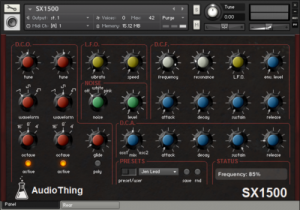
In the lab, for years, covered by other instruments and things, there was this old Italian analog synthesizer from 1979: the Jen SX1000. Monophonic with just 1 oscillator, it was often called “poor man’s Moog”. It is always hard to sample analog gears so, instead of trying to clone it (which is obviously impossible for a sampler), we decided to use the samples of each waveform to build an hybrid synthesizer taking advantage of the Kontakt Script language. It sounds both vintage and new! It is also possible to drift the oscillators to emulate the tuning problems of vintage analog synthesizers and to hear the usual knobs noise caused by dust while tweaking them. The Performance View follows the original parameters scheme adding, of course, new features.
 Documentation
Listen to it here:
SX1500 by AudioThing
About the original Jen SX1000:
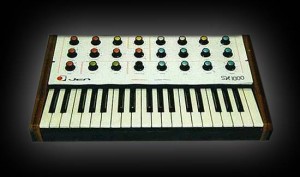
Mention the SX1000 to any serious vintage synth anorak, and you’ll be met with much laughter. But why the little Jen should have become so uniformly derided escapes me. Even in the digitally dominated days of 1985, Julian Colbeck described it as a “fine box for mucking around with, or for learning about synthesis” and “a first class first-time buy”. On its release in 1977 this might have been justified, at least in part, by its super-low recommended price of just £210. Indeed, this had dropped to £159 or thereabouts by the time that the SX1000 was discontinued in 1982, and its street price was often considerably less. But it would be unfair to suggest that the only reason for liking the SX1000 was its price. It was also a fine little synth.
At first sight, the SX1000 appeared very basic. And, on second and third sights, nothing changed this. It had a short, 37-note C-to-C keyboard, a mere 24 programming controls, no CV & Gate inputs or outputs, and no pitch-bend or modulation wheels. Indeed, it was entirely without frills: no velocity sensitivity, no pressure sensitivity, no nothing!
The sound was generated by a single oscillator, described on the control panel and the voice cards as a VCO, but by previous writers as a DCO. The truth is a strange halfway house that is neither entirely voltage-controlled nor digitally-controlled. It worked something like this… The oscillator itself was a high frequency squarewave generator stabilised by a digital circuit. So far, so DCO. The output from this was passed to a large 40-pin chip (that would now be almost impossible to replace) that shaped the wave into a wider selection of waveforms and divided it down to the standard range of audio frequencies. But what about the ‘Fine Tune’ control on the top panel? This, indeed, was a standard voltage control that affected the frequency of the high frequency oscillator. The range of its affect was rather small but it was, nonetheless, a voltage control.
Clearly, the SX1000 was a hybrid, and it suggests that, in 1978, Jen had a technological lead over much of the rest of the synthesiser industry. After all, it was to be another four years before Roland released the Juno6 – the instrument that is often credited as being the first DCO-based synth.
Inside the studio of John Foxx – video
Tara Busch & John Foxx & Benge in the studio with Moog
My friend Tara continues to deliver nice videos in conjunction with the Mute Short Circuit Festival. John Foxx was also featured by us a couple of months ago:

Anyone with the slightest interest in electronic music has come across the works of John Foxx. John more or less on his own reshaped the electronic landscape with albums like Metamatic and The Garden. Starting off in the 1970′s forming the band Tiger Lily, that later morphed into the legendary act Ultravox. However, John left the band in 1979 to pursue a solo career and over the years, since then, John has been extremely productive – to say the least. John did withdraw from the music scene for a while to pursue other areas, but reappeared in the 90′s via Nation12 and then later on actively started to pursue his music career often in collaboration with others like Louis Gordon, Harold Budd and most recently with Benge (ben Edwards). Currently we are all set for a real treat with the new album called Interplay, featuring John Foxx & the Maths. Without further a due, and introductions, we dive deep into the mind of Mr. John Foxx
Space feature in honor of Bob Moog
The new soundsources were developed using highly creative processing techniques with exotic gear like rare Buchla Modulars, Jean Michel Jarre’s EMS Synthi AKS, Hans Zimmer’s massive Modular Moog (including 1027 round robin Moog Drum samples!) and even Eric Persing’s one-of-a-kind OMG-1. With so many different world-class artists contributing, the library is very rich in style and filled with inspiring, cutting edge sounds!
In this video:
I had the honor to contribute some patches for the Bob Moog Tribute library from Spectrasonics for Omnisphere.
The soundtrack of this clip was done using only sounds from that library including a couple of the ones that i made.
If you purchase the library you can enter a competition to win the OMG-1, a very unique synthesizer that was invented by Eric Persing. Head over to spectrasonics.net for more details!
The video is a mashup of computer generated and real footage including some cool timelapse stuff from the videoblocks library.
Moog clone that might be worth checking out
Audio capabilities of the Manx MM+ vsti.
External reverb & delay is used in places
www.manxsynthersizers.com
DATAMASKIN

