
3π/2 Standuino synth revealed
3π/2 [pi] miami beach limited edition
The circle got reopened. Standuino comes back with three quarters of the circle waiting for YOU to fulfill the remaining quarter!
mystery drone synth with patchable clock sequencer is back !
buy now exclusively from noise.kitchen: http://noise.kitchen/shop/standuino/3…
get more info: http://www.standuino.eu/musical-instr…
3π/2 is amazing sensual experience with rough mahogany knobs, the touch of 100 % natural wool&cotton felt case, golden patching nails and UV leds… and the color finish glows in the dark!
Features
-several oscillators, wavetables and synthesis types
-settings accessed by randomizers
-high probability of getting cool bass sounds
-14 bit PWM sound core
-4 presets
-patchable clock sequencer with several patterns
-internal clock or MIDI clock divider
-MIDI input
-UV leds
-numbered limited edition
-natural pure wool felt case
Jupitar-X – tabletop monophonic synth with a single Juno DCO
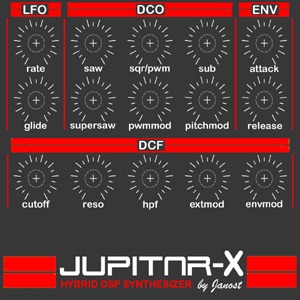
The Jupitar-X tabletop synth is a monophonic synth with a single Juno DCO voice available ready-built or as a kit from Jan Ostman at DSP Synthesizers
Features:
- Oscillator with SAW, SQR/PWM and SUB waveforms.
- SUPERSAW unison setting for the SAW waveform.
- LFO and AR-envelope.
- DSP filter with LPF, HPF and Resonance setting.
- MIDI input for note on/off.
- 5 volt CV/Gate input for oscillator. Frequency range 65-2093Hz (C2-C7).
- 5 volt CV input for filter cutoff.
- External audio input to filter.
- Great analog sound.
Also available is the extremely tiny (65x60mm) Jano-X synth
Features:
- Just CV/Gate, PWM-CV and Pitch-CV 0-5v analog inputs.
- SUPERSAW unison setting for the SAW waveform.
- Great for sequencing and use with external filter.
Pricing and Availability:
Jupitar-X : $330 ready built or $235 for a kit including all parts, knobs, box and frontpanel.
Jano-X: $70
Order from DSP Synthesizers
Closer look at the SAKURA Synthesizer
GR-SAKURAでMIDI音源を開発しました。
回路による再現ではなく、数学的技法によりアナログシンセサイザーを再現しています。
Googlish:
I have developed a MIDI sound source in the GR-SAKURA.
Rather than the reproduction by the circuit, we reproduce the analog synthesizer by mathematical techniques.
Freeware: Mantra Evo synthesizer – combining FM and Phase Dist synthesis
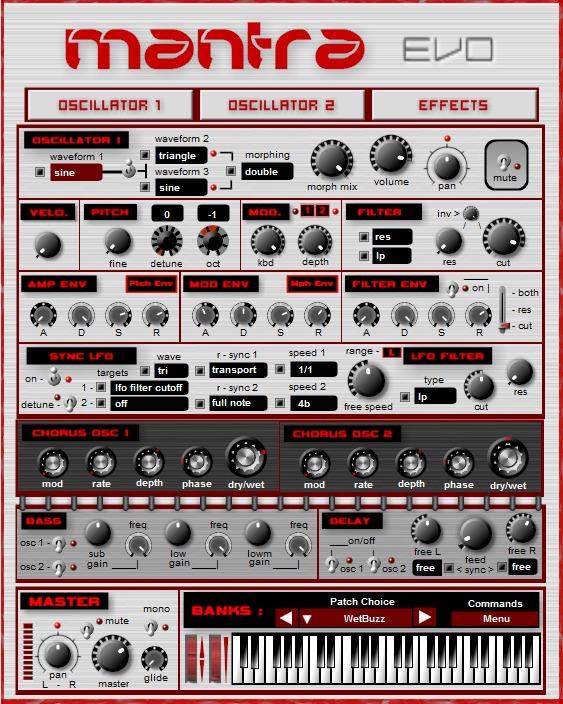
beatassist.eu says that Mantra Evo is a high capable synthesizer, combining FM and Phase Dist synthesis, all in one. Here’s what they have to say about it…
Mantra Evo is based on an FM synth and a Phase Dist synth. Both of these synths are gifted with a morphing system that will morph the basic waves into some more complex ones. Each of these synths are also gifted with 5 envelopes (amp, pitch, filter, modulation and morphing). The modulation of these synths is based on FM modulation system using kbd and depth.
On the filter envelope you can tweak just cutoff, resonance or both. Each of these synths are gifted of an LFO with two targets, dedicated filter, free speed knob, sync option and waveform choice. There is a Chorus for each synth too, making your sounds phater.
The effects you can use for Mantra are Octave Stepper, Distortion, Reverb, EQ, Stereo Delay and Trancegate.
Each of the synths can be individually connected to any of these effects leaving the other off.
Mono Mode can be used with a high gliding range.
Mantra Evo runs on Windows XP/Vista/Win7/Win8 32-bits and 64-bits when bridged.
Crank – new hybrid synthesiser for Kontakt
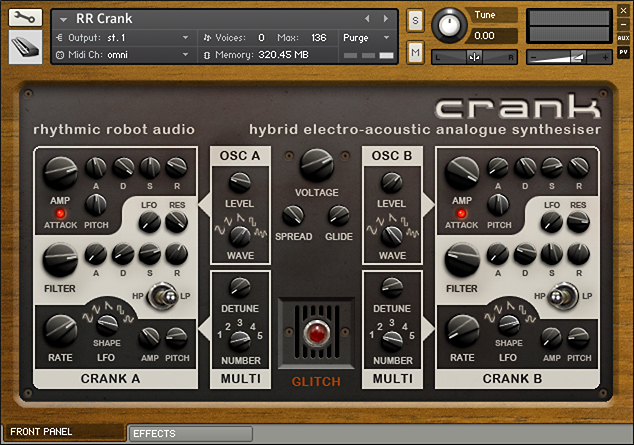
Rhythmic Robot Audio has released Crank, a hybrid synthesiser for Kontakt melding acoustic and electronic sources in a 4-oscillator architecture.
Crank takes over six hundred samples of an Eastern European stringed hurdy-gurdy – and places them at the heart of a four-oscillator analogue synthesiser framework ideally suited to the creation of strange, eerie, evolving patches.
The acoustic hurdy-gurdy produces its sounds by rubbing a rosined wooden wheel over a series of violin-style strings: the sound is half violin, half hand-cranked barrel organ and can be both plaintive and raw-sounding. Rhythmic Robot has sampled a hurdy-gurdy extensively to create the basic tones for Crank, and named the instrument after the handle that the player cranks round to make the hurdy-gurdy play.
The twin Crank oscillators are independently controllable, with dual filters, envelopes, pitch control, LFOs and so on; they also run in tandem with twin Analogue Oscillators, adding some classic analogue waves to the tonal palette. The characteristic attack “squeal” of the acoustic hurdy-gurdy can be turned on or off individually, and the sound sources mixed and blended to create haunting and evocative instruments that sound “almost real.”
Features:
- Twin Crank oscillators drawn from extensive samples of the hurdy-gurdy.
- Twin Analogue oscillators sampled from the Roland SH7 flagship analogue synth.
- Twin flavours of noise: classic white noise, plus vinyl-style crackle.
- Extensive LFO modulation of pitch, amplitude and filter cutoff, independently for both Cranks.
- The Rhythmic Robot GLITCH button to randomise the instrument in musically inspiring ways.
Price: £24.95 – Crank is available now from Rhythmic Robot, at an introductory special-offer price of £19.95. Requires Kontakt v.4.2.3 or later to run (including all versions of Kontakt 5). Kontakt Player is not supported.
Roland M-VS1 – Vintage Synth “Mary`s World”
Vintage synthesizer track featuring the Roland M-VS1
supported by UVI: http://bit.ly/retrosound-uvi
all sounds: Roland M-VS-1 “Vintage Synth” module from the year 1995
recording: multi-tracking without midi
fx: reverb and delay
No vintage synthesizer but a synthesizer module with nice vintage synth sound. 😉
256 waveforms (Oberheim, PPG, Moog, ARP, Mellotron, Solina, CS-80, Roland SH, Jupiter, JX, Juno, MKS, VP330, TR-808 samples and a lot more)
Wie funktioniert ein Synthesizer?
Das Eurovisionssignet kennt jedermann. Dass es auch ganz anders klingen kann, zeigt der Musiker Bruno Spoerri und führt uns gleichzeitig in die Welt des Synthesizers ein. (“Perspektiven” vom 13.4.1972)
NI Reaktor: West-coast style monophonic synthesizer
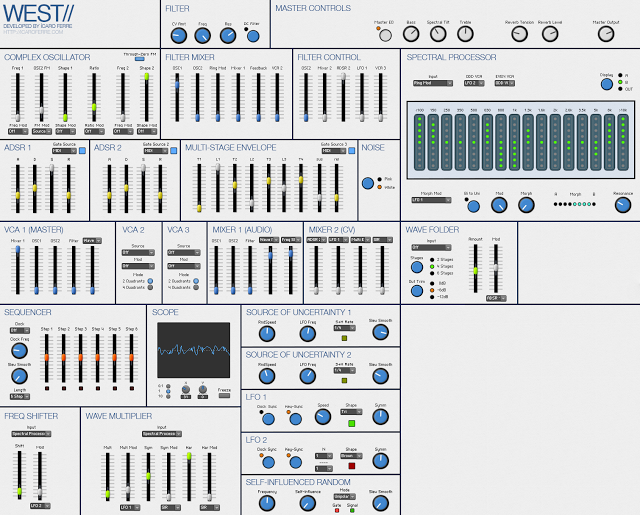
Here’s what the developer has to say about it:
Hey guys, since a lot of you enjoyed the 1.0 version, I thought it’d be a good idea to let you know that I’ve just updated my WEST// Reaktor ensemble.
This new 1.1 version adds a clone of the Buchla 296e Spectral Processor, Wave Folder, Master EQ, LFO Key Sync, new MIDI modulation sources as well as a bunch of bug fixes. Check the link for the full changelog.
Get it for free from the Reaktor user library
WEST// is a west-coast style monophonic synthesizer.
Since there aren’t too many of this kind of synths available for Reaktor I decided to try to create something. WEST// was inspired by the sounds of the Buchla modules and the semi-modular workflow from the ARP 2600 synthesizer.
It contains a Complex Oscillator (FM based dual-oscillator), a filter similar to a low-pass gate, 2 ADSRs, 1 Multi-Stage envelope, Noise generator, 3 VCAs, 2 mixers, 1 sequencer, 2 random modules inspired by the Source of Uncertainty, 2 regular LFOs, 1 Self-Influenced Random module, a frequency shifter and a Wave Multiplier.
The workflow on it is a bit particular so here are a few tips to get started:
– The VCA 1 is linked to the Master output and it’s always controlled by the ADSR 1.
– The sliders available on the Complex Oscillator behave as offsets when there’s no Modulation selected. Once you select a modulation source, the sliders turn into attenuators for the incoming modulation signals.
– Shape 1 and 2 are a bipolar slider
MUTE SYNTH Review – Wet & Dirty #TTNM
Here is a very serious review and sound demo of the Dirty Electronics Mute Synth I, a handheld noise synth with a twist … or tilt. More info below. Subscribe: http://www.youtube.com/subscription_c…
The Mute Synth is controlled by bridging connections with your fingers. It’s a weirdly fun noise maker and I’m looking forward to the Mute Synth II, which is just around the corner. What do you think?
Official Websites:
http://dirtyelectronics.org
http://www.mutebank.co.uk
MUTE SYNTH II in association with Dirty Electronics
The Dirty Electronics Mute Synth II (MSII), is a hand-held synth and sequencer designed in collaboration with the designer and writer, Adrian Shaughnessy. The MSII follows the first Dirty Electronics Mute Synth (MSI), originally created for the legendary Short Circuit presents Mute event at the Roundhouse in 2011.
MSII’s elegant design and focus on usability pushes through a pick-up-and-play approach, with switches and knobs, in conjunction with the touch controls inherent in the MSI, to enable complex and infinite rhythms and sounds to be created simply.
Mute Synth II comes with a selection of works created using the synth by artists associated with Dirty Electronics and Mute.
Mute Synth II is available to pre-order now from: http://www.mutebank.co.uk/mutebank/3J…
http://mute.com/
http://www.dirtyelectronics.org/
Features:
- Designer circuit board
- Noise generator
- Feedback
- Oscillator
- Wave-shaping
- Buffered output
- Sequencer
- Touch and pot control
- Mini patchbay
- Headphone/line output
Mute Synth II comes with a selection of works using the synth, by artists associated with Dirty Electronics and Mute. The CD features Chris Carter (Throbbing Gristle / Carter Tutti Void), Simon Fisher Turner, Dominic Butler (Bronze Teeth / Factory Floor), Kidanevil, Dirty Electronics and more.
DATAMASKIN

