
Daniel Miller Studio Tour
Interview 2014
Daniel Miller showing Minimoog, Pro One, TR 808 / 909 and even the Anyware Tinysizer – shown on the last modular synth meeting – as well as polivoks, System 100m and SE1X along with Microwave and Matrix 1000 by Oberheim and Arp Sequencer.
Teaser from Retronyms: The Build — Codename: Digits
Introducing our newest Tabletop ready phase distortion synthesizer, currently codenamed “Digits.” Louis, from the Adventures in Funk, is back to demo the prototype. Stay tuned to see Digits in development!
Wej needs you! Help support wej by pre-ordering yours and get 20% off. Get Wej for just $99.00 through November 7th preorder.retronyms.com
Follow Retronyms
http://www.facebook.com/retronyms
http://twitter.com/retronyms
The Build is a semi-regular series of videos showcasing what’s in development! Take a peek behind the scenes at our new tech and latest progress in Audio and Music creation.
Vintage synth demo featuring the YAMAHA DX7 II FM Synthesizer
Vintage synthesizer demo track
all sounds: YAMAHA DX7 II FM Synthesizer (1987)
drums: LinnDrum (1982)
recording: multi-track without Midi
fx: reverb and delay
Vintage Synths at Arturia HQ in France – 15th anniv.
Vintage Synths at Arturia HQ in France – 15th anniv.
Exploring the Moog Sonic 6
Tom demonstrating his new (old) Moog Sonic 6
The Sonic Six is an interesting, although obscure synthesizer from the Moog history books. Its predecessor, the Sonic V, was designed by an ex-Moog employee for the muSonics brand. When muSonics eventually bought out R.A. Moog, forming Moog muSonics, the Sonic V’s basic design was moved into a portable brief-case style synthesizer, and with only a few tweaks, the Sonic Six was born.
The fact that the Sonic Six originated from another company’s design not only accounts for why the Sonic Six looks different than any other Moog, but also for some pretty unique differences under the hood as well. To start, it is duo-phonic, utilizing two analog oscillators with three basic waveforms each plus tuning, modulation and scaling controls. There are two independent LFO generators with advanced control options not seen on other Moog synths (for instance, an X/Y knob is used to mix and balance the LFO outputs). Also on-board is a Ring Modulator (that can modulate either Osc. B or external audio) and pink/white noise generators.
Moog synthesizers are known for their filters, and the Sonic Six strays from the usual Moog in this area as well. While it is known that ARP stole a filter design from Moog for use in some of their 2600 and Odyssey models, leading to lawsuits between Moog and ARP, according to Mark Vail in “Vintage Synthesizers,” the Sonic Six actually used some circuitry in its filters which were stolen from an ARP design, although ARP never sued Moog over it. However, later models of the Sonic Six were eventually fitted with a more traditional Moog designed filter. In either case, the filter is a low-pass 24dB/oct which offers the usual controls and is capable of self-oscillation. The VCA, however, has a rather limited set of controls – attack and decay plus a sustain on/off switch.
Not commonly seen, they are actually rather durable devices and used ones generally (if proper care was taken of them) are found in good working order. It was originally designed for educational and home use so it is light and portable and even has a built-in amplifier and speaker. It’s a genuine Moog synth that is equally as obscure as useful these days. And its rather simple looking front-panel layout hides the uniquely flexible, powerful and great sounding little beast it truly is!
Worlds first electric keyboard / synth on auction in NYC for a mere 20K USD
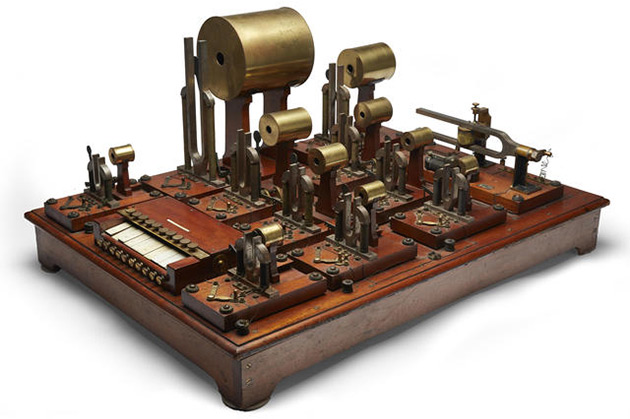
A “bargain” – if we may say so 😀
But it sure is a beauty !!
Abstract:
When Hermann von Helmholtz designed what was essentially the world’s first electric keyboard, he didn’t do out of a need to lay down crunchy riffs on the shores of the Rhine. What he needed was a way to generate tones and mix timbres in a bid to better understand the musicality and substance of vowel sounds. He ultimately came up with a series of electrically activated tuning forks hooked up to brass resonators, and now you can try to own one of your every own… assuming you’ve got between at least $20,000 burning a hole in your pocket. This particular unit — hewn of wood and keys whittled from African ivory — wasn’t made by Helmholtz himself, but it is one of the few remaining examples of such 19th century tech still in existence. To hear auction brokerBonhams tell the tale, there’s just one other floating around the United States (another seems to be in safe hands at the University of Toronto). Intrigued? The Helmholtz synthesizer will go up for auction in New York come late October along with a slew of other scientific curios from back in the day.
TherapSid – new SID synth from Twisted Electrons
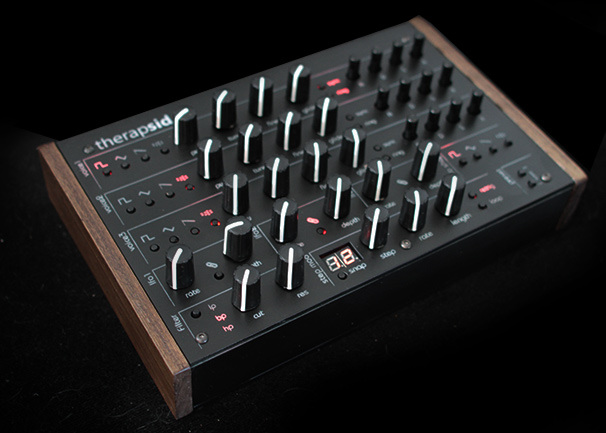
Twisted Electrons has released their newest synthesizer, the TherapSid.
Based on the SID (Sound Interface Design) chip and named for the fearsome long-toothed Therapsid dinosaur, the TherapSid is an “aggressive” synth intended “to create roaring noises that will cut through your mix like razor-sharp claws through a mammoth steak.”
TherapSid Features:
- Compatible with all SIDS
- 3 Oscillators, 4 waveforms per oscillator
- Multimode Filter
- 35 Knobs, 31 Buttons
- SID pcb isolated from main pcb (less noise)
- Switched audio input for running signals through the filter
- 100 Presets
- 3 LFOs: 4 waveforms, 12 target knobs
- 16 Step Modulator: sequence up to 20 knob positions, per step in a snap! Also modulate Ring Mod, Sync and Waveform for all voices.
- Pedal Glide: enable/disable glide with the sustain pedal
- Compatible with free iPad app (pending app store approval)
- Fully MIDI automated (see midi spec. chart in manual)
- Future proof: Firmware updates via sysex
http://twisted-electrons.com/therapSid
Overview: presets – lfo – step mod – ipad app
Punch-DB – bass drum synthesizer and sample player plug-in from Rob Papen
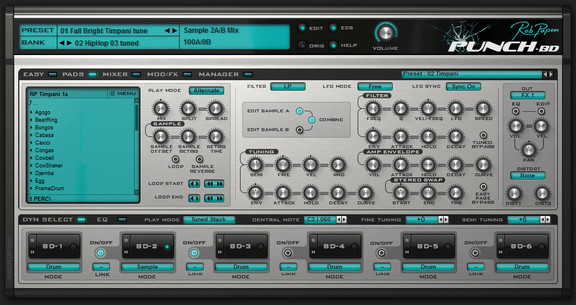
Rob Papen has introduced Punch-DB, a bass drum synthesizer and sample player plug-in based around the BD module of the multi award winning Punch virtual drum synthesizer.
Stacking bass drums is a popular technique used by today’s music producers and Punch-BD gives you the ability to stack up to 6 in total. Divide the 6 BD pads over the keyboard or use them ‘stacked’ in tuned mode to produce creative new BD sounds for all styles of contemporary music.
Punch-BD delivers synthesized drums in the finest audio quality or you can choose to load in your own samples for complete flexibility. Each pad has its own distortion module with several distortion types as well as its own 3 band graphic EQ. What’s more, each individual pad also has its own preset section next to the overall ‘BD kit’.
Like its big brother, Punch-BD features four FX units each with many 31 types of top quality FX plus further filters, envelopes, modulation routings and more for crafting your own unique sound.
From Electronic Dance and Hip Hop to Soundtrack projects, Punch-BD provides a solid speaker-busting sound for your productions.
Punch-DB will be available soon for Windows and Mac (VST/AU/AAX), priced at 49 EUR / $59 USD.
This is nice – Cosmosf vSaturn – a potential must have
Demonstrating the new Cosmosƒ vSaturn synthesiser. This version presents a unique “Sieves” engine, which makes it possible to calculate the known musical scales and custom designed ones, for mapping on multiple synthesis engine parameters at once.
vSaturn also offers a clever MIDI response to perform with the “sieves” on Cosmosƒ micro events. Single notes or chords can be performed with MIDI input to control the micro event pitch relationship inside the relevant meso events.
lso there is a audio precision arpeggiator “a la Cosmosƒ” with stochastic features implemented in this new version.
The Riser – synthesizer instrument designed for creating powerful transitions with electronic dance music
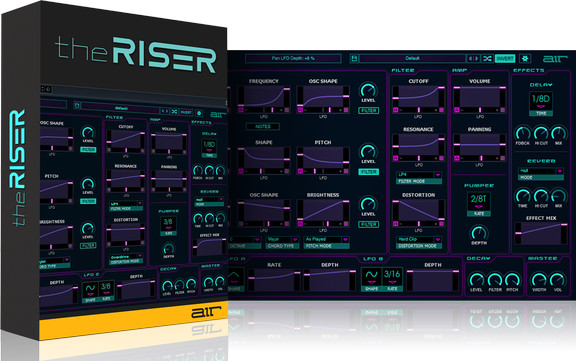
AIR Music Technology has introduced The Riser, a synthesizer instrument designed for creating powerful transitions with electronic dance music producers and DJs in mind.
A powerful, synth-based instrument, The Riser features all of the tools you need to compose heart-stopping transitions in one intuitive user-interface. In seconds, you can construct rises, falls, swells, fades, and more, based on our coveted sound synthesis technology. For instant inspiration, The Riser includes 300 pro-grade presets that you can edit, deconstruct, copy, mangle, and implement into your tracks.
Transitions add suspense, hype, drama, and movement to your music. Cymbal swells and reversed instruments were go-to transitions for years, until the DAW pioneered fast and flexible audio editing, paving the way for complex sound effects. When combined with synths and other audio shaping tools, transitions completed their metamorphosis from science to art. Until now, this process has convoluted and time-intensive, taking attention away from the overall project itself. The composer spent more time trying to get plugins, virtual sample players, hardware effects, sound modules, and other gear to play nice with each other – and that was before hitting “record”.
The Riser features
- Transition designer optimized for electronic music production, scoring, and remix work.
- 3 editable oscillators; sweep, noise, and chord.
- 3 LFOs; free-running, tempo-synced, and Pumper.
- 23 filter types including multi-pole and phase shift.
- 300 professionally designed, editable presets.
- Randomizer generates patches at the click of a button.
- Invert mode creates complementary patches by instantly changing transition direction.
- Easy MIDI-Learn Mode; just click and twist to assign parameters to your favorite MIDI controller hardware.
- Pumper effect creates pulsating movement.
- Configurable delay and reverb with wet/dry processing; 4 reverb types.
- Adjustable panning movements and master stereo width control.
- 64-bit AU; 32- and 64-bit VST/AAX; Mac or Windows.
The Riser will cost $79.99 USD. A full version 15-day demo is available for 48 hours only.
We hope this video gets a rise out of you.
DATAMASKIN

