
Thomas Dolby – Interview + Airwaves (Riverside)
Thomas Dolby showing us how he makes his music along with the video for Airwaves.
Shown on Riverside.
Thomas Dolby on tour in the US
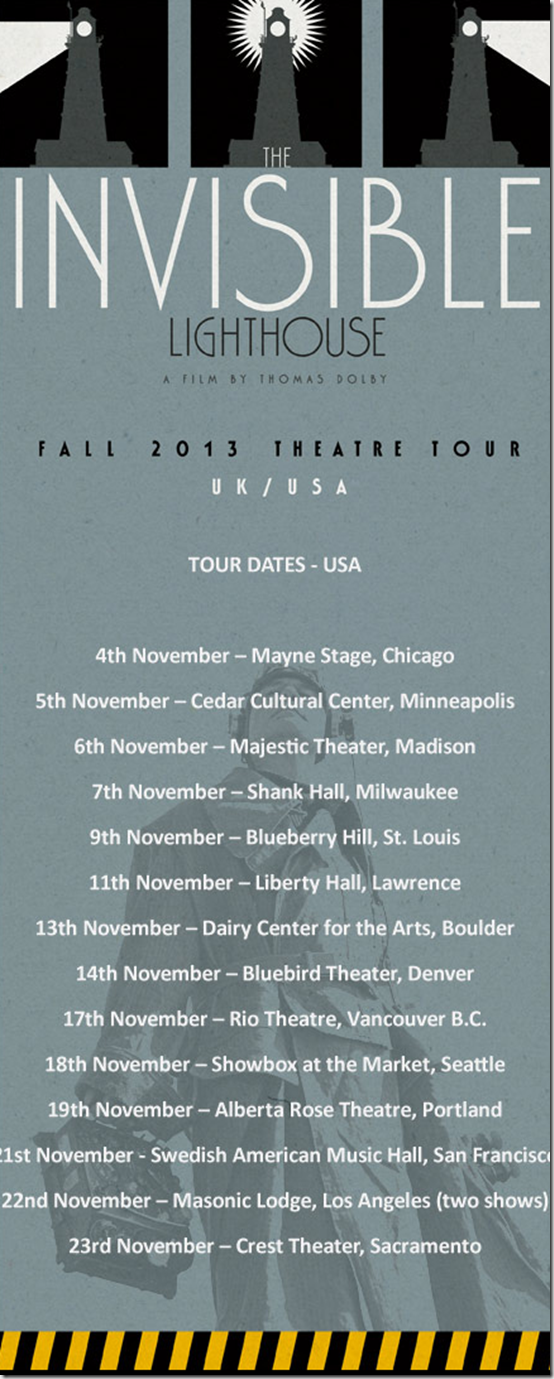
A trailer for the live performance US tour by Thomas Dolby, playing and narrating the soundtrack to his self-made film debut The Invisible Lighthouse, with special guest Blake Leyh on live Foley sound effects.
Thomas Dolby – The Invisible Lighthouse US tour trailer (w/ live Foley SFX)
A trailer for the upcoming live performance US tour by Thomas Dolby, playing and narrating the soundtrack to his self-made film debut The Invisible Lighthouse, with special guest Blake Leyh on live Foley sound effects.
Moog interview with Thomas Dolby
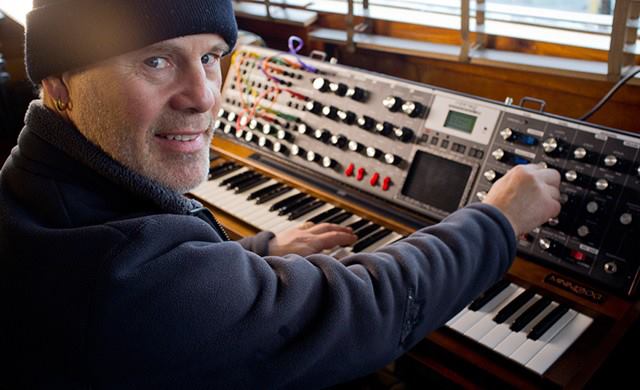
Moog had the pleasure to sit down with Thomas Dolby last week in England to deliver his custom Minimoog Voyager XL. Dolby talked with us about his experiences with Moog synthesizers, his musical process, and his history with many different musicians.
When were your first experiences with Moogs? When did you first get the opportunity to experiment and play with them?
There tended to be Minimoogs lying around professional studios round-about the end of the 70’s – 76-77-ish when I first got into studios. And when the Micromoog came out I picked one up second hand out of the back of Melody Maker. And that was the first off-the-shelf synth I’d owned. Before that the only synth I’d owned was a Transcendent 2000.
Ah, that’s the DIY one isn’t it?
Yeah. And I didn’t have a keyboard for it. So I could sort of generate tones but that was about it. I remember hooking it up to the keyboard from an ARP.
That’s very old school – in the sense of using it as an oscillator bank.
Yeah. So I was familiar with Minimoog but the Micro was the first one I could afford. And the next one was the Source. And for a while I had a three piece band, and I was basically playing the Micro and the bass player was using the Source.
And so I’ve used Mini’s a lot over the years but never owned one. The first serious recording I did with one was on the Foreigner “4” album. I remember Mutt Lange had left for the night, and left me for the night like a kid locked up in a toy shop. And I had six tracks and had to make an intro for “Waiting for a Girl Like You”.
Space performance: Buzz Aldrin and Thomas Dolby Perform “She Blinded Me With Science”
Some of the brightest minds in the world gathered at Smithsonian’s “The Future is Here” conference to discuss the great triumphs and future innovations in science and technology
http://www.smithsonianmag.com/ideas-i…
Thomas Dolby – Leipzig Is Calling
This 80sObscurities was founded by DJ Rexx Arkana to showcase old, often unknown or forgotten acts and tracks from the decade when electronic music was truly the new wave. Rexx Arkana has been a club/radio DJ and promoter since the mid-80s and headlined festivals on several continents and currently holds a residency at DEFCON, NYC’s current longest-running weekly scene party. He is also the founder and lyricist of Brudershaft and one half of harsh electro act FGFC820.
Heiko: “This song is the B-Side of Thomas Dolby’s debut single, ‘Europa And The Pirate Twins,’ from 1981. In those days I used to spend a lot of time in record shops. I still can remember the moment I discovered the great cover; showing Thomas Dolby as a kind of scientist, standing in the middle of a stage, surrounded by globes and telescopes. Even without listening, ‘Leipzig Is Calling’ caught my attention. In the days of the “Cold War” it wasn’t common that an international musician wrote songs about a city from East Germany. I bought the 12″ vinyl right away. The sounds and especially the harmonies blew me away. Since that day this song is one of my favorite compositions – in terms of songwriting and of sound. Thomas Dolby is one of the most gifted composers and synthesizer players I know. His work always inspired me. ‘Well you’ll soon feel yourself again – And everyplace is just the same, isn’t it?'”
Rexx Arkana’s 80sObscurities previous playlists are also available on Facebook and YouTube. (Via SL)
Interview with Thomas Dolby at Moogfest 2012
Electronic music pioneer, Thomas Dolby, sat down with Party Ben of Slacker Radio before his set at Moogfest 2012. Thomas Dolby (1958) is an English musician and producer. Best known for his 1982 hit “She Blinded Me with Science”, and 1984 single “Hyperactive!” he has also worked extensively in production and as a session musician.
Music video by Thomas Dolby performing She Blinded Me With Science (2009 Digital Remaster).
For more music and interviews from the festival, visit www.slacker.com/moogfest.
Thomas Dolby – Mulu the Rain Forest
• The song “Mulu the Rainforest” from Thomas Dolby’s classic album “The Flat Earth”.
• Shot and Directed by Chad Johnson in August 2012
• © Lost Toy People / Chad Johnson 2012
• Shot with a GoPro attached to the XP2 quadcopter: http://xproheli.com/affiliate/25/quadcopter/xp2-rc-aerial-video-quadcopter
• This video was shot in the Rockefeller Forest in the Giant Redwoods of Northern California.
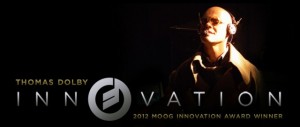
We are also happy to share that Thomas Dolby has won the Moog Innovation Award award this year. Past winners were DEVO in 2010 and Brian Eno in 2011.
Dolby is a self made man, synth pioneer, and mad scientist. Like Bob Moog, Thomas Dolby’s quest for knowledge and desire to sculpt the world around him led him to the world of electronics, where he designed his own synths, founded his own software company, and charged head long through the world of pop music and into America’s consciousness. To say he was blinded by science would be doing him a disservice, for science has been his guiding light, and technology his namesake. For expanding the sonic boundaries of the new wave movement and for fearlessly embracing the future, Moog is proud to present Thomas Dolby with a custom Minimoog Voyager XL, in honor of being the 2012 Moog Innovation Award winner.
The Ghost of Faffner Hall “Thomas Dolby”
Thomas Dolby Explains Synthesizers on Kid’s Show
When Farkas buys a robot to help him get rid of the musicians of Faffner Hall on Make a New Sound Day, the gang borrows some parts from the robot to construct a synthesizer so they can make all kinds of new sounds. Fughetta doesn’t understand how a synthesizer works so the Wild Impressario turns to his best source, Thomas Dolby, to explain it to her.
Peter Vogel and Thomas Dolby on the Impact of the Fairlight CMI
A one hour interview focusing on the classic Fairlight CMI
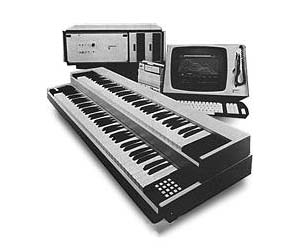
The Australian Fairlight Computer Music Instrument (CMI) is a vintage but state-of-the-art Synthesizer/Sampler workstation. An incredible sampler with 28 megabytes or more of memory! One or two full 73 note velocity sensitive keyboards! Complete synthesis and editing of digitally sampled sounds. Three different on-board SMPTE Sequencers and storage to various disk mediums. The processor itself is housed in a 24″ module. It was also the first digital sampler to hit the market back in 1979 and has endured throughout the eighties and nineties.
From 1979 to 1985 several versions of the Fairlight were produced, with the Series III being the last of them. Each new series added updates to the Fairlight as technology developed through the early eighties. The Fairlight 1 and 2 had only 16 kByte of Memory per voice, and only eight voices but expanded to several megabytes and double the polyphony by the Fairlight III. The IIx was the first Fairlight to offer MIDI. The Series III added aftertouch capability to the keyboard. They all had pitch/mod wheels, an 82-key alphanumeric keyboard, 15 function keys, a Graphics Tablet for drawing sounds and a Video Monitor for seeing what you’re doing while editing.
The sampler is the heart of the Fairlight. It’s a 16-bit resolution digital sampler with variable sample-rates up to 100kHz! Original Fairlight models used two standard 8 bit 6800 processors, updated to the more powerful 16 bit 68000 chips in later versions (the IIx had updated 6809 processors, which is what designated it a IIx over a II, and raised the sampling resolution to 32kHz, from the I & II’s 24kHz). In the Fairlight III, sample memory (RAM) comes in 28MB chunks per 16 voices of polyphony – wow! That’s plenty of room for creating stereo or mono samples. Edit them using various hi-tech functions and at a ‘microscopic’ level using the large Monitor screen. Samples can be looped, mixed and re-sampled with processing for sweetening. As for synthesis, create your own waveforms by sampling and applying Fast Fourier Transform and Waveform editing functions. Storing samples and synthesized waveforms can be done to Hard Disk or 8″ floppy disks.
As for sequencing, there are three sophisticated methods. There’s CAPS (Composer, Arranger, Performer Sequencer), an 80-track polyphonic sequencer. The complicated MCL (Music Composition Language) is like a text-based step time sequencer. And finally the Rhythm Sequencer which functions like a classic drum-machine style sequencer. All sequencer’s are SMPTE syncable.
The Fairlight is a horribly expensive Music Production Center and is rivalled only by the NED Synclavier. Although current samplers, sequencers and synths can blow away the Fairlight at a fraction of the cost – the Fairlight is an historical, prized piece of Vintage Digital Synthesizer and Sampler technology. It still holds up today, over twenty years later and is still a high quality and professional instrument. The facilities provided by it benefit hardcore synth programmers, wealthy musicians, sound designers, film composers and wealthy Vintage Synth collectors.
DATAMASKIN

