
Time machine: ARP Odyssey “Back In 1972”
Vintage synthesizer demo track by RetroSound
“Back In 1972”
all synthesizer sounds: ARP Odyssey Mk3 analog synthesizer
recording: multi-tracking without midi
fx: a bit reverb and delay
He used the internal LFO with the sample/hold modul for triggering the sequence. for the sounds: FM, Osc-Sync and Ringmodulator.
Time machine: KORG DELTA DEMO
Demo from the Korg Delta Vintage analog synthesizer/string machine.
Korg’s Delta is an analog semi-poly synth/string machine, basically a slimmed down version of the Korg Trident. Though limited in the range of sounds compared with other synths of the same genre, the sheer quality of the sound from this little beastie really does make it something of a marvel. It can be found used for cheap and is worth it for the retro synth strings and fat bass synth tones.
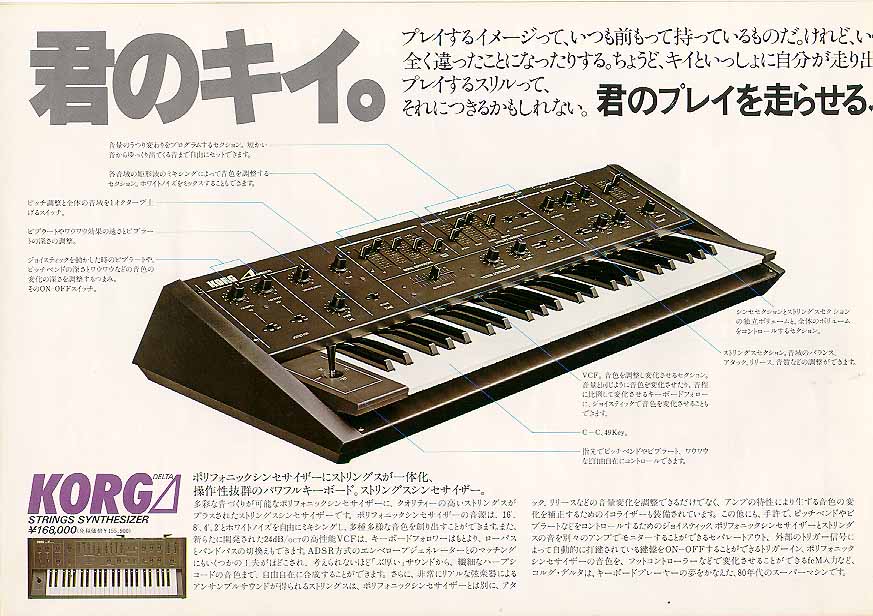
The synth is split into two sections, Strings and Synth, for which there are separate audio outputs along with a combined output for headphones or mixing. Each section has its own controls. The String section has two pitch sliders (16′ and 8′) along with two tone controls (Bass and Treble) and variable Attack and Release controls to modify the sound. The Synth section has four pitch sliders (16′, 8′, 4′ and 2′). There is also a white noise generator along with a very effective 24dB/oct low pass filter (high pass and band pass options are included too) and full ADSR controls. The synth has no memory storage or MIDI, however it does has voltage control and gate ins and outs.
The string sounds are very basic but with its separate outputs and when mixed together with the polysynth you do get that classic ‘layered’ sound which is useful enough on this synth; and it’s fully polyphonic, so you wont be running out of notes! There is a handy joystick to the left of the 49-note keyboard for pitch bending and modulation capabilities. The construction is solid and heavy partly due to the implementation of a wooden base but also because it was designed for heavy usage on the road. Added bonuses: noise modulation, stereo out (strings/synth split), and the ability to combine synth and strings or turn off oscillators in the mixer section.
Yamaha RX21L Drum Machine
Well the reviewer ain’t to happy 😉
Craptastic Yamaha drum machine from 1985 featuring Latin sounds. Boring as hell. Get a Roland TR727 instead!
A quick play of the sounds and several patterns.
Quick demonstration of a pair of mid 80’s drum machines. Demo starts out with dry, direct signals from the machines and then I add a little reverb from Alesis MultiMix 8 at the very end. These machines are popular with circuit benders.
BX-13-MICRO Vintage Roland Analog Guitar Synth to Modern GR-55 Bus Converter with VCA
The BX-13-MICRO is a most advanced, yet easiest to use, vintage 24-pin to 13-pin Roland guitar synthesizer bus converter.
The BX-13-MICRO tackles the problem of controlling the level of the normal guitar by including a voltage-controlled amplifier inside the BX-13, doing the same job as the voltage controlled amplifiers found inside a GR-500, GR-300 or GR-700.
And here is an added plus: no loss of tone as you turn the guitar volume down! The advanced VCA design does not roll off tone like a passive volume control. You get the full range of tone at any volume.
With an entirely redesigned circuit, the transparently converts the 24-pin format to the 13-pin format, and there are no levels to adjust, no additional cables, just clean, analog signal processing with no latency.
Time machine: ROLAND SUPER JX-10 PG800
Released in 1985 the JX-10 (Super JX) combines two individual JX-8P’s for an outstandingly warm, rich and analog sound which is still used in many modern studios all over the world. This synth was the first Roland Synth to be fitted with a quality 76 note keyboard with velocity and aftertouch. Two DCO’s per voice, two ADSR envelope generators per voice, and a resonant lowpass & non-resonant highpass filters are only the beginning. It has a 12 voice polyphony for a total of 24 oscillators and it is by far one of the most programmable synths of its time! However, as on the JX-8P, knobs and sliders have been replaced by low-profile buttons and a nice LCD display. Although this may look sleek and elegant, it makes editing a chore. Assign parameters to the alpha dial for tweaking, one at a time, or get the optional PG-800 Programmer to provide traditional, hands-on, dedicated sliders for editing the JX-10’s parameters.
The JX10 has a Chorus effect and a chase-play Delay function. The chase-play function allows programmable delayed repeats of voices by alternating patches of the upper and lower modules. The simple chorus effect is either off, slow or fast. It has two programmable sliders (if you don’t use the PG-800) for some real-time control which can be recorded along with other effects and keyboard modes into one of the 64 Program Patches. This is in addition to its standard 50 preset and 50 user patch memory. A simple sketch-pad 1-track real-time sequencer is also on-board. It stores sequence data directly to an M16C card, or an M64C card for Patch/Tone OR sequence data. The M16C has a capacity of 400 notes, the M64C 1440, according to the manual.
The JX-10 also comes in a rack-mount version known as the MKS-70. It’s worth noting that the JX-10 can not be edited via SysEx, however the MKS-70 can which is one reason many have chosen the rack version over the keyboard. The JX-10 can make bulk dumps of its sounds over sysex, but only with (discontinued) Roland M64C RAM cartridges.
Wersi Bass Synth and Korg Microkorg
Sounds. Footage. Recording. Music. Self-explanatory.
The Wersi Bass Synth is a mono VCO machine built in 1977 – it’s not really a ‘preset synth’ but it doesn’t have standard vco/vcf/lfo controls either. It features a bassguitar sound with adjustable release, a pulse and saw wave which can be filtered with a formant filter with adjustable envelope and lfo (only the depth, speed and polarity) and a sine wave. There also is a pitch envelope (called glide) and a tremolo (adjustable depth and speed).
More on the Wersi:
Billed as two instruments in one: an Electric Bass Guitar and Synthesizer, this compact light-weight instrument from German organ builders WERSI was aimed at keyboard and organ players. The purpose was to give the organist/keyboardist some Bass Guitar and Synthesizer sounds they could incorporate into their performances. It is a monophonic analog synth with funky controls, decent sounds and a unique character.
The Bass Guitar sound is actually very realistic, really capturing the sound of an electric bass guitar or acoustic bass. It has an attack control called “On” that lets you adjust the initial attack to make it sound like a picked bass or a fingered bass. A “Damp” control is essentially a sustain envelope that can be used to create more of a muted bass sound.
The Synthesizer section is pretty basic, and definitely designed using organ player lingo as opposed to synth player lingo. There a five flute stops (sine) from 16′, 8′, 4′, 2′, to 1′, two brass stops (sawtooth) at 16′ and 8′ and a woodwind stop (square) at 8′. Multiple stops and waveforms can be simultaneously engaged to create more complex tones. These waveform sections, as well as the Bass Guitar section, have independent volume controls to balance their mix.
There is a filter section—a formant filter referred to as “Wah-Wah”—that the brass (sawtooth) and woodwind (square) waveforms can be effected by in either automatic or manually adjusted modes using the “Wah-Wah” slider. No frequency cutoff or resonance knobs or anything usual like that here. Just an “On” switch, direction switch (“Up/Down”), a manual switch and a “Rotor” (auto) switch. A simple envelope section is available with attack and sustain parameters.
A unique “Glide” slider can be used to pitch shift the keyboard by an entire octave. The octave shift can also be automated up or down at variable speed. A really interesting feature is the “Hawaii” button—an intermittent switch that drops the pitch by a half-tone. It is effectively like a pitch bend but only goes down and at a quick fixed rate. A Vibrato effect is available as well, with rate and depth controls and either continuous or delayed modes.
The WERSI Bass Synthesizer was available in kit form but also came pre-assembled with many keyboard/manual options. The idea being that you could connect it to the keyboard or pedals of your organ, or you could choose from WERSI’s 13-, 25-, and 30-pedal claviers. WERSI provided connector kits and a wiring diagram to help connect your own keyboard or pedals to a 16-pin connector interface on the rear of the unit. It was encased in a carry-case-style chassis with a handle and cover.
If looking to buy one of these, potential units should be closely examined, as the original assembly may have been done by the factory or second hand. As a result, a unit may not always be fully functional. Also, some units may have been modified over the years with the original push buttons and knobs replaced by alternative switches and knobs. Other things to consider: is the cover included, are any of the pedal board and connector kit options available and are the owner’s manual and assembly instructions available.
Quick tour of ESLines – vintage clone plug-ins
A small demo of two of the plugins from Electro studio.
Time machine: ROLAND JX-8P Analog Synthesizer 1985
The Roland JX-8P is a programmable polyphonic analog synthesizer from 1985. It is 6 voice polyphonic, it has 2 DCO’s per voice. Oscillator sync and cross modulation available. Analog resonant filters. 2 envelopes. Velocity sensitive keyboard. It also has aftertouch, but be warned, you need very strong fingers… 😀 It has a built in chorus (two settings) and unisono modes.
It has 64 presets and 32 patch memory for your own patches. The optional PG-800 was a programmer which allowed tweaking the sounds with sliders and knobs – like on earlier analog synths. But even without the PG-800 sound editing is easy like on a Korg Poly-800.
The JX-8P has MIDI and sysex abilities, but no tape interface.
Time machine: KORG Z1 featuring “StepLight”
The Z1 is like a polyphonic Prophecy housed in a full sized and featured Trinity workstation-like casing! It does all the analog sounds and more. This is a great analog modeling synth with 12-voice polyphony, thirteen waveforms, four LFOs, two resonant filters, two effects units and more. The ability to create unique sounds is endless. The factory patches could use some help, but overall the sound is very nice! It has a fully polyphonic arpeggiator that blows all others away. It has five preset arpeggio patterns and fifteen user patterns. Unfortunately there is no on-board sequencer. There is incredible real-time control available with knobs to control the two resonant filters, and a touch controlled ‘XY’ pad for tweaking patches in real-time.
Background video description:
Synthesizer demo track by RetroSound.de
“StepLight”
all synthesizer sounds: KORG Z1 MOSS Synthesizer from the year 1997
I use own sounds and factory sounds.
recording: multi-tracking without midi
fx: reverb and delay
I use the internal programmable arpeggiator in this demo track.
Time machine: ARP AXXE Analog Synthesizer 1977
ARP Instruments, Inc. was an American manufacturer of electronic musical instruments, founded by Alan Robert Pearlman in 1969. Best known for its line of synthesizers that emerged in the early 1970s, ARP closed its doors in 1981 due to financial difficulties. The company earned a reputation for producing excellent sounding, innovative instruments and was granted several patents for the technology it developed.
The Axxe is basically a budget-proof version of the popular Odyssey. With just one oscillator (compared with two in the Odyssey), the Axxe certainly has a thinner sound but it is still that uniquely angular and powerful analog ARP sound. It’s not too exciting, but it is simple and straight forward. A perfect first vintage analog for any musician that will still find plenty of use among more seasoned synth players for quick analog bass lines, lead sounds and synth FX. It has no form of memory storage and external control comes via CV/Gate only. It came with a 155 page text book, overlay sheets, interface charts and a book of 50 patches.
DATAMASKIN

