
ALESIS ION , DEMO NA CLASSIC KEYBOARDS
About the synth:
The Ion Analog Modeling Synthesizer is one fat-sounding digital synth! Using Alesis’ proprietary DSP Analog Modeling technology with a 500 MIPS processor (500 million instructions per second), every knob and button is tweakable in real-time giving you the feel and sound of a true analog oldie.
The Ion has 8-voice polyphony with 3 oscillators per voice, and is 4-part multi-timbral. It offers continuously variable wave shapes (sine waves can morph into square waves), plus osc-sync and FM synthesis. 16 filter types are included, along with two LFOs, Sample & Hold, and an Arpeggiator-all of which sync to MIDI clock. A powerful and intuitive modulation matrix is built in, as well as a 40-band vocoder that does not use up any polyphony. External stereo audio can be processed through the filters, effects, or the vocoder.
Though not a true analog like the Andromeda A6, the Ion is capable of creating a wide variety of sounds from warm thick analog pads all the way to gritty monophonic leads and basses, as well as some funky and realistic sound effects. The Ion also simulates the best of the classic analogs such as Oberheims, Roland Jupiters, Arps, Moogs, etc, largely due to its great filters – there is hardly any aliasing even on the highest tones. The Ion also comes equipped with not one but two modulation wheels, both assignable to mods in the mod matrix (LFOs only assignable to mod wheel 1). The Ion has an amazing range of tonal possibilities.
The chic design, layout, and large backlit screen make editing on the Ion a dream! The Modulation Matrix is easy to understand and can route any modulation parameter to almost every component of the Ion!! All parameter knobs (excluding master volume & menu knob) are 360 degree pots allowing you to twist all the day long! A 160×160 graphic display provides instant visual feedback as a parameter is edited. Along with having 512 patch settings (all user-rewritable), the Ion has 64 multi-timbral setups. All parameters including arpeggiator settings are stored with each preset.
The ION keyboard contains 49 velocity-sensitive keys, 4 analog outputs and 2 stereo analog inputs (all balanced and using 24-bit conversion), 4 individual insert effects, a stereo master multi-FX processor, and an internal universal power supply. Expression and sustain pedal ports as well as headphone jacks are also there. For those who want a versatile synth and can’t afford the A6, this is the synth for you – arguably one of the best ‘virtual-analog’ synths for awesome, analogue-like sounds.
ALESIS ANDROMEDA A6 – Ambient arpeggiator soundscape on vintage analog synth keyboard
Alesis Andromeda A6 vintage analog synthesizer keyboard demo — playing live ambient chillout / electronica soundscape on Alesis A6 Andromeda analogue synth keyboard.
Created using 2 oscillators, filter and envelope adjustments, reverb, arpeggiator and ribbon controller on vintage Alesis A6 Andromeda analog synthesizer keyboard.
Performed live, no external processing. Excerpt from a longer session.
The Andromeda A6 is a true analog synthesizer using two analog oscillators per voice, sub-oscillators, hard and soft sync and more! It features 16-voice polyphony. With the Andromeda, you’ll find a huge range of tonal possibilities: searing leads, warm pads, fat bass lines, extreme sound effects and more. And of course there are plenty of knobs (72) and buttons (144), even an assignable ribbon controller for addictive hands-on real-time control! The large high-resolution LCD display is excellent and shows you actual rather than relative values of parameters. Andromeda will integrate seamlessly into any studio with its total MIDI control and sync, individual voice outputs, stereo outputs and several audio inputs.
- Andromeda’s fully analog signal path is controlled by a high-speed Motorola Coldfire microprocessor, offering 16-voice polyphony with 16-part multitimbral capability. Andromeda features two analog oscillators per voice, with standard waveforms (available simultaneously), suboscillators, hard and soft sync, and more. It provides two analog filters per voice: these 2-pole (multimode) and 4-pole (lowpass) resonating filters are classically-derived designs, and offer you an astounding range of sonic variability.
- Andromeda also provides external audio inputs that allow you to route any signal through its filters. Andromeda has three LFOs, each with six waveforms and many powerful features. It also has three 7-stage, 3-level envelopes capable of functions never before found in any analog synthesizer. An extensive mod matrix offers you an enormous freedom in configuring Andromeda’s sonic firepower, adding to its monstrous capabilities.
In-Depth Control of Your Sound
- Andromeda’s 61-note synth-weighted keypad features velocity and aftertouch sensitivity, and its ribbon controlled offers multiple, assignable functions. A distinctive, futuristic front panel features 72 knobs and 114 buttons (the majority are single function), optimally arranged for rapid-fire tweaking and in-depth experimentation. Andromeda’s large, backlit LCD display provides real-world values of parameters (time, frequency, BPM, etc.) and high-resolution graphics. No other synth has ever offered such a sophisticated, informative control panel for creating analog pyrotechnics.
Synton Syrinx Demo
The Syrinx is one of the few analog synths to come out of the Netherlands. It’s a monophonic lead synth in the same category as the Minimoog, Arp Odyssey, and Roland SH-7. But the Syrinx is pretty rare, only a few hundred were produced from 1983 through 1984.
The Syrinx uses seven Curtis chips for its VCO’s, VCF’s and envelopes. It has two analog VCO’s, a sub-oscillator and three flexible voltage-controlled filters. You can switch between the three filters for either a 24 dB lowpass, or two bandpass filters, and they can be patched in four different ways (series/parallel). Additionally the Syrinx has two LFO’s, FM, PWM, osc-sync, 2 ADSR envelopes, ring modulation, portamento and a cool touch-pad that can control various parameters from pitch-bending to the LFO rate. The Syrinx’s Mixer section lets you adjust levels for each VCO and the sub-osc as well as the Noise Generator and Ring Modulator. Unfortunately, being released around 1983, the Syrinx just missed out on MIDI and patch memory options. They came in a variety of flavors over the years. Most were black, but a handful were blue, red, or white. Some later models had no keyboard and were mounted in a flight-case, and a mid-nineties re-issue was a very rare rack-mount version with MIDI and external audio in.
Time machine: E-MU Emax performing “Stop And Go”
Vintage gear demo track featuring the E-Mu Emax
The original Emax was released in 1988, after the discontinuation of the Emulator II. The base model cost $2,995; a rack version was also available for $2,695. Although it was fairly similar to the Emulator II in sampling specifications, the Emax used much more reliable parts, and stored sounds on 3½” floppy disks, as opposed to the more antiquated 5¼” floppy disks that the Emulator used. The Emax was advertised as a 12-bit sampler, which was, in reality, only half-true; although playback was 12-bit, only 8 bits were used to store each sample. While this led some to regard the Emax as inferior to its competitors, many modern users consider it to be a key part of the Emax’s sound.
Numerous upgrades were available for the Emax during its lifetime. The Emax HD featured a 20 megabyte hard drive for storing samples. The Emax SE added an additive synthesis engine that let the user create sounds from scratch.
Sample memory remained the same at 512 KB for all models. SCSI can be retrofitted to second and third revision motherboards and was standard on the final model the Plus. The Emax was discontinued, replaced by Emax-II
all sounds: E-MU Emax Sampler from the year 1986
drums: LinnDrum
recording: multi-track without Midi
fx: a bit delay and reverb
Using the internal arpeggiator for sequencing and the original Emax sample library and some own samples for the sounds.
E-mu Planet Phatt G-Funk track
E-mu’s synth module designed with classic hip hop, modern R&B, acid jazz and trip hop in mind! All the sounds you need to create PHATT tracks! Tight basslines and thumpin’ 808 kicks, this box has it all. It also includes all the common lead and rhythmic sounds in hip hop, rap and R&B. The BEATS mode is great for generating grooves and ideas that you can jam with! They have very analog-like controls such as filters, envelopes and LFO modulation effects! And everything is MIDI controllable!
“I’ve been looking for a Planet Phatt for quite a long time and I finally got one for a good price. Here is a quick demo track I put together, using Cakewalk Pro Audio 9 to sequence the different parts. All sounds are coming from the Planet Phatt, with some outboard compression and reverb.”
Yamaha AN1x – demo
Demo of Yamaha AN1x synthesizer. Sounds, sequences & video editing by WC Olo Garb.
The AN1x is a powerful retro-analog synth with a really cool new feature that lets you record real-time editing and filtering and be able to store it as part of the sound! A major contender in the new wave of analog-digital synths using DSP modeling of analog waveforms to recreate the coveted sounds of analog synths with modern digital specifications. It offers truly traditional yet modern methods of analog synthesizing, 10 notes of polyphony, 8 knobs for tweaking, and an arpeggiator with dozens of inspiring patterns!
Although the AN1x is not a follow-up to the CS1x (which has since been followed by the CS2x and the CS6x) it has borrowed many functions and technologies from the CS1x synth. First, it’s built in an almost identical case with the same layout of buttons and knobs as the CS1x. However the function of every knob and button has been greatly expanded. The AN1x also has 2 Scene memories for instant recall of any envelope and filter settings and the mod-wheel can be used to morph between the two scenes. On-board effects and a state-of-the-art arpeggiator section also are on-board for giving your sounds life and motion.
The AN1x adds a new Ribbon controller for increased real-time control. It also includes pulse width modulation, ring modulation and oscillator syncing. The AN1x may not be the next evolution of the CS1x but it is basically a more advanced synth capable of increased sound potential and quality. It has a better feeling keyboard than the CS1x as well assuming that the AN1x is for those looking for something more professional than the CS1x.
Time machine: PPG wave 2.2 + Waveterm A
Vintage synthesizer demo track
all sounds: PPG wave 2.2 synthesizer + Waveterm A
using some factory samples from the original Waveterm A sample library.
recording: multi-tracking without midi
fx: a bit reverb and delay
The PPG Waveterm A – or just PPG Waveterm – was PPG’s first entry into a full studio solution.
The PPG Waveterm A does NOT produce any sound itself meaning you will need a PPG Component like the PPG Wave 2.2, PPG Wave 2.3 or PPG EVU if you want to hear anything you do on it.
The PPG Waveterm made PPG owners able to produce their own wavetables and to save their own programs to floppy disk instead of tape using the Cassette interface.
It also made PPG owners able to create songs and to – most importantly to most – sample something and play it back using the PPG Wave 2.2.
The PPG Waveterm is based on an old german computer called Eltec Eurocom II based on the Motorola 6809 processor, and can be set up to run the ‘ordinary’ Eurocom II software (Flex 9).
You can also hook up a keyboard and a printer to it to have a ‘fully featured’ home computer – a very expensive one though.
The PPG Waveterm was not cheap – but it was a giant leap in music technology, and the quality of the samples you could produce using the PPG Waveterm was astonishing back then in all its 8 bit glory.
Time machine: LinnDrum Drummachine 1982
Vintage gear demo by RetroSound
LinnDrum drummachine from the year 1982
12 sampled 8bit sounds: bass, snare, rimshot, hihat, 3 toms, crash, ride, cabasa, tambourine, high and low congas, cowbell, claps
15 individual outs
trigger out; tape sync and clock
the 80s hit drummachine 😉
more info: http://www.retrosound.de
Maxikorg duophony
“Analog sound. Impossible to recreate with today’s synths.”
A popular duophonic/monophonic classic from Korg. It’s got 2 analog oscillators that can be used for one fat monophonic sound or 2 VCO’s per voice for a fat duophonic sound. Flexible design with 2 voltage controlled filters and even a ring modulator. The Maxi-Korg is a great source of early Korg sound that rivals competitors like the OSCar and Roland SH-synths. No MIDI, no memory, but good bass and screechin’ leads! It has no CV input either, though it can be modified to accept externnal control from the less standard Hz/V protocol (also used by Yamaha).
Most people usually understand it best as two separate MiniKorgs inside one keyboard with all the controls to both. Most people will stack both voices as the triggering can be tricky as duophonic. It has the very effective ability to delay one voice before it triggers when played mono.
Yamaha FB-01 Bundle – vintage synthesizer sounds for Native Instruments Kontakt
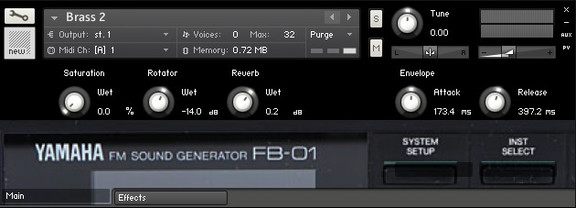
TW-Sounds has announced the Yamaha FB-01 Bundle, a collection of vintage synthesizer sounds for Native Instruments Kontakt.
The samples are recorded from the old vintage FB-01 FM Synthesizer from Yamaha. The Bundle include 46 Instruments mapped in Kontakt 5 with a GUI for manipulation of the sounds.
The bundle is currently available to purchase from Sampleism for £7 GBP.
TW-Sounds is also offering all Sampleism users a free copy of the SampleWiz Sound Library as part of Sampleism’s Summer Sale.
DATAMASKIN

