
Alesis Andromeda + EHX Small Stone (live session)
Alesis Andromeda A6 + EHX Small Stone + Deluxe Memory Boy + Cathedral Stereo Reverb
Moog Taurus III
Roland SH 01 GAIA
Roland Juno Di
Moog Minimoog Voyager
Ambient Chillout Soundscape featuring the Alesis Andromeda A6
Playing live ambient chillout / electronica soundscape / space music on Alesis A6 Andromeda analogue synth.
Created using 2 oscillators, step sequencer pattern, filter and envelope adjustments, delay, phaser, LFOs on the Alesis A6 Andromeda synthesizer.
Hawkeye – Analog Mind
Background video information below:
An analog session with the Alesis Andromeda in four-voice unison mode, accompanied only by the Yamaha FS1R FM Synth and an Elektron Machinedrum for percussion and samples.
All pattern changes and filter actions are performed live, this would have been impossible without the incredible MIDIbox Sequencer. Many thanks to TK. for his work!
Filmed in Fuerteventura with a quadcopter and a GoPro Hero3.
Hope you enjoyed the flight  – thanks for watching and listening!
Hawkeye/Maelstroem Records
Moonlight Matters – Why I Love My…Alesis Andromeda
Sebastiaan Vandevoorde aka Moonlight Matters explains why he loves his classic analogue synth, the Alesis Andromeda.
CREDITS
Producer: Chris Barker
Videographer: Will Seelig
Video Editor: Will Seelig
The Andromeda A6 is a true analog synthesizer using two analog oscillators per voice, sub-oscillators, hard and soft sync and more! It features 16-voice polyphony. With the Andromeda, you’ll find a huge range of tonal possibilities: searing leads, warm pads, fat bass lines, extreme sound effects and more. And of course there are plenty of knobs (72) and buttons (144), even an assignable ribbon controller for addictive hands-on real-time control! The large high-resolution LCD display is excellent and shows you actual rather than relative values of parameters. Andromeda will integrate seamlessly into any studio with its total MIDI control and sync, individual voice outputs, stereo outputs and several audio inputs.
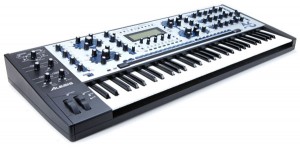
Andromeda is completely analog – no emulation! It features two analog filters per voice that sound great! They are a multimode 2-pole and a 4-pole lowpass. External audio can be routed through these filters too (three 1/4″ jacks)! As for modulation, Andromeda has three LFOs, each with six waveforms and they can be synced to MIDI clock. And there are three 7-stage envelopes with very creative and flexible functions. Also onboard is an extensive mod matrix for enormous freedom in configuring Andromeda’s sounds!
No analog synth would be complete without a set of classic effects and features. Andromeda also offers Portamento with nine slopes and legato functions. A built-in arpeggiator and analog-style sequencer are available, with MIDI sync! There are also some high quality digital effects such as reverbs, chorus, echo, distortion and more! Andromeda comes with 256 breathtaking preset patches plus 128 user. A PCMCIA-format memory card slot allows for additional programs and mixes. Andromeda is pure analog bliss, with all the features, stability and widgets of modern digital synths.
NAMM 2014: Alesis New Drum Modules Sample
Alesis New Drum Modules Sample Updated DM-4 and Pads add sample playback
The DM Pro Expandable 20 Bit Drum Module is the most advanced electronic drum and percussion device available today. It surpasses the capabilities of what you expect in a drum module by offering features like 64 voice polyphony, a massive drum and percussion library that includes over 1,000 sounds, and open-ended expandability that lets you bring in new sounds whenever you need them. For composers who need a dedicated MIDI module for drums, or drummers looking for the professional solution for triggered electronic drum performances, the DM Pro represents the most powerful tool for creative inspiration. Designed to accommodate nearly any musical style, the DM Pro offers 1,024 different kick, snare, tom, cymbal, hi-hat, percussion and special effect samples. You can create and store up to 32 virtual drumkits, and each kit can contain up to 64 different drum sounds so the right drum is always available when you need it.
The DM Pro has 16 fast trigger inputs for drummers using electronic pads or triggered acoustic drums, and provides six independent audio outputs so that processing of levels and effects for discrete sounds is easier than on any other Alesis drum device. Plus, the DM Pro’s customizable onboard multieffects use the same processing engine as our top-of-the-line multieffects device, the Q20. Its expansion slot lets you pull in new sounds anytime you need them. Since the PCMCIA-format cards store up to 8MB of memory, you can simultaneously access a massive collection of 24MB of sounds. Plus, the DM Pro is compatible with Alesis’ Sound Bridge sample management software, so you can burn your own sounds and samples to a card for customized sounds. Also, the DM Pro’s stereo audio inputs on RCA connectors allow external audio sources, like CD Players or tape decks, to be routed through an audio system so drummers can practice along with recorded music.
Two new keyboard controllers from Alesis
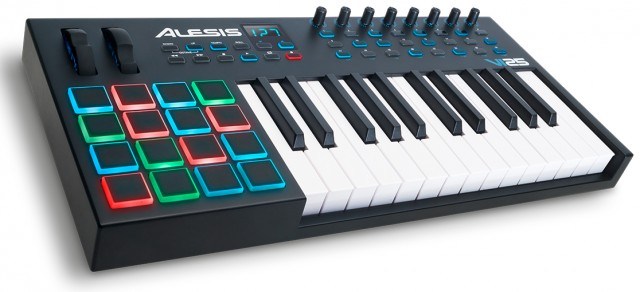
Alesis has introduced the new V Series and VI Series of full-size keyboard/pad controllers:
- The new Alesis V Series (V61, V49, V25) combine velocity-sensitive keys with eight drum/trigger pads. Blue LEDs illuminate the pads, as well as the four assignable knobs and buttons. Assignments may be made quickly via the MIDI Learn feature. Octave shift keys provide access to the entire note range. A single USB cable provides both a power and data connection to nearly any computer.
- The Alesis VI Series (VI61, VI49, VI25) add semi-weighted keys and aftertouch. The pad count has been increased to 16, with multi-color illumination. This layout provides intensive command over the clip trigger workflow of top DAW and compositional software. The internal clock offers drum roll, tempo, and sync capabilities. An optional power supply and a standard MIDI output allow for stand-alone use.
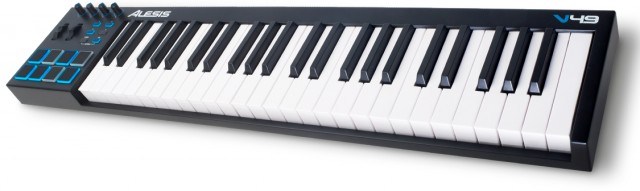
Alesis V Series Highlights:
- Full size, flat-front keys (25, 49, or 61)
- Pitch Bend and Modulation Wheels
- 8 Pads with blue LED illumination
- 4 Assignable knobs and buttons
- Sustain pedal input
- USB MIDI
Alesis VI Series Highlights:
- Full size, flat-front keys (25, 49, or 61)
- Semi-weighted keys with Aftertouch
- Pitch Bend & Modulation Wheels
- 16 Pads with Multi-color LED illumination
- VI25: 8 knobs, 24 buttons
- VI49: 12 knobs, 36 buttons
- VI61: 16 knobs, 48 buttons
- Transport and Present up/down buttons
- Sustain pedal input
- USD MIDI, MIDI Out
- Internal Clock for sync, tempo, rolls, etc.
The V and VI Series will have the following respective estimated street prices, V25 ($79.99 USD), V49 ($99.99 USD), V61 ($149.99 USD), VI25 ($169.99 USD), VI49 ($199.99 USD), and VI61 ($249.99 USD).
New keytar from Alesis at NAMM 2014
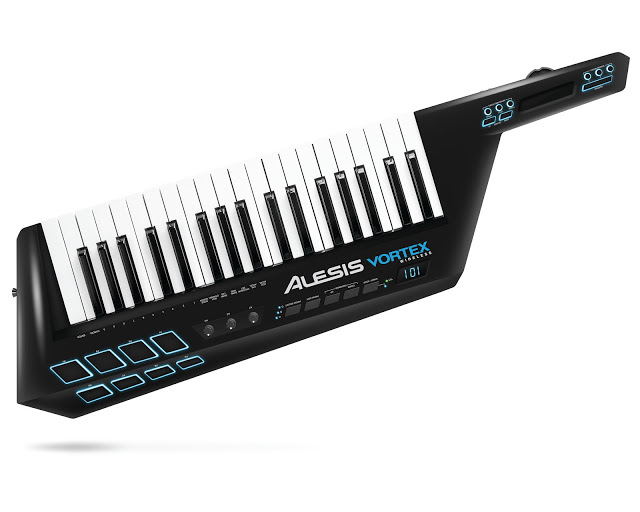
Alesis has introduced a $199 wireless Keytar controller, the Alesis Vortex Wireless, all the details below:
VORTEX WIRELESS
USB/Midi Keytar Controller With Accelerometer
Combines onstage mobility with expressive control
37 velocity-sensitive keys with aftertouch
8 velocity-sensitive trigger/drum pads
USB dongle creates a wireless connection to any Mac/PC
Volume slider, pitch wheel, ribbon controller, sustain pedal jack
USB, battery, or external power; USB/MIDI + MIDI outputs
Includes SONiVOX Vortex I DVI and Ableton™ Live Lite Alesis Edition
Press release:
“ALESIS VORTEX WIRELESS KEYTAR OFFERS TRUE ONSTAGE MOBILITY FOR ALL KEYBOARD PLAYERS
The popular Alesis Vortex has been updated with wireless USB MIDI
Cumberland, RI, USA – January 22, 2014. Alesis, a leading manufacturer of instruments and tools for today’s musician, announces the new Vortex Wireless USB MIDI keyboard controller with accelerometer.
A keytar for the modern performer, Vortex Wireless delivers unprecedented control and expression by transmitting MIDI via a wireless USB connection for dynamic on-stage freedom, and includes the virtual synthesizer plug-in Vortex-I Digital Virtual Instrument from acclaimed software creator SONiVOX. In addition to 37 velocity sensitive keys with aftertouch—the keyboard features an assignable accelerometer (tilt-sensor) in the neck that can translate gestures into additional controls—adding vibrato when the neck is pulled up, for example. For additional control, Vortex Wireless provides 8 drum/trigger pads, 3 assignable knobs, a multi- mode ribbon controller, pitch bend wheel, and a volume slider.
Plugging the included USB receiver dongle into any MAC or PC establishes a live USB/MIDI link with the Vortex Wireless. There is also a standard MIDI output (5-pin) mounted in the Vortex Wireless for connecting to other MIDI-enabled equipment, such as a favorite hardware synthesizer. Vortex Wireless can run on batteries, USB bus power, or can be powered using an optional AC adaptor. Each Vortex Wireless also includes a USB cable with extension for the USB receiver dongle and 4 x AA batteries, so users can begin playing right away.
In addition, the Vyzex Vortex Patch Editor Software is also provided, making it easy to create, edit, and backup patches to your computer. AbletonTM Live Lite 8 Alesis Edition is also included.
Alesis Vortex Wireless Keytar Highlights:
‘Nearly every keytar or remote keyboard has required a cable of one sort or another, be it power, MIDI, audio, or USB” said Nate Lane, Product Manager at Alesis. “With the Vortex Wireless, the player is truly free to move about at will. This onstage freedom allows the player to make the most of the onboard accelerometer and other extensive controls to create an original, expressive performance without the hassle of cables on stage.’
Combines expressive control with onstage mobility
37 velocity-sensitive keys with aftertouch
8 velocity-sensitive trigger/drum pads
USB dongle creates a wireless connection to any Mac/PC
Volume slider, pitch wheel, ribbon controller, sustain pedal jack
USB, battery, or external power; USB MIDI + 5-pin MIDI outputs
Includes SONiVOX Vortex I DVI and AbletonTM Live Lite Alesis Edition
Vortex Wireless will be available with an estimated street price of $199.99 USD
Alesis will present the Vortex Wireless at the 2014 NAMM Show in Hall A, Booth 6700, January
23-26 in Anaheim, California. For more information, visit: www.alesis.com/WNAMM2014”
ALESIS ANDROMEDA A6 – Ambient performance demo
Alesis Andromeda A6 ambient meditation music synthesizer demo — playing relaxing live ambient chillout / electronica arpeggiator soundscape on Alesis A6 Andromeda analogue synth keyboard.
Created using 2 oscillators, filter and envelope adjustments, reverb, arpeggiator controller on vintage Alesis A6 Andromeda analog synthesizer keyboard.
Performed live, no external processing. Excerpt from a longer session.
Alesis Andromeda A6…The Return
The second video in series demoing the Alesis Andromeda A6 analog synth.
— Fx’s Used —
DAW Fx: Synapse Audio Diffuse Delay
A6 Fx: Reverb, Analog Distortion
ALESIS ANDROMEDA A6 – Step sequencer
Alesis Andromeda A6 analog synthesizer step sequencer keyboard demo. Performing live ambient space music on Alesis A6 Andromeda analogue synth keyboard using the built-in step sequencer. Created using 2 oscillators, LFOs, filter / envelope adjustments, portamento, unison detune, delay effects on vintage Alesis A6 Andromeda analog synthesizer keyboard. Performed live, no external processing. Excerpt from a longer session.
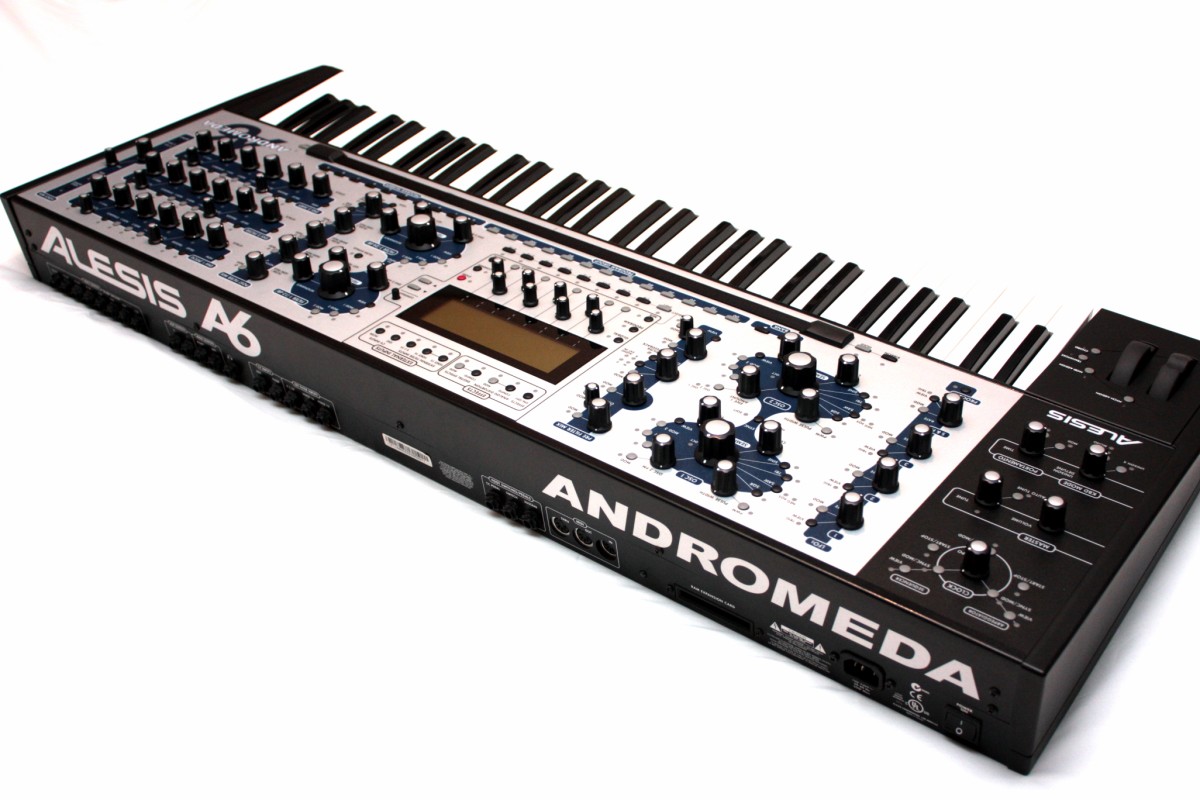
The Andromeda A6 is a true analog synthesizer using two analog oscillators per voice, sub-oscillators, hard and soft sync and more! It features 16-voice polyphony. With the Andromeda, you’ll find a huge range of tonal possibilities: searing leads, warm pads, fat bass lines, extreme sound effects and more. And of course there are plenty of knobs (72) and buttons (144), even an assignable ribbon controller for addictive hands-on real-time control! The large high-resolution LCD display is excellent and shows you actual rather than relative values of parameters. Andromeda will integrate seamlessly into any studio with its total MIDI control and sync, individual voice outputs, stereo outputs and several audio inputs.
Andromeda is completely analog – no emulation! It features two analog filters per voice that sound great! They are a multimode 2-pole and a 4-pole lowpass. External audio can be routed through these filters too (three 1/4″ jacks)! As for modulation, Andromeda has three LFOs, each with six waveforms and they can be synced to MIDI clock. And there are three 7-stage envelopes with very creative and flexible functions. Also onboard is an extensive mod matrix for enormous freedom in configuring Andromeda’s sounds!
No analog synth would be complete without a set of classic effects and features. Andromeda also offers Portamento with nine slopes and legato functions. A built-in arpeggiator and analog-style sequencer are available, with MIDI sync! There are also some high quality digital effects such as reverbs, chorus, echo, distortion and more! Andromeda comes with 256 breathtaking preset patches plus 128 user. A PCMCIA-format memory card slot allows for additional programs and mixes. Andromeda is pure analog bliss, with all the features, stability and widgets of modern digital synths.
DATAMASKIN

