
Alesis A6 Andromeda pads in 16-voice analog power
Selection of pads made on the Alesis A6 Andromeda analog synthesizer, full details below:
All patches played use all the 16-voices A6 can offer simultaneously.. No processing, just straight output from the A6. YouTube conversion kills the high-resolving analog sound quality and fatness, but hopefully this gives you a glimpse into the A6 inner life… All played are Alesis factory patches. I’ve only had the synth for a couple of days now so just barely scratching the surface of it – here’s a proof that even with the much-chriticized factory banks you can make some good sounds. Use the “HD” quality mode button below to get the most out of it.
If anyone wonders, some pictures on the background are from our own Milkyway’s massive cosmic neighbour Messier’s catalog M31 Andromeda galaxy, one of the few galaxies that has blue-shift instead of red-shift like all other galaxies we see, meaning it comes towards us and with the “locked” gravitational pull our Milkyway Galaxy will collide and merge with the bigger brother Andromeda in a very distant future, forming a new galaxy. Hopefully the Solar system will not be thrown out into the vast emptyness of space or sucked into a black-hole due to the viscous gravitational play during the merging. The name for the synth is inspired from Andromeda – and I would say it’s a very fitting name for it 
ALESIS ION , DEMO NA CLASSIC KEYBOARDS
About the synth:
The Ion Analog Modeling Synthesizer is one fat-sounding digital synth! Using Alesis’ proprietary DSP Analog Modeling technology with a 500 MIPS processor (500 million instructions per second), every knob and button is tweakable in real-time giving you the feel and sound of a true analog oldie.
The Ion has 8-voice polyphony with 3 oscillators per voice, and is 4-part multi-timbral. It offers continuously variable wave shapes (sine waves can morph into square waves), plus osc-sync and FM synthesis. 16 filter types are included, along with two LFOs, Sample & Hold, and an Arpeggiator-all of which sync to MIDI clock. A powerful and intuitive modulation matrix is built in, as well as a 40-band vocoder that does not use up any polyphony. External stereo audio can be processed through the filters, effects, or the vocoder.
Though not a true analog like the Andromeda A6, the Ion is capable of creating a wide variety of sounds from warm thick analog pads all the way to gritty monophonic leads and basses, as well as some funky and realistic sound effects. The Ion also simulates the best of the classic analogs such as Oberheims, Roland Jupiters, Arps, Moogs, etc, largely due to its great filters – there is hardly any aliasing even on the highest tones. The Ion also comes equipped with not one but two modulation wheels, both assignable to mods in the mod matrix (LFOs only assignable to mod wheel 1). The Ion has an amazing range of tonal possibilities.
The chic design, layout, and large backlit screen make editing on the Ion a dream! The Modulation Matrix is easy to understand and can route any modulation parameter to almost every component of the Ion!! All parameter knobs (excluding master volume & menu knob) are 360 degree pots allowing you to twist all the day long! A 160×160 graphic display provides instant visual feedback as a parameter is edited. Along with having 512 patch settings (all user-rewritable), the Ion has 64 multi-timbral setups. All parameters including arpeggiator settings are stored with each preset.
The ION keyboard contains 49 velocity-sensitive keys, 4 analog outputs and 2 stereo analog inputs (all balanced and using 24-bit conversion), 4 individual insert effects, a stereo master multi-FX processor, and an internal universal power supply. Expression and sustain pedal ports as well as headphone jacks are also there. For those who want a versatile synth and can’t afford the A6, this is the synth for you – arguably one of the best ‘virtual-analog’ synths for awesome, analogue-like sounds.
ALESIS ANDROMEDA A6 – Ambient arpeggiator soundscape on vintage analog synth keyboard
Alesis Andromeda A6 vintage analog synthesizer keyboard demo — playing live ambient chillout / electronica soundscape on Alesis A6 Andromeda analogue synth keyboard.
Created using 2 oscillators, filter and envelope adjustments, reverb, arpeggiator and ribbon controller on vintage Alesis A6 Andromeda analog synthesizer keyboard.
Performed live, no external processing. Excerpt from a longer session.
The Andromeda A6 is a true analog synthesizer using two analog oscillators per voice, sub-oscillators, hard and soft sync and more! It features 16-voice polyphony. With the Andromeda, you’ll find a huge range of tonal possibilities: searing leads, warm pads, fat bass lines, extreme sound effects and more. And of course there are plenty of knobs (72) and buttons (144), even an assignable ribbon controller for addictive hands-on real-time control! The large high-resolution LCD display is excellent and shows you actual rather than relative values of parameters. Andromeda will integrate seamlessly into any studio with its total MIDI control and sync, individual voice outputs, stereo outputs and several audio inputs.
- Andromeda’s fully analog signal path is controlled by a high-speed Motorola Coldfire microprocessor, offering 16-voice polyphony with 16-part multitimbral capability. Andromeda features two analog oscillators per voice, with standard waveforms (available simultaneously), suboscillators, hard and soft sync, and more. It provides two analog filters per voice: these 2-pole (multimode) and 4-pole (lowpass) resonating filters are classically-derived designs, and offer you an astounding range of sonic variability.
- Andromeda also provides external audio inputs that allow you to route any signal through its filters. Andromeda has three LFOs, each with six waveforms and many powerful features. It also has three 7-stage, 3-level envelopes capable of functions never before found in any analog synthesizer. An extensive mod matrix offers you an enormous freedom in configuring Andromeda’s sonic firepower, adding to its monstrous capabilities.
In-Depth Control of Your Sound
- Andromeda’s 61-note synth-weighted keypad features velocity and aftertouch sensitivity, and its ribbon controlled offers multiple, assignable functions. A distinctive, futuristic front panel features 72 knobs and 114 buttons (the majority are single function), optimally arranged for rapid-fire tweaking and in-depth experimentation. Andromeda’s large, backlit LCD display provides real-world values of parameters (time, frequency, BPM, etc.) and high-resolution graphics. No other synth has ever offered such a sophisticated, informative control panel for creating analog pyrotechnics.
ALESIS ANDROMEDA A6 【SYNTH DEMO】 – Ambient chillout / space music
Alesis Andromeda A6 analog synthesizer demo — playing live ambient chillout / electronica soundscape / space music on Alesis A6 Andromeda analogue synth.
Created using 2 oscillators, filter and envelope adjustments, reverb, LFOs on the Alesis A6 Andromeda synthesizer.
Performed live, no external processing. Excerpt from a longer session.
Alesis Andromeda A6 – Synth Demo – Ambient sequencer / chillout drone music / soundscape
Alesis Andromeda A6 synthesizer demo — playing ambient electronica soundscape / chillout drone / space music using a custom sequencer pattern.
This performance starts out with a catchy repeating motif, followed by live improvisation ending with a nice sustained drone and live fadeout. This music was created using 2 oscillators, filter and envelope adjustments, delay, LFOs, resonance and various other parameters on the Alesis A6 Andromeda synthesizer. Performed live, no external processing. Excerpt from a longer session.
About the machine:
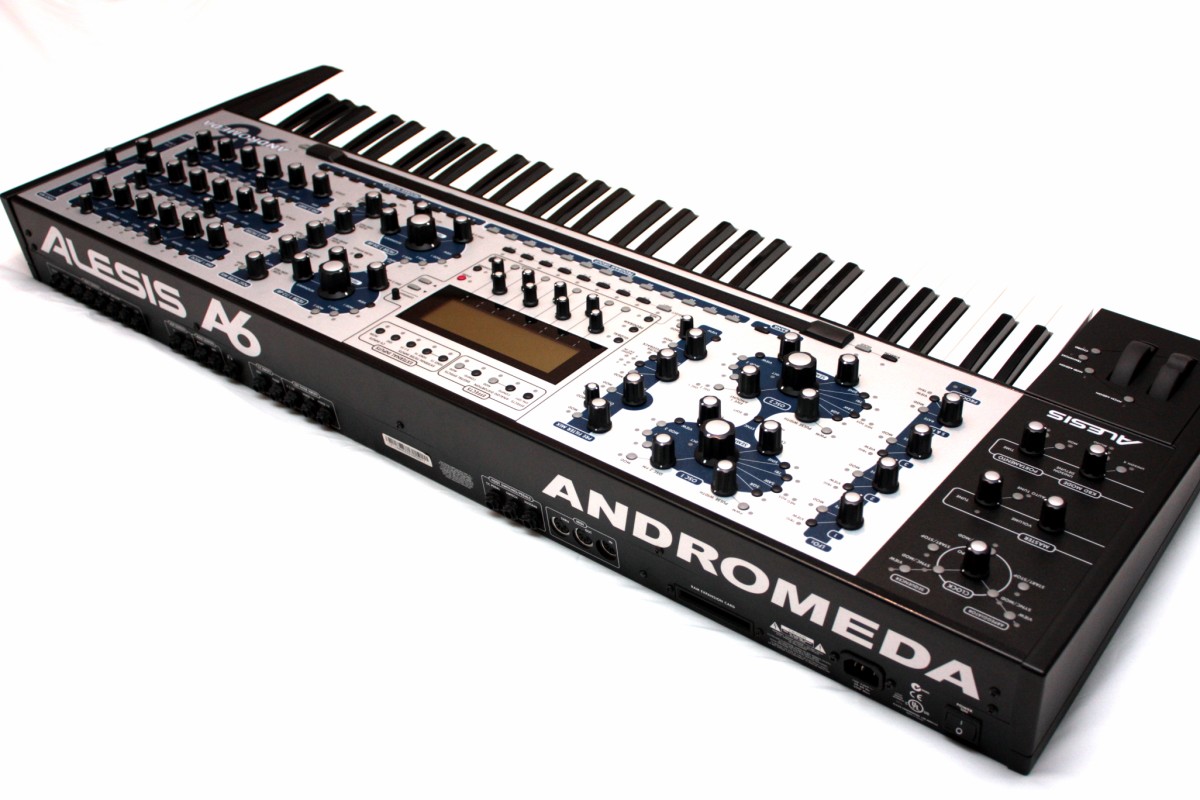
The Andromeda A6 is a true analog synthesizer using two analog oscillators per voice, sub-oscillators, hard and soft sync and more! It features 16-voice polyphony. With the Andromeda, you’ll find a huge range of tonal possibilities: searing leads, warm pads, fat bass lines, extreme sound effects and more. And of course there are plenty of knobs (72) and buttons (144), even an assignable ribbon controller for addictive hands-on real-time control! The large high-resolution LCD display is excellent and shows you actual rather than relative values of parameters. Andromeda will integrate seamlessly into any studio with its total MIDI control and sync, individual voice outputs, stereo outputs and several audio inputs.
Andromeda is completely analog – no emulation! It features two analog filters per voice that sound great! They are a multimode 2-pole and a 4-pole lowpass. External audio can be routed through these filters too (three 1/4″ jacks)! As for modulation, Andromeda has three LFOs, each with six waveforms and they can be synced to MIDI clock. And there are three 7-stage envelopes with very creative and flexible functions. Also onboard is an extensive mod matrix for enormous freedom in configuring Andromeda’s sounds!
No analog synth would be complete without a set of classic effects and features. Andromeda also offers Portamento with nine slopes and legato functions. A built-in arpeggiator and analog-style sequencer are available, with MIDI sync! There are also some high quality digital effects such as reverbs, chorus, echo, distortion and more! Andromeda comes with 256 breathtaking preset patches plus 128 user. A PCMCIA-format memory card slot allows for additional programs and mixes. Andromeda is pure analog bliss, with all the features, stability and widgets of modern digital synths.
Early ’80s Synth Pop with SH 1000, Juno 60, DR 110, MidiVerb
Background video description:
This video isn’t the best. I’m sleepy and I didn’t even notice that the mixer channel with the DR-110 was panned to the side, so the drum machine is only on one channel. The rest of the video is just noodling with the synths, but I just wanted to put something out that showcased the sounds.
Roland SH-1000: synth bass
Roland Juno-60: synth strings
Boss DR-110: drum machine
Alesis Midiverb: reverb
Doepfer Dark Time – Islands in the ocean
Background video description:
Yesterday was E-day, always inspiring, you met people who are also involved in E-music which genarate new ideas.
This one pops up, just a combinated single 8 step and 4 step row off the Doepfer Dark Time. The 4 step row controls the Moog LP bass and the 8 step the Waldorf micro Q and at 2:36 the Roland Juno 106.
Additional sounds/solo’s came from the Korg DS 8/Lamda, Realistic Concertmate MG-1 and the Kawai K1r.
Used delay’s for the Moog two from the Yamaha E1005 and the Ibanez DM1000, for Waldorf the Alesis Midiverb (3 triplets) and the Ibanez DM1000.
For the Juno I use the Electrix. Mo-fx.
Halfway there are some variations in tone / octave settings (Berlin School style).
I hope your enjoy, and feel free to leave a comment/question
Use a good audio device to listen to it.
greetings Hans
“Skoulaman”
Alesis Vortex Keytar Review – Accelerometer Fun
Mitchell Sigman talks about the innovative accelerometer control in the new Alesis Vortex Keytar Controller.
Watch for a full review in the June issue of Keyboard Magazine.
Alesis Andromeda “Analog Spacepad”
The Andromeda A6 is a true analog synthesizer using two analog oscillators per voice, sub-oscillators, hard and soft sync and more! It features 16-voice polyphony. With the Andromeda, you’ll find a huge range of tonal possibilities: searing leads, warm pads, fat bass lines, extreme sound effects and more. And of course there are plenty of knobs (72) and buttons (144), even an assignable ribbon controller for addictive hands-on real-time control! The large high-resolution LCD display is excellent and shows you actual rather than relative values of parameters. Andromeda will integrate seamlessly into any studio with its total MIDI control and sync, individual voice outputs, stereo outputs and several audio inputs.
Andromeda is completely analog – no emulation! It features two analog filters per voice that sound great! They are a multimode 2-pole and a 4-pole lowpass. External audio can be routed through these filters too (three 1/4″ jacks)! As for modulation, Andromeda has three LFOs, each with six waveforms and they can be synced to MIDI clock. And there are three 7-stage envelopes with very creative and flexible functions. Also onboard is an extensive mod matrix for enormous freedom in configuring Andromeda’s sounds!
No analog synth would be complete without a set of classic effects and features. Andromeda also offers Portamento with nine slopes and legato functions. A built-in arpeggiator and analog-style sequencer are available, with MIDI sync! There are also some high quality digital effects such as reverbs, chorus, echo, distortion and more! Andromeda comes with 256 breathtaking preset patches plus 128 user. A PCMCIA-format memory card slot allows for additional programs and mixes. Andromeda is pure analog bliss, with all the features, stability and widgets of modern digital synths.
Vocoder exploration: Alesis, Clavia, Digitech and Roland
1.Alesis MetaVox
2.Clavia Micro Modular
3.Digitech Talker
4.Roland SVC 350
carrier Flame Talking Synth Modul
input Moog Freqbox quartet
CP251
Buchla System #1
Doepfer 2x A132-3
4ms Peg RCD VCAMatrix
Make Noise Format Jumper Wogglebug
Roland System 104 Sequencer
Kenton Pro 2000 II
Kick Logic Ultrabeat
FX Boss VF 1 Line6 Echopro Lexicon PCM 80 TC M3000
DATAMASKIN

